Join us on a literary world trip!
Add this book to bookshelf
Grey
Write a new comment Default profile 50px
Grey
Subscribe to read the full book or read the first pages for free!
All characters reduced
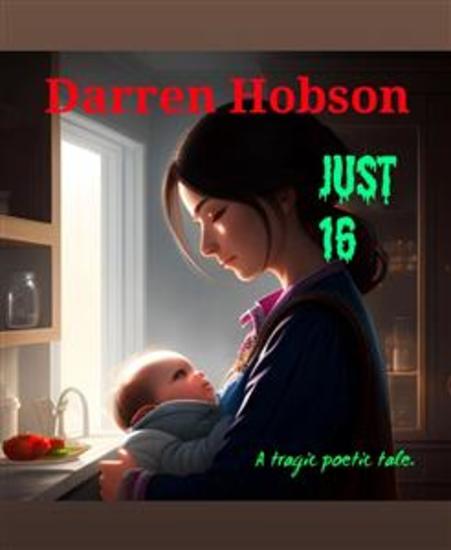
Just 16 - cover

Just 16

Darren Hobson

Publisher: BookRix

  • 0
  • 0
  • 0

Summary

As the seasons deepen into a cold, evocative autumn, it's time to huddle down with a warm drink and journey into something profoundly unsettling."Just 16" is a collection of poetry that explores the raw and often grim truths of human experience. From the very first page, prepare to be transported through narratives that delve into unseen struggles, startling twists of fate, and profound reflections on life's darker corners.You'll find tales that resonate with the echoes of past lives, touching on themes of unwanted identities and the complexities of human desire and corruption. This poetry isn't just about horror; it's about the unvarnished truth found in life's hidden corners and the sometimes unsettling beauty of the human spirit."Just 16" offers a unique glimpse into a personal archive of words, painting pictures that are simple to read yet ingeniously crafted. While not everyone will find comfort in these stark realities, this collection promises a compelling and unforgettable journey. Just turn the page to discover the enduring power of poetry that dares to reveal.
Available since: 12/22/2023.
Print length: 39 pages.
Other books that might interest you

  • The Poetry of Trains - A wide ranging anthology of classic poets for their take on the arrival of the system that powered the industrial revolution - cover

    The Poetry of Trains - A wide...

    Damon Runyon, Amy Lowell,...

    • 0
    • 0
    • 0
    The mythology of the Train, the Railroad, those two shiny tracks running off into the far distance is a powerful symbol of the industrial age. 
     
    The train was the first mass transit system to network the land and to carry people and materials of every class and of every shape.  A sort of democracy with the only requirement of use being the price of a ticket. 
     
    Poets who grew up with this pulsating leviathan of industry were quick to see its merits for their own lines and verse.   
     
    Across these poems comes both an individual eye across a wide range of feelings, thoughts and ideas as well as, occasionally, the trainspotter’s delight for form and detail from poets such as Emily Dickinson, Thomas Hardy, Edward Thomas, Edna St Vincent Millay, Damon Runyon and a host of others. 
     
    1 - The Poetry of Trains - An Introduction 
    2 - A Song of the Rails by Damon Runyon 
    3 - Song of a Train by John Davidson 
    4 - Song of the Rail by Ella Wheeler Wilcox 
    5 - Rhyme of the Rail by John Godfrey Saxe 
    6 - Up the Line by Will Carleton 
    7 - From a Railway Carriage by Robert Louis Stevenson 
    8 - An Incident in a Railroad Car by Jamers Russell Lowell 
    9 - Railway Times by Martin Faraquar Tupper 
    10 - On the Engine by Night by Alexander Anderson 
    11 - The Night Journey by Rupert Brooke 
    12 - Travel by Edna St Vincent Millay 
    13 - Train Ride by Federico Garcia Lorca 
    14 - The Train by Mary Elizabeth Coleridge 
    15 - Homeward Ho! by Ada A Mosher 
    16 - The Rail Road by James Very 
    17 - The Railway Train by Emily Dickinson 
    18 - In the Train by James Thomson 
    19 - The Division Superintendent by Ambrose Bierce 
    20 - The Word of an Engineer by James Weldon Johnson 
    21 - The Train Among the Hills by Sir Charles George Douglas Roberts 
    22 - The Gospel Train. Transcribed by Christine Rutledge of the Carolina Singers 1873 
    23 - The Jaffa and Jerusalem Railway by Eugene Field 
    24 - In the Train and At Versailles by Dante Gabriel Rossetti 
    25 - The Ledbury Train by Radclyffe Hall 
    26 - Adlestrop by Edward Thomas 
    27 - The Ancient Arteries of America by Daniel Sheehan 
    28 - Subway Wind by Claude McKay 
    29 - In a Station of the Metro by Ezra Pound 
    30 - Railway Rhymes by C L Graves 
    31 - What's the Railroad to Me by Henry David Thoreau 
    32 - The Railway Station by Archibald Lampman 
    33 - Thompson's Lunch Room, Grand Central Station by Amy Lowell 
    34 - Faintheart in a Railway Train by Thomas Hardy 
    35 - Song O' the Lost Trains by Damon Runyon 
    36 - The Phantom Train by Tom Hood 
    37 - One of the Unfair Sex by Ambrose Bierce 
    38 - September 1st. 1802 by William Wordsworth 
    39 - Autumn in the Garden by Fredegond Shove 
    40 - A Winter Day - Noon and Afternoon by Thomas Aird 
    41 - In the Train by Sara Teasdale 
    42 - To a Locomotive in Winter by Walt Whitman 
    43 - On the Departure Platform by Thomas Hardy 
    44 - Guild Signal by Bret Harte 
    45 - The Send Off by Wilfred Owen
    Show book
  • Collier Laddie - cover

    Collier Laddie

    Rab Wilson

    • 0
    • 0
    • 0
    Forty years on from the 1984–85 UK Miners' Strike, the largest union-led industrial action in the 20th century, Rab Wilson – a former miner deeply entrenched in the strike – delivers a powerful narrative through his mining poems and strike diary, addressing contemporary social and economic issues in Scotland and the UK then and now.
    Having toiled in Scotland's mining industry for eight years, Rab provides an authentic voice that resonates with the struggles faced during the strike, vividly captured from his involvement between 12 March 1984 and 5 March 1985. This book serves as a testament to the working-class struggle, offering a unique perspective on the historical significance of Scotland's mining industry, skillfully expressed by a poet intimately connected to it. Rab Wilson emerges as an essential chronicler, ensuring the legacy of the miners' challenging strike endures in the pages of this evocative and timely work.
    Collier Laddie is an ode to resilience, solidarity and the enduring legacy of those who fought for justice during a pivotal moment in industrial history.
    Show book
  • A Rare Recording of Sylvia Plath Reading Her Best Poems - cover

    A Rare Recording of Sylvia Plath...

    Sylvia Plath

    • 0
    • 0
    • 0
    Sylvia Plath born on October 27, 1932, in Boston, MA, was an American poet, novelist, and short story writer. She is credited with advancing the genre of confessional poetry and is best known for two of her published collections, The Colossus and Other Poems (1960) and Ariel (1965), and also The Bell Jar, a semi-autobiographical novel published shortly before her suicide on February 11, 1963. In this recording, Plath reads "Tulips," "Poppies In October," "Daddy," "Ariel," "Lady Lazarus," and "The Applicant."
    Show book
  • Falsely Accused - cover

    Falsely Accused

    Pamela J

    • 0
    • 0
    • 0
    Is Spank a cheater? Or is Daphne just an insecure, paranoid wife, who believes her husband is always cheating if she is not right in front of him.  Come alone to find out if Spank is a loving caring husband or if Daphne is right and he is a cheater or is Spank just is Falsely Accused
    Show book
  • The Rupture Tense - Poems - cover

    The Rupture Tense - Poems

    Jenny Xie

    • 0
    • 0
    • 0
    Shaped around moments of puncture and release, The Rupture Tense registers what leaks across the breached borders between past and future, background and foreground, silence and utterance. In polyphonic and formally restless sequences, Jenny Xie cracks open reverberant, vexed experiences of diasporic homecoming, intergenerational memory  
    transfer, state-enforced amnesia, public secrecies, and the psychic fallout of the Chinese Cultural Revolution. Across these poems, memory—historical, collective, personal—stains and erodes. Xie voices what remains irreducible in our complex entanglements with familial ties, language, capitalism, and the histories in which we find ourselves lodged. 
     
    The Rupture Tense begins with poems provoked by the photography of Li Zhensheng, whose negatives, hidden under his floorboards to avoid government seizure, provide one of the few surviving visual archives of the Chinese Cultural Revolution, and concludes with an aching elegy for the poet’s grandmother, who took her own life shortly after the end  
    of the Revolution. This extraordinary collection records the aftershocks and long distances between those years and the present, echoing out toward the ongoing past and a trembling future.
    Show book
  • Dying To End It - cover

    Dying To End It

    Joey Sanchez

    • 0
    • 0
    • 0
    When Frank’s wife of many years is killed in a car accident and he is left badly injured, he quickly grows tired of life. No longer wishing to be a burden on his daughters who are missing out on their own lives by having to care for him, he hatches a plan. 
    Heading off out onto the mean streets of New York, the city he grew up in, Frank decides that he will find a way to end his life there without resorting to the sin of taking it himself. 
    However, his plans are thrown into confusion when he bumps into an old friend, Carlo. In years gone by Frank had helped Carlo, who was part of the Mafia, with fraudulent insurance claims but had turned his back on a life of crime, leading to Carlo being demoted by his bosses. 
    Now, the two old friends catch up on past times as Frank’s plans for his final hours slowly draw closer. But Carlo has a dark secret that he has kept from Frank. The resentment he had been carrying after being betrayed by his friend had been allowed to fester and boil to the surface, and now he is about to reveal the full shocking truth of his actions to him. 
    How will Frank react? Will he still be able to find a way to end his life on his terms? Or is that nagging feeling at the back of his mind about to show him something terrifying?
    Show book