Rejoignez-nous pour un voyage dans le monde des livres!
Ajouter ce livre à l'électronique
Grey
Ecrivez un nouveau commentaire Default profile 50px
Grey
Abonnez-vous pour lire le livre complet ou lisez les premières pages gratuitement!
All characters reduced
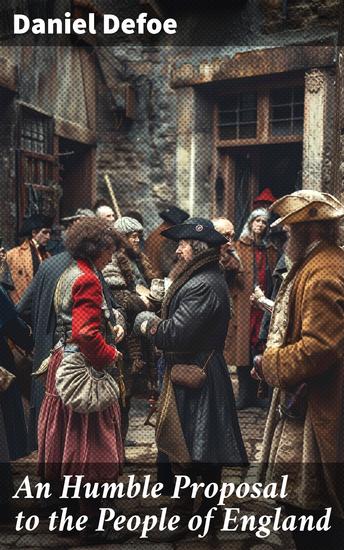
An Humble Proposal to the People of England - For the Increase of their Trade and Encouragement of Their Manufactures - cover

An Humble Proposal to the People of England - For the Increase of their Trade and Encouragement of Their Manufactures

Daniel Defoe

Maison d'édition: Good Press

  • 0
  • 0
  • 0

Synopsis

In "An Humble Proposal to the People of England," Daniel Defoe employs a satirical yet earnest tone to address pressing social issues of early 18th-century England, particularly the dire circumstances faced by the impoverished. Through a series of imaginative suggestions that propose practical solutions to alleviate poverty, Defoe critiques the socio-economic conditions of his time while simultaneously engaging the reader in a dialogue about moral responsibility. The work's style is characterized by its blend of persuasive rhetoric and biting irony, offering a unique glimpse into the complexities of human misery and societal indifference prevalent during the period. Defoe, a journalist and pioneer of the novel, is renowned for his keen observations of society and his ability to weave complex narratives that explore themes of individualism and economics. His own experiences with poverty and financial ruin likely motivated him to craft this proposal, as he sought to draw attention to the plight of the marginalized and advocate for reforms. Defoe's background in trade and his passionate engagement with the socio-political climate further enrich his arguments, allowing him to speak from a position of informed empathy. This book is highly recommended for anyone interested in social reform, economic thought, or satirical literature. Defoe'Äôs blend of humor and earnestness makes "An Humble Proposal" not only a compelling read but also a timeless reflection on the responsibilities of society towards its most vulnerable members.
Disponible depuis: 04/10/2023.
Longueur d'impression: 35 pages.

D'autres livres qui pourraient vous intéresser

  • From Red Terror to Terrorist State - Russia's Secret Service and Its Fight for World Domination: from Felix Dzerzhinsky to Vladimir Putin - cover

    From Red Terror to Terrorist...

    Yuri Felshtinsky, Vladimir Popov

    • 0
    • 0
    • 0
    'Detail worthy of a John le Carre novel.' Telegraph The history of modern Russia traditionally has Communism at its centre: Lenin defines its rise, Gorbachev its fall, and Putin its aftermath. In this radical new history, Yuri Felshtinsky and Vladimir Popov, however, introduce a new historical axis: the Cheka―the Bolsheviks' nebulous revolutionary intelligence service. Wrapped around the Party in a fight to the death from 1918 under its first head Felix Dzerzhinsky, only Stalin was able to resist its stranglehold at the cost of enormous bloodshed. Luring Russia into submission over less than a century, its murder-plots and unrivalled scheming culminated in the capture of the Kremlin in 2000. Drawing on Popov's secret documents of over two decades as a senior officer in one of the KGB's key covert sections, and on Felshtinsky's encyclopedic knowledge of Russian state archives open in the 1990s, little-known sources, and access to leading oligarchs, a new Russian history emerges. The story they tell is often unexpected while introducing a new cast of characters still of great influence―potentially surpassing Lenin's role―on our world today. From Red Terror to Terrorist State is the first complete history of the Cheka. Written from the inside, it fundamentally transforms our understanding of Russia and rethinks the way today's Kremlin views itself and the rest of the world. Animated by lifelong study, this authoritative narrative by two exceptional Russian-intelligence experts presents ground-breaking new insights based on an unrivalled wealth of new factual details.
    Voir livre
  • Statecraft - The New Rules of Power in a Divided World - cover

    Statecraft - The New Rules of...

    Jack Watling

    • 0
    • 0
    • 0
    From top defence analyst Jack Watling, Statecraft reveals how states collaborate, compete and fight in this era of global turmoil. For readers of Prisoners of Geography or Material WorldWhy did Russia struggle in the early months of its full-scale invasion of Ukraine?Why does Israel ignore international pressure on Gaza?Why does the UK spend billions on aircraft carriers that it struggles to support at sea?How do smaller states shape world events when dwarfed by superpowers?The world today is gripped by conflict. Whether in Ukraine, the Middle East or Taiwan, we are in a period of intense power competition. In Statecraft, Dr Jack Watling takes you behind the scenes to meet the world’s powerbrokers in their wood-panelled offices, and the bunkers from which battles are coordinated.With a career spent on the ground in conflict zones, and advising generals and political leaders, Watling examines the dilemmas that states face to get ahead, no matter their size. From economic alliances and global trade to sea power and military technology, Statecraft provides a powerful new lens to understand geopolitics in a divided world.
    Voir livre
  • Vote With Your Phone - Why Mobile Voting Is Our Final Shot at Saving Democracy - cover

    Vote With Your Phone - Why...

    Bradley Tusk

    • 0
    • 0
    • 0
    Gun Control. Abortion. From the halls of Congress, it may seem that Americans are bitterly polarized on the biggest policy issues of the day. But Americans are not as divided as we think, and polls show that most of us largely agree on even the most divisive issues. The problem lies in how we vote. 


    Politics is more extreme because only the most extreme voters turn out in primaries. And with politicians prioritizing reelection above all else, they shun compromise, feed this extremism, and get rewarded for it. If a lot more people vote, the views of the electorate become more mainstream, and our politicians and policies will shift to the center. 


    Mobile voting is the solution. We do just about everything on our phones, and yet we still can't use them to vote. But the technology exists, provides enhanced security over traditional paper ballots, and it could exponentially increase voter turnout. 


    Including essays by Martin Luther King Jr. III, David Hogg, and other prominent political figures, Vote with Your Phone shows us that a solution to restoring faith in our representative democracy is right in the palm of our hands.
    Voir livre
  • Inventing the Future - Postcapitalism and a World Without Work - cover

    Inventing the Future -...

    Nick Srnicek, Alex Williams

    • 0
    • 0
    • 0
    This major new manifesto offers a "clear and compelling vision of a postcapitalist society" and shows how left-wing politics can be rebuilt for the twenty-first century (Mark Fisher, author of Capitalist Realism 


    Neoliberalism isn't working. Austerity is forcing millions into poverty and many more into precarious work, while the left remains trapped in stagnant political practices that offer no respite. 


    Inventing the Future is a bold new manifesto for life after capitalism. Against the confused understanding of our high-tech world by both the right and the left, this book claims that the emancipatory and future-oriented possibilities of our society can be reclaimed. Instead of running from a complex future, Nick Srnicek and Alex Williams demand a postcapitalist economy capable of advancing standards, liberating humanity from work and developing technologies that expand our freedoms. 


    This new edition includes a new chapter where they respond to their various critics.
    Voir livre
  • Britain’s Secret Defences - Civilian Saboteurs Spies and Assassins During the Second World War - cover

    Britain’s Secret Defences -...

    Andrew Chatterton

    • 0
    • 0
    • 0
    The first full history of the highly trained and ruthless civilian volunteers secretly trained across Britain to be deployed in the case of a German invasion.The narrative surrounding Britain’s anti-invasion forces has often centered on ‘Dad’s Army’-like characters running around with pitchforks, on unpreparedness and sense of inevitability of invasion and defeat. The truth, however, is very different.  Top-secret, highly trained and ruthless civilian volunteers were being recruited as early as the summer of 1940. Had the Germans attempted an invasion they would have been countered by saboteurs and guerrilla fighters emerging from secret bunkers, and monitored by swathes of spies and observers who would have passed details on via runners, wireless operators and ATS women in disguised bunkers.  Alongside these secret forces, the Home Guard were also setting up their own ‘guerrilla groups’, and SIS (MI6) were setting up post-occupation groups of civilians – including teenagers – to act as sabotage cells, wireless operators, and assassins had the Nazis taken control of the country.  The civilians involved in these groups understood the need for absolute secrecy and their commitment to keeping quiet meant that most went to their grave without ever telling anyone of their role, not even their closest family members. There has been no official and little public recognition of what these dedicated men and women were willing to do for their country in its hour of need, and after over 80 years of silence the time has come to highlight their remarkable role.
    Voir livre
  • The Conquest of Bread - cover

    The Conquest of Bread

    Peter Kropotkin

    • 0
    • 0
    • 0
    The Conquest of Bread  is an 1892 book by the Russian anarcho-communist Peter Kropotkin.
    Peter Kropotkin was born a Russian prince whose father owned 1,200 serfs. But he became  a Russian activist, writer, revolutionary, scientist, economist, sociologist, historian, essayist, researcher, political scientist, biologist, geographer  and philosopher.
    The Conquest of Bread has become a classic of political anarchist literature. It was heavily influential on both the Spanish Civil War and the Occupy movement.
    In the work, Kropotkin goes on to propose a more decentralized economic system based on mutual aid and voluntary cooperation, asserting that the tendencies for this kind of organization already exist, both in evolution and in human society.
    Voir livre