Rejoignez-nous pour un voyage dans le monde des livres!
Ajouter ce livre à l'électronique
Grey
Ecrivez un nouveau commentaire Default profile 50px
Grey
Abonnez-vous pour lire le livre complet ou lisez les premières pages gratuitement!
All characters reduced
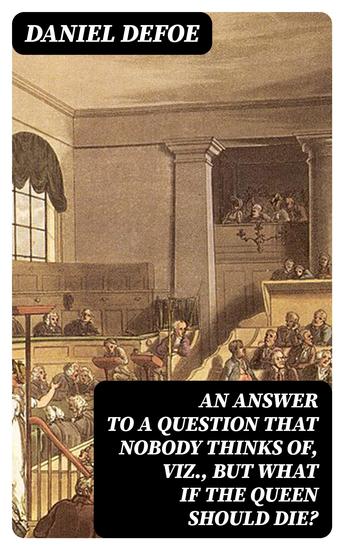
An Answer to a Question that Nobody thinks of viz But what if the Queen should Die? - cover

An Answer to a Question that Nobody thinks of viz But what if the Queen should Die?

Daniel Defoe

Maison d'édition: DigiCat

  • 0
  • 0
  • 0

Synopsis

In "An Answer to a Question that Nobody thinks of, viz., But what if the Queen should Die?", Daniel Defoe engages readers with a satirical yet profound examination of royal succession amidst the political unrest of early 18th-century England. Written in a clear, conversational prose style, the book employs a mix of humor and serious reflection, positioning a seemingly trivial question within the broader context of national stability and governance. Defoe artfully navigates the fears and anxieties surrounding the potential death of Queen Anne, illustrating the fragility of monarchical power and the public's role in imagining its consequences for society at large. Daniel Defoe, a prolific writer known for his insightful social commentary, was deeply aware of the political turbulence of his era, including the War of the Spanish Succession and the shifting alliances that marked Queen Anne's reign. His diverse career as a merchant, journalist, and political pamphleteer informed his understanding of public sentiment, prompting him to address poignant issues like the monarchy's uncertain future and the people's apprehensions regarding state stability. This book is highly recommended for readers interested in political philosophy, satire, and early modern history. Defoe's unique blend of wit and analysis not only entertains but also provokes critical thought about power, governance, and the psyche of a nation facing potential upheaval.
Disponible depuis: 15/09/2022.
Longueur d'impression: 22 pages.

D'autres livres qui pourraient vous intéresser

  • Values We Hold Dear - Inspiring Stories to Reconnect America - cover

    Values We Hold Dear - Inspiring...

    Kyle A. Stone

    • 0
    • 0
    • 0
    Do you feel a disconnection from the traditional values that once defined the American spirit?  
    You're not alone. Kyle A. Stone brings you a deep dive into the virtues, values and traditions that have molded generations. 
    What You'll Discover:​The bedrock principles that have shaped the American journey.​How destructive ideas are celebrated at the cost of age-old virtues.​Strategies to equip your family with knowledge that safeguards our nation's legacy.​Real stories of patriots who championed liberty and justice against all odds.Clear, achievable calls to action, which if practiced consistently will help you, your posterity, community, state and nation heal. 
    You'll encounter a treasure trove of historical narratives and events that weave together a cultural memory which serves to awaken us from our stupor, and reacquaint us with our true American identity. The work connects timeless values and virtues passed down from the Founders, who learned these truths from ancient philosophers and the Divine, and integrated them into a revolutionary form of government “of the people, by the people and for the people.” 
    Values We Hold Dear bridges the generational gap by equipping people with the means to share America's foundational values with the youth. 
    "Bondage is Easy. Freedom Takes Passionate Effort!"
    Voir livre
  • The Cuban Missile Crisis - Brink of Nuclear War - cover

    The Cuban Missile Crisis - Brink...

    Nova Ashford

    • 0
    • 0
    • 0
    The Cuban Missile Crisis, one of the most critical moments in the Cold War, did not emerge in isolation but was the culmination of a decades-long geopolitical struggle between the United States and the Soviet Union. The context of this crisis lies deeply within the broader Cold War, which began shortly after the end of World War II. This period was marked by intense ideological rivalry, military standoffs, and a nuclear arms race that would define much of the second half of the 20th century. 
    The origins of the Cold War can be traced back to the conflicting political and economic ideologies of the two superpowers. The United States, championing capitalism and democracy, viewed the spread of communism, led by the Soviet Union, as a direct threat to global stability and democratic values. On the other hand, the Soviet Union, under the leadership of Joseph Stalin, sought to expand the reach of communism and solidify its control over Eastern Europe, which had been acquired as a result of the war. This division between the capitalist West and the communist East created a tense geopolitical environment that shaped every diplomatic interaction between the two powers. 
    In the early stages of the Cold War, several key events served to heighten the distrust between the U.S. and the Soviet Union. The Berlin Blockade in 1948, the Korean War in the early 1950s, and the formation of opposing military alliances like NATO (North Atlantic Treaty Organization) and the Warsaw Pact solidified the division of the world into two hostile camps. As both nations escalated their military capabilities, the nuclear arms race emerged as a central aspect of Cold War tensions. The development and stockpiling of nuclear weapons made the Cold War not just an ideological battle but also a dangerous game of survival, with the constant threat of global annihilation hanging over every political and military maneuver.
    Voir livre
  • Politics vs Power - Why Facts Don't Win and How Strategy Does - cover

    Politics vs Power - Why Facts...

    Lorenzo L. Sellers

    • 0
    • 0
    • 0
    This audiobook is narrated by an AI Voice.   
    For seven years, Lorenzo Sellers debated MAGA supporters across dinner tables, social media threads, workplaces, and public forums. Not to win. To understand. 
    What he discovered is something most people never see. These debates were never about facts. They were about emotion, identity, belonging, and power. Facts don’t build movements. Strategy does. 
    Politics vs Power is a bold and unflinching guide to understanding why movements like MAGA grow so fiercely and why facts alone will never break their grip. Drawing from real conversations, psychological patterns, and cultural fault lines, Lorenzo reveals the emotional engines that power these movements and how to counter them with precision. 
    Inside you’ll learn: 
    *Why facts fall flat against emotional loyalty 
    *How belonging, power proximity, and rebellion keep people loyal 
    *How to recognize when someone is unreachable and when the real audience is watching 
    *Why outrage fuels movements and clarity dismantles them 
    *How to build spaces that meet emotional needs before extremism exploits them 
    This is not a partisan rant. It is a playbook for those tired of shouting into the void. Politics vs Power shows you how to stop reacting, start strategizing, and build influence that lasts long after the noise fades. 
    Whether you’re trying to reach someone who has fallen deep into the MAGA fold, protect your peace in conversations that go nowhere, or understand the real battlefield beneath the headlines, this book gives you the clarity and strategy you need to stand firm in the storm. 
    Politics is performance. Power is strategy. Learn the difference.
    Voir livre
  • Russia's War on Everybody - And What it Means for You - cover

    Russia's War on Everybody - And...

    Keir Giles

    • 0
    • 0
    • 0
    Russia's 2022 attack on Ukraine saw confrontation between Moscow and the West spill over into open conflict once again. But Russia has also been waging a clandestine war against the West for decades. Hostile acts abroad, from poisoning dissidents to shooting down airliners, interfering in elections, spying, hacking, and murdering, have long seemed to be the Kremlin's daily business. But what is it all for? Why does Russia consistently behave like this? And what does it achieve? 


    In this book, Keir Giles explains how and why Russia pushes for more power and influence wherever it can reach, far beyond Ukraine—and what it means not just for governments, but for ordinary people. Bringing together stories from the military, politics, diplomacy, espionage, cyber power, organized crime, and more, Giles describes how Moscow conducts its campaigns across the globe, and how nobody is too unimportant to be caught up in them. By lifting the lid on the daily struggle going on behind the scenes to protect governments, businesses, societies, and people from Russian hostile activity, Russia's War On Everybody shows how Moscow's hostile intentions for the rest of the world are far broader and more ambitious, and the ways it tries to achieve them far more pervasive and damaging, than we realize.
    Voir livre
  • Generation Gap - Why the Baby Boomers Still Dominate American Politics and Culture - cover

    Generation Gap - Why the Baby...

    Kevin Munger

    • 0
    • 0
    • 0
    The Baby Boomers are the largest and most powerful generation in American history—and they aren't going away any time soon. They dominate cultural and political institutions and make up the largest slice of the electorate. Generational conflict, with Millennials and Generation Z pitted against the aging Boomer cohort, has become a media staple. The generation gap is widening into a political fault line. 


    Kevin Munger marshals novel data and survey evidence to argue that generational conflict will define the politics of the next decade. He examines the historical trends that made the Baby Boomers so consequential and traces the emergence of age-based political and cultural divisions. Boomers continue to prefer the media culture of their youth, but Millennials and Gen Z are using the internet to render legacy institutions irrelevant. These divergent media habits have led more people than ever to identify with their generation. Munger shows that a common "cohort consciousness" binds aging Boomer voters into a bloc—but a shared identity and purpose among Millennials and Gen Z could topple Boomer power. 


    Bringing together expertise in data analysis and digital culture with keen insight into contemporary politics, Generation Gap explains why the Baby Boomers remain so dominant and how quickly that might change.
    Voir livre
  • American Epic - Reading the US Constitution - cover

    American Epic - Reading the US...

    Garrett Epps

    • 0
    • 0
    • 0
    In 1987, E. L. Doctorow celebrated the Constitution's bicentennial by reading it. "It is five thousand words long but reads like fifty thousand," he said. Distinguished legal scholar Garrett Epps disagrees. It's about 7,500 words. And Doctorow "missed a good deal of high rhetoric, many literary tropes, and even a trace of, if not wit, at least irony," he writes. 


    In American Epic, Epps takes us through a complete reading of the Constitution to achieve an appreciation of its power and a holistic understanding of what it says. In this book he seeks not to provide a definitive interpretation, but to listen to the language and ponder its meaning. He draws on four modes of reading: scriptural, legal, lyric, and epic. The Constitution's first three words, for example, sound spiritual—but Epps finds them to be more aspirational than prayer-like. He turns the Second Amendment into a poem to illuminate its ambiguity. He notices oddities and omissions. The Constitution lays out rules for presidential appointment of officers, for example, but not removal. Should the Senate approve each firing? Can it withdraw its "advice and consent" and force a resignation? And he challenges himself, as seen in his surprising discussion of the Defense of Marriage Act (DOMA) in light of Article 4, which orders states to give "full faith and credit" to the acts of other states.
    Voir livre