Rejoignez-nous pour un voyage dans le monde des livres!
Ajouter ce livre à l'électronique
Grey
Ecrivez un nouveau commentaire Default profile 50px
Grey
Abonnez-vous pour lire le livre complet ou lisez les premières pages gratuitement!
All characters reduced
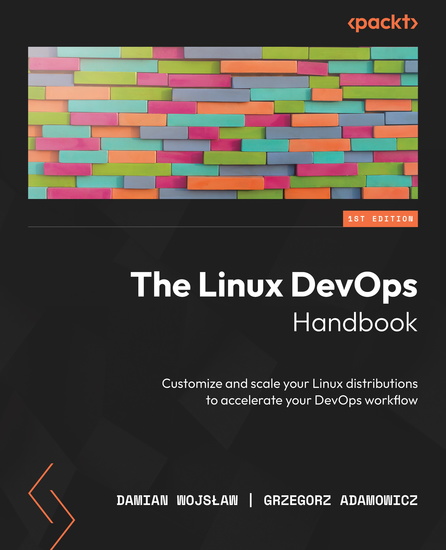
The Linux DevOps Handbook - Customize and scale your Linux distributions to accelerate your DevOps workflow - cover

The Linux DevOps Handbook - Customize and scale your Linux distributions to accelerate your DevOps workflow

Damian Wojsław, Grzegorz Adamowicz

Maison d'édition: Packt Publishing

  • 0
  • 0
  • 0

Synopsis

The Linux DevOps Handbook is a comprehensive resource that caters to both novice and experienced professionals, ensuring a strong foundation in Linux. This book will help you understand how Linux serves as a cornerstone of DevOps, offering the flexibility, stability, and scalability essential for modern software development and operations.You’ll begin by covering Linux distributions, intermediate Linux concepts, and shell scripting to get to grips with automating tasks and streamlining workflows. You’ll then progress to mastering essential day-to-day tools for DevOps tasks. As you learn networking in Linux, you’ll be equipped with connection establishment and troubleshooting skills. You’ll also learn how to use Git for collaboration and efficient code management.The book guides you through Docker concepts for optimizing your DevOps workflows and moves on to advanced DevOps practices, such as monitoring, tracing, and distributed logging. You’ll work with Terraform and GitHub to implement continuous integration (CI)/continuous deployment (CD) pipelines and employ Atlantis for automated software delivery. Additionally, you’ll identify common DevOps pitfalls and strategies to avoid them.By the end of this book, you’ll have built a solid foundation in Linux fundamentals, practical tools, and advanced practices, all contributing to your enhanced Linux skills and successful DevOps implementation.
Disponible depuis: 17/11/2023.
Longueur d'impression: 428 pages.
D'autres livres qui pourraient vous intéresser

  • Life by Design - Automate to Master Time Health Money and Unlock Personal Success - cover

    Life by Design - Automate to...

    Marlon Buchanan

    • 0
    • 0
    • 0
    Imagine a life where you spend less time managing tasks and more time pursuing your passions. 
    In Life By Design, you'll discover how to leverage technology to automate the everyday tasks that consume your time—so you can focus on what truly matters to you. Whether you want to spend more time with family, improve your health, or get ahead at work, this book provides the tools to help you streamline your life. 
    Inside, you'll learn how to:Automate your daily tasks, from finances to household chores, and free up your time for the things you loveMaster time management by automating your schedule and staying on top of important tasks effortlesslyOptimize your health and fitness routines with smart tech to track and improve your well-beingSimplify your work life with automation tools that increase productivity and reduce stressImprove your financial management by setting up automatic savings, investing, and bill paymentsEnhance your travel experiences by automating bookings, reminders, and packing lists 
    Stop letting life’s demands overwhelm you. Life By Design will help you take control, create more time, and focus on what truly matters.
    Voir livre
  • On the Origin of Species 6th Edition - cover

    On the Origin of Species 6th...

    Charles Darwin

    • 0
    • 0
    • 0
    Discover the groundbreaking scientific work that transformed our understanding of life, evolution, and the natural world.
    
    Charles Darwin's On the Origin of Species presents one of the most influential scientific explanations in history: the theory of evolution through natural selection. In this sixth edition, Darwin develops and discusses his observations and arguments concerning the diversity of living organisms, adaptation, variation, and the processes that shape species over time.
    
    Through detailed reasoning and examples drawn from nature, breeding, geography, and biology, Darwin examines how organisms change across generations and how natural selection contributes to the development of life.
    
    First published in 1859, On the Origin of Species remains an essential work for readers interested in evolutionary biology, scientific history, natural science, and the development of modern biological thought. The sixth edition represents the final edition published during Darwin's lifetime.
    
    Explore Darwin's influential ideas and experience the classic work that reshaped scientific perspectives on the origins and diversity of life.
    Voir livre
  • Big Techs Hi 5 - cover

    Big Techs Hi 5

    Mike Blake

    • 0
    • 0
    • 0
    Big Techs: Hi 5  (Social Media Book 2) 
    A Poem about : The 5 Biggest 'Tech' Companies in the Western World. 
    In Chrono order: Microsoft, Apple, Amazon, Facebook (Meta), Alphabet (Google). 
    A brief overview of these 5 biggest Social Media Tech companies and their emergence in chronological order. 
    As they came springing forth as the Internet developed.. 
    https://www.amazon.com/dp/B09RW7WS43
    Voir livre
  • Biocivilisations - A New Look at the Science of Life - cover

    Biocivilisations - A New Look at...

    Predrag B. Slijepcevic, Vandana...

    • 0
    • 0
    • 0
    Biocivilisations is an important, original rethinking of the mystery of life and its deep uncertainty, exploring the complex civilisations that existed on Earth long before humans.  
    What is life? Many scientists believe life can be reduced to ‘mechanistic’ factors, such as genes and information codes. Yet there is a growing army of scientists, philosophers and artists who reject this view. The gene metaphor is not only too simplistic but deeply misleading. If there is a way to reduce life to a single principle, that principle must acknowledge the creativity of life, turning genetic determinism on its head.  
    The term biocivilisations is the acknowledgement of this uncertainty of life, as opposed to a quasi-certainty of the human position governed by a narrow time window of the scientific revolution. Life existed without humans for more than 99.99 percent of the Earth’s existence. Life will also continue without humans long after our inevitable extinction.  
    In Biocivilisations, Dr Predrag Slijep?evi? shows how bacteria, amoebas, plants, insects, birds, whales, elephants and countless other species not only preceded human beings but demonstrate elements of how we celebrate human civilisation – complex communication, agriculture, science, art, medicine and more.  
    Humans must try to adopt this wisdom from other biocivilisations that have long preceded our own. By rethinking the current scientific paradigm, Dr Slijep?evi? makes clear that a transformation – from a naïve young species into a more mature species in tune with its surroundings – will save us from our own violence and the violence we inflict on the rest of our living planet.
    Voir livre
  • Artificial Intelligence Secrets 2 in 1 - What Your Career Counsellors Won't Tell You About AI and Automation and How to Leverage Their Potential to Build Your Career Real Quick - cover

    Artificial Intelligence Secrets...

    Ryan Baumgartner

    • 0
    • 0
    • 0
    What if artificial intelligence stopped feeling like a black box you're simply supposed to trust?
     
    You're told AI will reshape your career, yet nobody hands you a clear picture of how it actually works or what it means for you. So you nod along in meetings, half-guessing, quietly hoping the technology doesn't leave you behind.
     
    That not-quite-knowing wears on you. It's hard to make confident choices about your skills or your next move when the force driving all the change stays a mystery.
     
    This two-in-one collection carries you from the fundamentals to the real-world impact, with no technical background required. Here, at last, is artificial intelligence explained in plain language. In this audiobook, you'll discover:
    
    The three types of AI - what narrow, general, and super intelligence really mean once you strip away the buzzwords.
    How machines actually learn - why an everyday spam filter reveals the whole logic behind machine learning.
    The main training methods - supervised, unsupervised, and semi-supervised learning, plus classification, regression, and adversarial training.
    How deep learning works - the neural networks that power it, and why there are so many different kinds.
    The tools behind the tech - the programming languages, bots, and platforms like TensorFlow that make AI run.
    Where AI already lives in your day - from email and social media to maps and smart personal assistants.
    How major companies deploy it - the way AI reshapes marketing, finance, and customer service.
    What stays uniquely human - the skills to double down on as the machines advance.
    
     
    You'll learn from clear, grounded explanations, including insight from computer scientist Melanie Mitchell, creator of the analogy-making program Copycat.
     
    You don't need a degree or a background in coding to follow a word of it. Understand how the technology works, and it stops being something that happens to you and becomes something you can use.
    Voir livre
  • The Shaking Woman or A History of My Nerves - cover

    The Shaking Woman or A History...

    Siri Hustvedt

    • 0
    • 0
    • 0
    While speaking at a memorial event in 2006, Siri Hustvedt suffered a violent seizure from the neck down. Despite her flapping arms and shaking legs, she continued to speak clearly and was able to finish her speech. It was as if she had suddenly become two people: a calm orator and a shuddering wreck. Then the seizures happened again and again. The Shaking Woman tracks Hustvedt's search for a diagnosis, one that takes her inside the thought processes of several scientific disciplines, each one of which offers a distinct perspective on her paroxysms but no ready solution. In the process, she finds herself entangled in fundamental questions: What is the relationship between brain and mind? How do we remember? What is the self? 


    During her investigations, Hustvedt joins a discussion group in which neurologists, psychiatrists, psychoanalysts, and brain scientists trade ideas to develop a new field: neuropsychoanalysis. She volunteers as a writing teacher for psychiatric in-patients at the Payne Whitney clinic in New York City and unearths precedents in medical history that illuminate the origins of and shifts in our theories about the mind-body problem. Hustvedt synthesizes her experience and research into a compelling mystery: Who is the shaking woman? In the end, the story she tells becomes, in the words of George Makari, "a brilliant illumination for us all."
    Voir livre