Begleiten Sie uns auf eine literarische Weltreise!
Buch zum Bücherregal hinzufügen
Grey
Einen neuen Kommentar schreiben Default profile 50px
Grey
Jetzt das ganze Buch im Abo oder die ersten Seiten gratis lesen!
All characters reduced
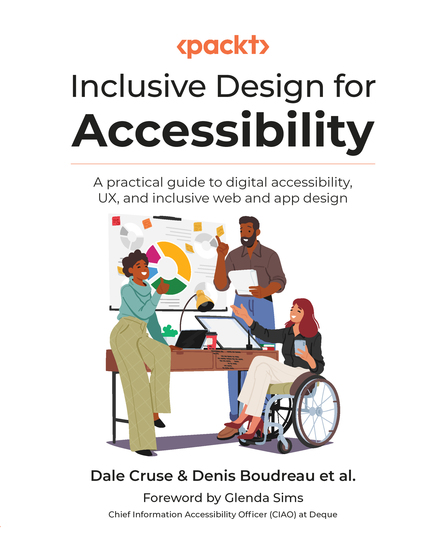
Inclusive Design for Accessibility - A practical guide to digital accessibility UX and inclusive web and app design - cover

Inclusive Design for Accessibility - A practical guide to digital accessibility UX and inclusive web and app design

Dale Cruse, Denis Boudreau

Verlag: Packt Publishing

  • 0
  • 0
  • 0

Beschreibung

In today's digital world, creating inclusive experiences is both a moral and business necessity. To expand your thinking, Inclusive Design for Accessibility provides an overview of the tools and knowledge to transform your approach to digital design and development.With contributions from twelve accessibility leaders — Dale Cruse, Denis Boudreau, Dr. Angela Young, Maya Sellon, Julianna Rowsell, Nandita Gupta, Jennifer Chadwick, Crystal Scott, Chris McMeeking, Dr. Keith Newton, Charlie Triplett, and Kai Wong — this book will lay out the fundamentals of inclusive design, as well as its application in advanced and emerging technologies, helping you build digital products that go beyond compliance and truly empower all users, regardless of abilities.Here, you'll discover practical strategies and real-world examples that will allow you to embed accessibility into projects, from user research and testing to creating accessible websites and mobile apps. You’ll also explore how AI can enhance accessibility and how to tackle challenges posed by VR and AR technologies.For designers, developers, product managers, and business leaders, this book will reshape how you approach inclusive design, helping you move beyond ticking boxes and toward building digital solutions that serve all users effectively.
Verfügbar seit: 07.08.2025.
Drucklänge: 322 Seiten.


Weitere Bücher, die Sie mögen werden

  • Roadkill - Unveiling the True Cost of Our Toxic Relationship with Cars - cover

    Roadkill - Unveiling the True...

    Arthur Kay, Henrietta Moore

    • 0
    • 0
    • 0
    Roadkill: Unveiling the True Cost of Our Toxic Relationship with Cars, by Professor Henrietta Moore and Arthur Kay, explores the philosophical implications of car culture, as well as the practical impacts it has on your money, your taxes, your neighborhood, your planet, your health, and your happiness. 
     
    While the car has been marketed as a symbol of "freedom", the authors convincingly argue that it has limited the flourishing of our cities and restricted our choices. How can we fix our toxic relationship with cars? The authors offer a new way of thinking that promises to multiply your choices, improve your city, and expand your freedoms.  
     
    Inside the book, you'll find real-world examples of the human and monetary costs imposed by cars; philosophical arguments explaining how car-centric cities restrict the freedoms of drivers and non-drivers alike; a catalogue of ideas and approaches for urban designers, transport planners, policymakers, and mayors; and much more. 
     
    Roadkill is a persuasive and illuminating call to action for city dwellers, drivers, environmentalists, urbanists, and policymakers―anyone interested in practical ways to improve your life and expand your freedoms.
    Zum Buch
  • Blockchain - DecentralizedDistributed ledger Technology - cover

    Blockchain -...

    Bright Mills

    • 0
    • 0
    • 0
    Blockchain is a decentralized, distributed ledger technology that records digital transactions across multiple computers in a secure, immutable, and transparent way. Originally designed to support the digital currency Bitcoin, blockchain has evolved into a foundational technology with applications in finance, healthcare, supply chains, governance, and beyond. This comprehensive 8,000-word guide will explore the origins, key components, consensus mechanisms, types of blockchain, use cases, security implications, and future trends.
    Zum Buch
  • Data Quality Assurance - Strategies Tools and Insights for Exceptional Data Quality - cover

    Data Quality Assurance -...

    Brian Paul

    • 0
    • 0
    • 0
     In the digital era, where data is as valuable as currency, maintaining impeccable data quality is not just an option—it's a necessity. "Data Quality Assurance: Strategies, Tools, and Insights for Exceptional Data Quality " serves as an indispensable resource for professionals who understand the critical role data plays in their organization's success and are seeking to implement or enhance their data quality initiatives. 
    Across industries, the quality of data directly influences decision-making, operational efficiency, customer satisfaction, and ultimately, profitability. However, ensuring high data quality is a complex challenge that involves more than just technology. It requires a deep understanding of data quality dimensions, a robust framework for data governance, and a culture that values data accuracy and integrity. 
    This book offers a holistic view of Data Quality Assurance (DQA), covering everything from the fundamental principles of data quality, through to advanced techniques for managing data in the era of Big Data and AI. Readers will learn to identify and address common data quality issues, select and implement the right tools and technologies, and establish metrics for ongoing monitoring and improvement. 
    Whether you are a data management professional aiming to refine your organization’s data quality practices, a business leader seeking to understand the impact of data quality on your bottom line, or a student of information technology or business analytics, "Data Quality Assurance: Strategies, Tools, and Insights for Exceptional Data Quality " is your go-to resource for mastering Data Quality Assurance in today’s data-driven world. 
    Unlock the full potential of your data. Start ensuring excellence today. 
     
    Zum Buch
  • The Human Brain - Anatomy Functions and Disorders - cover

    The Human Brain - Anatomy...

    Ava Westwood

    • 0
    • 0
    • 0
    The human brain is the command center of the body, responsible for processing information, regulating bodily functions, and enabling cognitive abilities such as thinking, memory, and emotions. As the most complex organ in the human body, the brain contains billions of neurons that communicate through intricate networks, allowing for seamless coordination of voluntary and involuntary actions. Understanding the structure and function of the brain is essential for gaining insights into neurological health, mental well-being, and the mechanisms underlying various cognitive and motor processes. 
    The brain is divided into three primary regions: the cerebrum, cerebellum, and brainstem. The cerebrum, the largest part of the brain, is responsible for higher cognitive functions such as reasoning, problem-solving, language, and sensory perception. It is further divided into four lobes—frontal, parietal, temporal, and occipital—each with distinct roles in processing information. The cerebellum, located at the back of the brain, is crucial for coordinating movement, maintaining balance, and fine motor control. The brainstem, connecting the brain to the spinal cord, regulates vital autonomic functions such as breathing, heart rate, and digestion, ensuring the body’s survival. 
    Neurons, the fundamental units of the brain, communicate through electrical and chemical signals. This intricate communication network enables the processing of sensory inputs, the initiation of motor responses, and the storage of memories. Supporting cells known as glial cells play a crucial role in maintaining brain health by providing nutrients, removing waste, and protecting neurons from damage. Neurotransmitters, chemical messengers in the brain, facilitate signal transmission between neurons and influence mood, behavior, and cognitive functions.
    Zum Buch
  • Raising Goats For Beginners - Step-By-Step Guide to Raising Happy Healthy Goats For Milk Cheese Meat Fiber and More - cover

    Raising Goats For Beginners -...

    Small Footprint Press

    • 0
    • 0
    • 0
    In Raising Goats For Beginners, you’ll discover:How to properly prepare your land to be ready for goats, so that they stay happy and you remain stress-free7 of the most powerful benefits of having goats, including a detailed look into the top 3 most important lessons to learn when raising goats – and what you can do to avoid learning these things the hard wayHow to raise happy milk goats and use this milk for also making delicious cheesesWhy goat meat is so good for you -- and what you can do to ensure your goats stay tasting deliciousEverything you need to know for turning your goats’ fiber into profitProfessional insight into breeding your goats the right way, so you and your family have all the meat, milk, cheese, and fiber you want for years to come 
    … and much more! 
    Raising goats is not some kind of overly complex task. It doesn't require special skills or enhanced intelligence. 
    In fact, anyone can do it with just a bit of patience and willingness to learn. 
    Not only will bringing goats into your yard or farm help make you a happier person, but the goats themselves will also provide for you in ways otherwise unattainable. 
    If you’re ready to put the control of your land (and life) back into your own hands, then start listening right now
    Zum Buch
  • Lyme Disease - cover

    Lyme Disease

    Sam Dickinson

    • 0
    • 0
    • 0
    Lyme disease is an infectious disease caused by the bacteria Borrelia burgdorferi. B. burgdorferi is transmitted to humans by biting an infected black-legged or deer tick. The tick becomes infected after feeding on infected deer, birds, or mice.A tick has to be present on the skin for at least 36 hours to transmit the infection. Many people with Lyme disease have no memory of a tick bite.Lyme disease was first recognized in the town of Old Lyme, Connecticut, in 1975. It’s the most common tick-borne illness in Europe and the United States.People who live or spend time in wooded areas known for disease transmission are more likely to get this illness. People with domesticated animals visiting wooded regions also have a higher risk of developing Lyme disease.Cases of Lyme disease have varied yearly but have steadily increased for the past 20 years in the United States.Lyme disease is not common in all United States and is primarily concentrated in the Northeast and upper Midwest regions.
    Zum Buch