


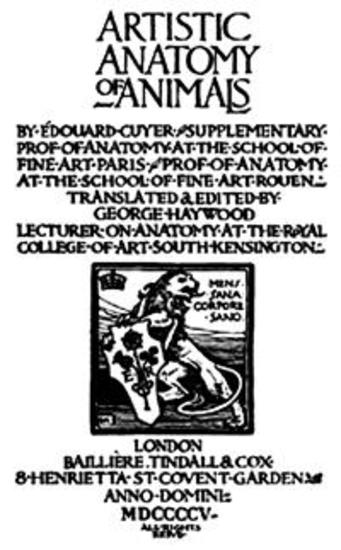
Artistic Anatomy Of Animals
Cuyer Édouard
Verlag: Author
Beschreibung
Artistic Anatomy Of Animals By Edouard Cuyer
Language English
Verfügbar seit: 21.03.2022.

Verlag: Author
Artistic Anatomy Of Animals By Edouard Cuyer Language English

A Croft in the Hills captures, in simple, moving descriptions, what it was really like trying to make a living out of a hill croft near Loch Ness fifty years ago. A couple and their young daughter, fresh from city life, immerse themselves in the practicalities of looking after sheep, cattle and hens, mending fences, baking bread, and surviving the worst that Scottish winters can throw at them.


Their neighbors are few, but among them they find the generosity and community spirit that has survived in the Highlands for generations. Working as a tight family unit, they learn to cope, and in time grow to love their little croft. As Neil Gunn writes in his Foreword, their lives gain extra dimensions that 'give the book its unusual quality, its brightness, and its wisdom'.
Zum Buch
Technology has transformed every aspect of modern life, reshaping the way people communicate, work, learn, and even think. The rapid evolution of digital tools, artificial intelligence, and automation has created new opportunities for innovation and progress. At the same time, it has introduced complex challenges, raising questions about privacy, security, and the ethical implications of technological advancement. While some argue that technology is a force for good, improving efficiency and convenience, others warn of its unintended consequences, such as addiction, misinformation, and social disconnection.

The digital revolution has promised to connect the world like never before, making information more accessible and enabling instant communication across continents. However, the same tools that foster global connectivity also contribute to a decline in real-world interactions. Social media platforms, for example, offer a space for people to share ideas, but they have also been linked to mental health issues, cyberbullying, and the spread of false information. Additionally, concerns about surveillance and data privacy have grown, as companies and governments collect vast amounts of personal information, often without users' full awareness or consent.

Another major area of technological impact is the workforce. Automation and artificial intelligence are changing the job market, replacing certain human roles while creating new ones. While these advancements increase efficiency and reduce costs, they also raise concerns about job displacement and economic inequality. Many industries, from manufacturing to customer service, have seen a shift toward AI-driven processes, leaving workers struggling to adapt. At the same time, some experts believe that technology can enhance human capabilities rather than replace them, leading to a future where humans and machines collaborate rather than compete.
Zum Buch

Have you ever looked at the effects of climate change and the apathy of so many around you and wondered, "What are we missing here?"
Climate activist Kyle Meyaard-Schaap understands this feeling from personal experience. But in his years of speaking to and equipping Christians to work for climate action, he's seen the trend begin to shift. More and more young Christians are waking up to the realities of climate change. They want to help, but they're not sure how.
Through stories from the field, theological and scriptural exploration, and practical advice, Meyaard-Schaap offers hope to Christians paralyzed by the scale of the crisis, helping us turn our paralysis into meaningful action. Following Jesus in a Warming World is a field guide for Christian climate action—one grounded not in a sense of guilt or drudgery, but in the joy of caring for creation.
Zum Buch

Sally Sierer Bethea was one of the first women in America to become a "riverkeeper"—a vocal defender of a specific waterway who holds polluters accountable. In Keeping the Chattahoochee, she tells stories that range from joyous and funny to frustrating—even alarming—to illustrate what it takes to save an endangered river. Her tales are triggered by the regular walks she takes through a forest to the Chattahoochee over the course of a year, finding solace and kinship in nature.


For two decades, Bethea worked to restore the neglected Chattahoochee, which provides drinking water and recreation to millions of people, habitat for wildlife, and water for industries and farms as it cuts through the heart of the Deep South. Pairing natural and political history with reflective writing, she draws listeners into her watershed and her memories. Bethea's passion for the natural world—and for defending it with a strong, informed voice animates this instructive memoir. Offering lessons on how to fight for our fundamental right to clean water, Bethea and her colleagues take on powerful corporate and government polluters. They strengthen environmental policies and educate children, reviving the great river from a century of misuse.
Zum Buch
This is a concise summary and analysis of Stiff, by Mary Roach. It is not the original book and is not affiliated with or endorsed by Mary Roach. Ideal for those seeking a quick and insightful overview.

A fascinating and darkly humorous exploration of what happens to human bodies after death. This book delves into the many roles cadavers have played in advancing science, medicine, and even forensic investigations. From crash tests to medical dissections, the narrative combines scientific curiosity with wit, revealing the unexpected contributions of the deceased to the living world.
Zum Buch

The time for effective change is shrinking.
In this book, writer, researcher and advocate Gerry Gillespie outlines how we can create a global solution, and it starts between our ears. In order to restore our world ecosystems and our vital soils, he wants to change how we think about our trash. Readers will learn why we all need to change our mind about waste management systems, how to reconnect our organic waste to local soil and food growers, and why this leads to more local jobs.
With chapters about source separation, soil management and climate change, and practical approaches to zero waste, Gillespie presents a practical, logical argument for one way to save the world and grow a local economy. In economic and environmental terms, clearly explains how, if waste were collected as source-separated products, more than half of it could be returned to soils as quality compost and biological products. A very large percentage of the remainder can be put back through recycling, re-manufacturing and reusing. And it’s not just theoretical. Gillespie details how this reduction of waste is already being achieved in parts of the world and how we could do it globally … if we could only think differently.
Advocates, nonprofit directors, waste managers, landfill directors, environmentalists, entrepreneurs, eco-farmers and anyone searching for environmental solutions and opportunities with source separation should not only read this book … we must figure out how to change our thinking, and put Gillespie’s plan into action.
Zum Buch





