Rejoignez-nous pour un voyage dans le monde des livres!
Ajouter ce livre à l'électronique
Grey
Ecrivez un nouveau commentaire Default profile 50px
Grey
Abonnez-vous pour lire le livre complet ou lisez les premières pages gratuitement!
All characters reduced
WHY TRUMP’S TARIFFS WILL NOT WORK - A comprehensive study on the most important presidential economic measure in recent years - cover

WHY TRUMP’S TARIFFS WILL NOT WORK - A comprehensive study on the most important presidential economic measure in recent years

CORTEZ ALEXANDER HORTENSIO

Maison d'édition: Publisher s13109

  • 0
  • 0
  • 0

Synopsis

A comprehensive study on the most important presidential economic measure in recent years
Disponible depuis: 06/04/2025.

D'autres livres qui pourraient vous intéresser

  • The Anarchist Movement - A historical Overview of Anarchist Theory and Practice - cover

    The Anarchist Movement - A...

    Arlo Holders

    • 0
    • 0
    • 0
    Anarchism, as both a philosophy and a political movement, seeks to abolish hierarchical structures of power, particularly the state, and promote a society based on voluntary cooperation, mutual aid, and self-governance. The term “anarchy” is often misunderstood and associated with chaos or disorder, but in the context of anarchism, it refers to the absence of coercive authority, not lawlessness. Anarchism challenges the legitimacy of centralized governments, institutions, and systems that perpetuate inequality and domination, advocating instead for decentralized, egalitarian forms of social organization. 
    The roots of anarchism can be traced back to the philosophical and political developments of the 17th and 18th centuries, particularly in the Enlightenment. Thinkers such as William Godwin and Jean-Jacques Rousseau laid the groundwork for anarchist thought by critiquing the rise of centralized authority and envisioning societies based on the autonomy of individuals and communities. However, it was in the 19th century that anarchism began to take shape as a distinct political ideology, largely influenced by the writings and activism of figures like Pierre-Joseph Proudhon, Mikhail Bakunin, and Peter Kropotkin. 
    Central to anarchist theory is the belief in individual freedom and autonomy. Anarchists argue that all individuals should have the right to govern their own lives without interference from external authorities, whether those authorities are political, economic, or social. Anarchism posits that society can function without the need for a state, which is often seen as a coercive and oppressive institution. Instead, anarchists advocate for decentralized forms of governance, such as direct democracy, mutual aid, and voluntary association, where decisions are made collectively by communities rather than imposed by a centralized authority.
    Voir livre

  • 1984 Nomination Acceptance Address - cover

    1984 Nomination Acceptance Address

    Ronald Reagan

    • 0
    • 0
    • 0
    On August 23, 1984, at the Dallas Convention Center, Reagan accepts the presidential nomination of the Republican party. Reagan reminds Democrats of the high inflation and interest rates when he took office in 1980 and claims Democrats “never met a tax they didn't like or hike.”  
    In 1981 “we started a policy of tightening the Federal budget instead of the family budget.” Reagan cites an improved “misery index” (the total of the inflation and unemployment rates) and improved poverty levels.  
    “In the 4 years before we took office, country after country fell under the Soviet yoke. Since January 20th, 1981, not 1 inch of soil has fallen to the Communists.” (long applause)  
    America is “more confident than ever” with “the strongest economic growth” and “the fastest rate of job creation”.  
    We support NATO, Israel, and free Latin American States that “struggle to prevent Communist takeovers fueled massively by the Soviet Union and Cuba.” We rescued “American students on the imprisoned island of Grenada.” 
    We oppose deficits, and support a balanced budget amendment, the line-item veto, tuition tax credits, enterprise zones, and lower taxes. There is no room for anti-Semitism or bigotry in the party of Lincoln. 
    With America at peace, “we’re in the midst of a springtime of hope” and see America as “a shining city on a hill.” We look forward to “the Olympic Games here in the United States” and marvel “at the journey of the Olympic torch” across our country. 
    Audio recording courtesy of the Ronald Reagan Presidential Library.  
    AspenLeafMedia.com
    Voir livre
  • Living Disability - Building Accessible Futures for Everybody - cover

    Living Disability - Building...

    Emily Macrae

    • 0
    • 0
    • 0
    How can we build more accessible cities? Living Disability brings together vibrant perspectives on disability justice and urban systems. From sidewalks to the climate crisis, Living Disability brings together the vibrant perspectives of thirty-five disabled writers. They explore disability justice, analyze urban systems, and propose more equitable approaches to city building. Essays and interviews push the conversation about accessibility beyond policy papers and compliance checklists to show how disabled people are already creating more inclusive spaces in cities of all sizes.
      
      Living Disability is universal in scope but intimate and local in focus, grounded in personal struggles and celebrations. 
     Decisions about public transit, affordable housing, and park design all disproportionately impact disabled communities; by sharing stories and strategies, contributors consider the ways disabled thinkers and doers are embracing overlooked aspects of urban design and tackling the toughest problems facing cities. 
     
    "Living Disability is at once hopeful and infuriating, solemn and joyous. The stories shared within these pages point to both the past and future simultaneously – illuminating the struggles and joys and history of disabled life, while putting access barriers on blast in a way that is more necessary than ever. The deep, rich work of this collection lies in its embrace of complexity, community, grief, and also its belief in the capacity of our world (read: us) to change. May these stories touch your heart, kindle the flame of your anger, and move you forward into fighting for the better world we all deserve." – Amanda Leduc, author of Disfigured: On Fairy Tales, Disability, and Making Space
    Voir livre
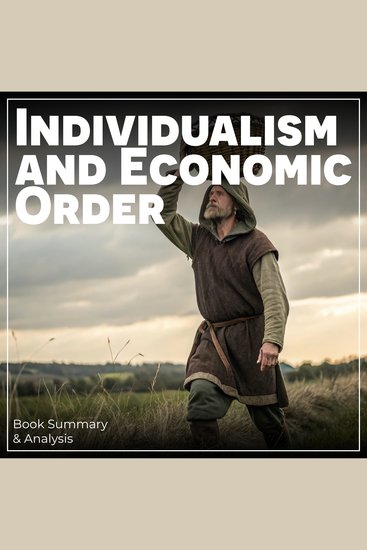
  • Individualism and Economic Order: Book Summary & Analysis - cover

    Individualism and Economic...

    Briefly Summaries

    • 0
    • 0
    • 0
    This is a concise summary and analysis of Individualism and Economic Order, by Friedrich A. Hayek.
     
    It is not the original book and is not affiliated with or endorsed by Friedrich A. Hayek.
    Ideal those seeking a quick and insightful overview.
     
    Individualism and Economic Order explores the intricate relationship between personal freedom and economic organization, presenting a series of essays that advocate for decentralized decision-making, the limitations of central planning, and the virtues of a free-market system. The book delves into the philosophical foundations of individualism, the challenges of socialism, and the role of knowledge in society. With profound insights into economics, philosophy, and political theory, this work remains a cornerstone for understanding the interplay between liberty and economic systems in the modern world.
    Voir livre
  • The Coronation - cover

    The Coronation

    Charles Eisenstein

    • 0
    • 0
    • 0
    Renowned public speaker, bestselling author, social critic, and activist Charles Eisenstein offers a way forward from our present moment through a series of unforgettable essays that give us a new model of sense-making. Through a series of piercing essays, The Coronation takes listeners through the initiation of the Covid era?exploring topics like despair, hope, courage, division, and reunion?in this stunning collection. Paired with each essay is the author’s commentary locating the essay in a social, political, and spiritual journey. After all, it wasn’t only outward normality that the pandemic disrupted. Of all the social crises that COVID-19 has revealed, The Coronation addresses the most profound: the crisis in our sense-making. An old reality has disintegrated. This book reveals just how deep that breakdown is. Acknowledging it, we might build something more sound, more whole, and more sane. Underneath the shifting sands of the arguments and narratives, something else calls to us: the possibility of renewal, a revolution in the agreements and myths that organize society. *Individually, these essays have been read, shared, and discussed by tens of thousands of people around the globe, but they are collected together here for the first time!
    Voir livre
  • Confronting Saddam Hussein - George W Bush and the Invasion of Iraq - cover

    Confronting Saddam Hussein -...

    Melvyn P. Leffler

    • 0
    • 0
    • 0
    America's decision to go to war in Iraq in 2003 is arguably the most important foreign policy choice of the entire post–Cold War era. Nearly two decades after the event, it remains central to understanding current international politics and US foreign relations. 


    In Confronting Saddam Hussein, the eminent historian of US foreign policy Melvyn P. Leffler analyzes why the US chose war and who was most responsible for the decision. Employing a unique set of personal interviews with dozens of top officials and declassified American and British documents, Leffler vividly portrays the emotions and anxieties that shaped the thinking of the president after the shocking events of 9/11. He shows how fear, hubris, and power influenced Bush's approach to Saddam Hussein's Iraq. At the core of Leffler's account is his compelling portrait of Saddam Hussein. Rather than stressing Bush's preoccupation with promoting freedom or democracy, Leffler emphasizes Hussein's brutality, opportunism, and unpredictability and illuminates how the Iraqi dictator's record of aggression and intransigence haunted the president and influenced his calculations. Throughout, Leffler highlights the harrowing anxieties surrounding the decision-making process after the devastating attack on 9/11 and explains the roles of contingency, agency, rationality, and emotion.
    Voir livre