Begleiten Sie uns auf eine literarische Weltreise!
Buch zum Bücherregal hinzufügen
Grey
Einen neuen Kommentar schreiben Default profile 50px
Grey
Jetzt das ganze Buch im Abo oder die ersten Seiten gratis lesen!
All characters reduced
Parenting Stress Solutions - cover

Parenting Stress Solutions

Cordelia Sloane

Übersetzer A AI

Verlag: Publifye

  • 0
  • 0
  • 0

Beschreibung

Parenting Stress Solutions offers a comprehensive guide to help modern parents understand and manage the unique stressors they face. Recognizing that societal expectations and personal histories significantly contribute to parental overwhelm, the book provides effective coping strategies. Did you know chronic parental stress can negatively affect not only the parent's mental and physical health, but also the child's development and family dynamics? This resource emphasizes practical, evidence-based solutions, moving beyond generic advice to offer actionable strategies grounded in psychological research and real-world experiences. 

 
The book takes a holistic approach, integrating psychological understanding, practical coping mechanisms like mindfulness and time management, and the crucial practice of self-care for parental well-being. It emphasizes that effective stress management isn't just about individual resilience but requires a comprehensive approach. Beginning with the core concepts of parental stress, it progresses through strategies for stress reduction, dedicating a section to self-care and highlighting the long-term benefits of proactive management for both parents and children.
Verfügbar seit: 22.02.2025.
Drucklänge: 128 Seiten.

Weitere Bücher, die Sie mögen werden

  • The AgeTech Revolution - cover

    The AgeTech Revolution

    Keren Etkin

    • 0
    • 0
    • 0
    Have you ever thought about what your life may be like as you grow older, and what technology will be available to you at that time?In The AgeTech Revolution, Keren Etkin takes you on a journey to explore what the intersection of tech and aging looks like today. This book explores the changing face of aging in the 21st century, through the lens of the fast-paced digital transformation our society is going through. It goes into challenges of aging that are currently being tackled by technology - using the real-life stories of tech entrepreneurs and older adults. Etkin also provides a glimpse into the future, and what agetech could be like five, ten, fifteen years down the road. We have a unique, once-in-a-lifetime opportunity to impact the experience of living as an older adult in this world, using technology. The AgeTech Revolution provides us with the data and perspective necessary to change our tech landscape and to create a world that is more inclusive and supportive of older adults.
    Zum Buch
  • Bernhard Sindberg - The Schindler of Nanjing - cover

    Bernhard Sindberg - The...

    Peter Harmsen

    • 0
    • 0
    • 0
    In December 1937, the Chinese capital, Nanjing, falls and the Japanese army unleash an orgy of torture, murder, and rape. Over the course of six weeks, hundreds of thousands of civilians and prisoners of war are killed. At the very onset of the atrocities, the Danish supervisor at a cement plant just outside the city, 26-year-old Bernhard Arp Sindberg, opens the factory gates and welcomes in 10,000 Chinese civilians to safety. He becomes an Asian equivalent of Oskar Schindler, the savior of Jews in the Holocaust. 


    This biography follows Sindberg from his childhood and on his first adventures as a sailor and a Foreign Legionnaire to the 104 days as a rescuer of thousands of helpless men, women, and children in the darkest hour of the Sino-Japanese War. After his remarkable achievement, he receded back into obscurity, spending decades at sea and becoming a naturalized American citizen, before dying of old age in Los Angeles in 1983. 


    The book sets the record straight by providing the first complete account of Sindberg's life in English. What emerges is the surprising tale of a person who was average in every respect but rose to the occasion when faced with unimaginable brutality, discovering an inner strength and courage that transformed him into one of the great humanitarian figures of the twentieth century and an inspiration for our modern age.
    Zum Buch
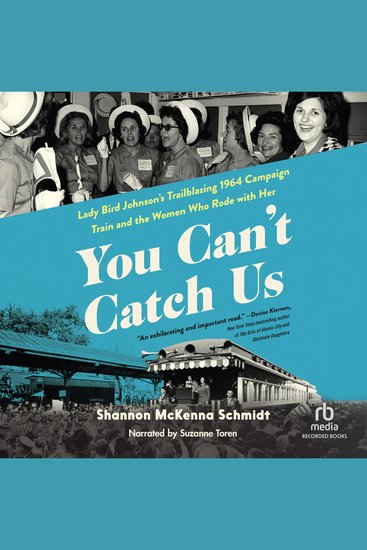
  • You Can't Catch Us - Lady Bird Johnson's Trailblazing 1964 Campaign Train and the Women Who Rode with Her - cover

    You Can't Catch Us - Lady Bird...

    Shannon McKenna Schmidt

    • 0
    • 0
    • 0
    1,682 miles. The First Lady of the United States. One incredible journey. 
      
    At a time when political candidates' wives were expected to be seen and not heard, Lady Bird Johnson made history as the first presidential spouse to take a leading role on the campaign trail. Her mission: to aid her husband, Lyndon B. Johnson, in his reelection bid. 
      
    Proud of her southern heritage and of what her husband had done for civil rights, Lady Bird undertook an eight-state whistle-stop tour in October 1964, both to garner votes for Lyndon and to help ease the animosity that arose from the signing of the Civil Rights Act three months earlier. 
      
    The "Lady Bird Special," a custom, nineteen-car train, forged headlong into the powder keg of Southern politics, traveling from Washington DC to New Orleans and making forty-seven stops in only four days. Despite the potential dangers, the First Lady, aided by a team of pioneering women, pressed forward, making speeches, shaking hands, and breaking ground. 
      
    You Can't Catch Us isn't simply the story of an election campaign. It's the story of a women-led operation and an appeal for understanding and civility. Lady Bird Johnson's monumental journey expanded the role of women in politics and progressed the fight for women's rights—a fight we still continue today. 
      
    "Surprising, gripping, and hilarious, this inspiring journey through the American South never derails. Shannon McKenna Schmidt has written a gem of American campaign history. All aboard!"—Margaret McMullan, author of Where the Angels Lived: One Family's Story of Exile, Loss, and Return
    Zum Buch
  • Ancient Egypt’s Most Important Cult Centers: The History of the Sacred Sites that Shaped Egyptian Mythology - cover

    Ancient Egypt’s Most Important...

    Charles River Editors

    • 0
    • 0
    • 0
    Perhaps the most intriguing aspect of ancient Egyptian civilization was its inception from the ground up, as the ancient Egyptians had no prior civilization which they could use as a template. In fact, ancient Egypt itself became a template for the civilizations that followed.  
    One of the primary reasons why modern scholars know so much about Egyptian history is due to many monuments found up and down the Nile. Although some of the tombs built on the west bank of the Nile River have suffered a fair amount of wind damage and all of the great monuments have endured the ravages of time, they are amazingly well-preserved, thanks both to Egypt’s arid climate and good workmanship. The Egyptian monument builders were truly a class above their contemporaries in terms of their trade, which was helped by the fact that they worked with the more permanent materials of sandstone and limestone, unlike Mesopotamian builders who were forced to primarily work with mud and brick.  
    In ancient Egypt, cities held political and religious significance, which meant that if the political or religious tides changed, so too could the fortunes of particular cities. Memphis is perhaps the best known of ancient Egypt’s cities because it was fortunate enough to be the political capital of the Egyptian state for most of its history. Hundreds of miles to Memphis’ south, Thebes became an important city during the Middle Kingdom and its stature grew during the New Kingdom when many of the pharaohs came from there and the national god, Amun, had its cult center in the city. Other cities, such as Tanis and Sais, were important for much shorter periods in Egyptian history. The city of Abju, which was known as Abydus to the Greeks, and later became known simply as “Abydos” had a history that was as long as Memphis’, and although its influence on pharaonic culture may not have been as apparent, it was no less profound.
    Zum Buch
  • The Trauma Beat - A Case for Re-Thinking the Business of Bad News - cover

    The Trauma Beat - A Case for...

    Tamara Cherry

    • 0
    • 0
    • 0
    A groundbreaking and thorough examination of the trauma caused by the media covering crimes, both to victims and journalists, from a respected journalist and victim advocate 


    In The Trauma Beat, an eye-opening combination of investigative journalism and memoir, former big-city crime reporter Tamara Cherry calls on her award-winning skills as a journalist to examine the impact of the media on trauma survivors and the impact of trauma on members of the media. As Tamara documents the experiences of those who were forced to suffer on the public stage, she is confronted by everything she got wrong on the crime beat. 


    Covering murders and traffic fatalities to sexual violence and mass violence, Cherry exposes a system set up to fail trauma survivors and journalists. Why do some families endure a swell of unwanted attention after the murder of a loved one, while others suffer from a lack of attention? What is it like to have a microphone shoved in your face seconds after escaping the latest mass shooting? What is the lasting impact on the reporter holding that microphone? The Trauma Beat explores these issues with the raw, reflective detail of a journalist moving from ignorance to understanding and shame to healing.
    Zum Buch
  • Tank Warfare on the Eastern Front 1941-1942 - Schwerpunkt - cover

    Tank Warfare on the Eastern...

    Robert A. Forczyk

    • 0
    • 0
    • 0
    The German panzer armies that swept into the Soviet Union in 1941 were an undefeated force that had honed their skill in combined arms warfare to a fine edge. The Germans focused their panzers and tactical air support at points on the battlefield defined as Schwerpunkt—main effort—to smash through any defensive line and then advance to envelope their adversaries. 


    Initially, these methods worked well in the early days of Operation Barbarossa and the tank forces of the Red Army suffered defeat after defeat. Although badly mauled in the opening battles, the Red Army's tank forces did not succumb to the German armored onslaught and German planning and logistical deficiencies led to over-extension and failure in 1941. In the second year of the invasion, the Germans directed their Schwerpunkt toward the Volga and the Caucasus and again achieved some degree of success, but the Red Army had grown much stronger and by November 1942, the Soviets were able to turn the tables at Stalingrad. 


    Robert Forczyk's incisive study offers fresh insight into how the two most powerful mechanized armies of WWII developed their tactics and weaponry during the early years of the Russo-German War. He uses German, Russian, and English sources to provide the first comprehensive overview and analysis of armored warfare from the German and Soviet perspectives.
    Zum Buch