Begleiten Sie uns auf eine literarische Weltreise!
Buch zum Bücherregal hinzufügen
Grey
Einen neuen Kommentar schreiben Default profile 50px
Grey
Jetzt das ganze Buch im Abo oder die ersten Seiten gratis lesen!
All characters reduced
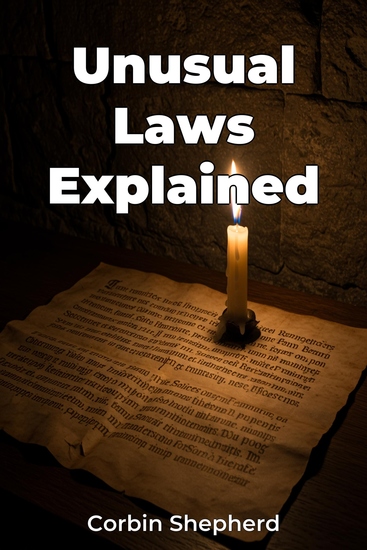
Unusual Laws Explained - cover

Unusual Laws Explained

Corbin Shepherd

Übersetzer A AI

Verlag: Publifye

  • 0
  • 0
  • 0

Beschreibung

Unusual Laws Explained explores the peculiar world of antiquated legislation still in effect today, offering insights into the historical and political forces that shaped them. These seemingly bizarre laws, such as restrictions on wearing camouflage or peculiar economic regulations, provide a unique lens through which to understand evolving social norms and the complexities of legal systems across the globe. By examining these historical laws, the book reveals how specific events and cultural beliefs have shaped legal frameworks, often with lasting consequences.

 
The book progresses logically, beginning with an introduction to legal history and then exploring laws related to public order, economic regulations, and morality. For instance, seemingly odd restrictions on personal freedoms or religious practices reflect the ongoing tension between individual liberty and societal control.

 
The book argues that these legal oddities are valuable artifacts illuminating societal development, prompting critical thinking about the necessity and reform of laws in modern society. Through a global perspective, Unusual Laws Explained avoids legal jargon and presents legal history in an accessible manner, using historical records and expert opinions to support its claims. This approach makes the book a valuable resource for anyone interested in history, politics, or the stranger side of legal history, encouraging a deeper understanding of legal reform and social justice.
Verfügbar seit: 31.03.2025.
Drucklänge: 76 Seiten.

Weitere Bücher, die Sie mögen werden

  • World’s Deadliest Plagues The: The History and Legacy of the Worst Global Pandemics - cover

    World’s Deadliest Plagues The:...

    Editors Charles River

    • 0
    • 0
    • 0
    Human beings seem to have a particular fascination for microbiological threats. They are invisible, unpredictable and mysterious, and it is only in the past 150 years or so that scientists have begun to understand microorganisms and the maladies they can cause. Modern society has long been horrified and enthralled by accounts of such pestilences as the Black Death, which exterminated up to 60% of the population of Europe from 1347-1351. Less known is the Plague of Justinian which was even more deadly in that it carried away a quarter of the world’s population within the space of one year (542 CE). The Great Plague of London, which killed 100,000 in 1666, is another infamous pestilence, as is the Spanish Flu of 1918, which took the lives of as many as one million worldwide, making that epidemic even deadlier than the medieval Black Death. 
    Such virulent outbreaks of disease are by no means distant historical events. While scientific and technological advances have limited and in many places eradicated such community-devastating diseases as cholera, smallpox, bubonic plague, typhus, Salmonella and yellow fever, new microscopic threats have arisen, including Ebola, SARS, bird flu, and most recently Coronavirus 2. 
    The terror associated with pestilence speaks to people’s insecurities concerning the unknown and invisible. The ancients had no knowledge of microorganisms that caused disease-instead they postulated that pestilence was caused by miasma, air fouled by decomposing matter. That said, modern awareness of microscopic viruses and bacteria does nothing to lessen humanity’s insecurity. If anything, it is terrifying that such tiny creatures have the capacity to overthrow powerful and vibrant societies. This is one of the themes of H. G. Wells’ famous War of the Worlds (1897).
    Zum Buch
  • Hoysala Empire - The Architectural Splendor of Southern India - cover

    Hoysala Empire - The...

    Rolf Hedger

    • 0
    • 0
    • 0
    The Hoysala Empire was one of the most influential dynasties in South Indian history, known for its patronage of art, culture, and architecture. Flourishing between the 10th and 14th centuries, the empire left an indelible mark on the Deccan region, particularly in present-day Karnataka. The Hoysalas emerged as a powerful force after the decline of the Western Chalukyas, establishing their capital first at Belur and later at Halebidu. Their rule was characterized by military conquests, administrative efficiency, and an enduring legacy of architectural splendor that continues to captivate historians and art enthusiasts. 
    The origins of the Hoysala dynasty are traced to a chieftain named Sala, who, according to legend, was instructed by a Jain monk to kill a tiger that was attacking them. This act of bravery led to the adoption of the royal emblem depicting a warrior slaying a tiger, symbolizing the valor of the Hoysala rulers. Over the centuries, the dynasty expanded its influence through strategic alliances and military campaigns, gaining control over vast territories in the Deccan. Prominent rulers such as Vishnuvardhana and Veera Ballala II played a crucial role in consolidating the empire and fostering a rich cultural heritage. 
    A significant aspect of Hoysala rule was its deep connection with religious and artistic traditions. The dynasty was known for its support of Hinduism, Jainism, and, to some extent, Buddhism, leading to the construction of numerous temples and religious institutions. These temples were not just places of worship but also centers of learning and artistic expression. The Hoysalas employed skilled artisans and sculptors who developed a distinctive architectural style, characterized by intricate carvings, star-shaped temple layouts, and finely detailed sculptures depicting gods, celestial beings, and mythological narratives.
    Zum Buch
  • The Boy that walked from Virginia to Texas - cover

    The Boy that walked from...

    Travis Lee Darden

    • 0
    • 0
    • 0
    It chronicles the adventures of an African American Boy who walks from Virginia to Texas in 1948. 
    Zum Buch
  • Animals on the Farm - cover

    Animals on the Farm

    Kim Mitzo Thompson, Karen Mitzo...

    • 0
    • 0
    • 0
    Kids will love this playful story about animals that live on a farm and the wonderful sounds that they make. Simple sentence structures and repetitive words will encourage young children to fall in love with learning to read.  Kids will enjoy following along word-for-word with the recorded story that features sound effects and professional voices to help children develop vocabulary and improve listening skills.  This reader features adorable art to engage young learners.
    Zum Buch
  • Thinking Historically - A Guide to Statecraft and Strategy - cover

    Thinking Historically - A Guide...

    Francis J. Gavin

    • 0
    • 0
    • 0
    It seems obvious that we should use history to improve policy. If we have a good understanding of the past, it should enable better decisions in the present, especially in the extraordinarily consequential worlds of statecraft and strategy. But how do we gain that knowledge? How should history be used? Sadly, it is rarely done well, and historians and decision-makers seldom interact. But in this remarkable book, Francis J. Gavin explains the many ways historical knowledge can help us understand and navigate the complex, often confusing world around us. Good historical work convincingly captures the challenges and complexities the decisionmaker faces. At its most useful, history is less a narrowly defined field of study than a practice, a mental awareness, a discernment, and a responsiveness to the past and how it unfolded into our present world—a discipline in the best sense of the word. Gavin demonstrates how a historical sensibility helps us to appreciate the unexpected; complicates our assumptions; makes the unfamiliar familiar and the familiar unfamiliar; and requires us, without entirely suspending moral judgment, to try to understand others on their own terms. This book is a powerful argument for thinking historically as a way for listeners to apply wisdom in encountering what is foreign to them.
    Zum Buch
  • Intimate Subjects - Touch and Tangibility in Britain’s Cerebral Age - cover

    Intimate Subjects - Touch and...

    Simeon Koole

    • 0
    • 0
    • 0
    An insightful history of nineteenth- and twentieth-century Britain told through a single sense: touch. 
      
    When, where, and who gets to touch and be touched, and who decides? What do we learn through touch? How does touch bring us closer together or push us apart? These are urgent contemporary questions, but they have their origins in late nineteenth- and early twentieth-century Britain, when new urban encounters compelled intense discussion of what touch was, and why it mattered. In this vividly written book, Simeon Koole excavates the history of these concerns and reveals how they continue to shape ideas about “touch” in the present. 
      
    Intimate Subjects takes us to the bustling railway stations, shady massage parlors, all-night coffee stalls, and other shared spaces where passengers, customers, vagrants, and others came into contact, leading to new understandings of touch. We travel in crammed subway cars, where strangers negotiated the boundaries of personal space. We visit tea shops where waitresses made difficult choices about autonomy and consent. We enter classrooms in which teachers wondered whether blind children could truly grasp the world and labs in which neurologists experimented on themselves and others to unlock the secrets of touch. We tiptoe through London’s ink-black fogs, in which disoriented travelers became newly conscious of their bodies and feared being accosted by criminals. Across myriad forgotten encounters such as these, Koole shows, touch remade what it meant to be embodied—as well as the meanings of disability, personal boundaries, and scientific knowledge. 
      
    With imagination and verve, Intimate Subjects offers a new way of theorizing the body and the senses, as well as a new way of thinking about embodiment and vulnerability today.
    Zum Buch