Join us on a literary world trip!
Add this book to bookshelf
Grey
Write a new comment Default profile 50px
Grey
Subscribe to read the full book or read the first pages for free!
All characters reduced
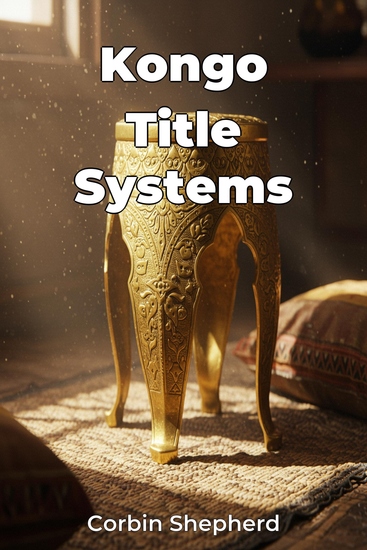
Kongo Title Systems - cover

Kongo Title Systems

Corbin Shepherd

Translator A AI

Publisher: Publifye

  • 0
  • 0
  • 0

Summary

Kongo Title Systems explores the sophisticated political organization of the Kongo Kingdom through its intricate system of titles. This book examines how these titles governed rank, administration, and ceremonial life, offering a crucial look into pre-colonial African governance. The Kongo Kingdom, located in what is now northern Angola and the western Democratic Republic of Congo, utilized this system to maintain order and project power for centuries. One intriguing aspect is how the mani Kongo, or king, and provincial governors used these titles to effectively distribute power and manage resources.

 
The book uniquely delves into the functional logic of the Kongo titles, examining not just who held them but how they were used to govern and resolve disputes. Drawing from Portuguese chronicles, oral traditions, and linguistic analysis, the book presents detailed descriptions of the titles and their functions. It begins by introducing the core concepts of Kongo political organization, then categorizes the types of titles based on their function and geographical scope. Finally, it analyzes the evolution of the title system, showing its adaptation to internal and external pressures.

 
Understanding the Kongo’s political organization challenges Eurocentric views and highlights the ingenuity of African political thought.
Available since: 05/03/2025.
Print length: 57 pages.

Other books that might interest you

  • Hate Speech on Social Media: A Global Approach - cover

    Hate Speech on Social Media: A...

    Branco Di Fátima, Allen...

    • 0
    • 0
    • 0
    This book explores the nature of hate speech on social media. Readers will find chapters written by 21 authors from 18 universities or research centers. It includes researchers from 11 countries, prioritizing a diversity of approaches from the Global North and Global South – Brazil, Cyprus, Ethiopia, Germany, Nigeria, Portugal, South Africa, Spain, Switzerland, Turkey, and the USA. The analyses herein involve the realities in an even larger number of countries, given the transnational approach of some of these studies.
    One can find a preview of the chapters at the beginning of the book, with abstracts organized in a separate section. It is evident that the authors study the impact of recent events on hate speech – the Covid-19 pandemic, Russia- Ukraine war, the refugee crisis – and recurrent attacks on minority groups such as women, immigrants, or the LGBTQ+ community. The authors employ classic and digital research methods, using quantitative and qualitative data gathered from platforms like Telegram, Facebook, Instagram, Twitter, and YouTube. As a result, readers will encounter taxonomic proposals, new methodological approaches, theoretical frameworks, and mapping of behavioral patterns.
    Show book
  • The Conscious Code - Decoding the Implications of Artificial Consciousness - cover

    The Conscious Code - Decoding...

    Prof. Rocky Scopelliti

    • 0
    • 0
    • 0
    In an age where Artificial Intelligence (AI) evolves at a breakneck pace, the boundaries of machine capabilities are constantly being redefined. Propelled by advancements in deep learning and related technologies, AI is inching ever closer to mimicking human intellect. But can it achieve consciousness? And if so, at what cost to humanity?
     
    This book delves deep into the multi-faceted debate surrounding artificially conscious AI. It untangles ethical quandaries, philosophical dilemmas, technological challenges, political considerations, and the regulatory landscape. By drawing connections between AI research, neuroscience, and cognitive science, the narrative provides a comprehensive understanding
     of what consciousness might mean in the context of AI.
     
    As over a thousand AI luminaries globally sound the alarm, urging a pause on certain AI developments, the book underscores the urgency of its message. Recent incidents have spotlighted AI systems with capabilities so advanced that even their creators grapple to fully grasp or control them. It’s imperative, now more than ever, to critically assess the implications of AI consciousness, weighing its potential risks against its benefits. This book offers both a timely warning and a call to informed action.
    Show book
  • The Cop's Sissy 2 - More Like a Woman - cover

    The Cop's Sissy 2 - More Like a...

    Kinky Press

    • 0
    • 0
    • 0
    Is Christine ready to turn her masculine body into what she knows her cop wants? Into what she has come to see herself as? There’s one more long, hanging thing between her and becoming more like a woman.
    Show book
  • Oyo Empire - The Yoruba Powerhouse of West Africa - cover

    Oyo Empire - The Yoruba...

    Rolf Hedger

    • 0
    • 0
    • 0
    The Oyo Empire, one of the most powerful and influential states in West Africa, has a rich and complex history that spans centuries. Located in what is today southwestern Nigeria, the empire was a major force in the region, known for its military prowess, sophisticated political system, and extensive trade networks. The history of the Oyo Empire dates back to the 14th century, when it emerged as one of the leading Yoruba kingdoms in the area. Over time, Oyo became a dominant power in West Africa, shaping the political, economic, and cultural landscape of the region. 
    At its height, the Oyo Empire controlled a vast territory stretching across modern-day Nigeria and parts of Benin and Togo. The empire was strategically positioned along important trade routes, allowing it to thrive economically and maintain strong ties with neighboring kingdoms. Its economy was based primarily on agriculture, with crops such as yams, millet, and sorghum being grown in abundance. Additionally, the Oyo people were involved in long-distance trade, exchanging goods like kola nuts, textiles, and metalwork with other African states and even European traders. 
    Politically, the Oyo Empire was an advanced and well-organized state. The Alafin, the emperor of Oyo, was the supreme ruler and held significant authority over the empire. However, the Alafin did not rule alone. The Oyo Mesi, a council of chiefs, played a critical role in governance, advising the Alafin and ensuring the balance of power. This system of governance allowed the empire to remain stable for centuries, even as it faced external threats and internal challenges. The military was also a key component of the empire’s strength, with the Oyo army being one of the most formidable in West Africa. The empire’s military success was due in part to its highly disciplined forces, as well as the use of cavalry, which gave it a tactical advantage over its enemies.
    Show book
  • Soviet Union - cover

    Soviet Union

    Kelly Mass

    • 0
    • 0
    • 0
    From 1922 till 1991, the Soviet Union, officially the Union of Soviet Socialist Republics (USSR), was a socialist state that covered Europe and Asia. It was in theory a federal union of different sovereign republics; but, till its closing years, its administration and economy were highly centralized.The Bolsheviks, led by Vladimir Lenin, ousted the Provisional Federal government that had formerly toppled the Russian Empire's Romanov family in the October Revolution of 1917, bring to life the Soviet Union. They established the Russian Soviet Republic, the world's first socialist state with a constitution. Stress between the Bolshevik Red Army and some anti-Bolshevik forces across the previous Empire emerged into a civil war, with the White Guard being the most effective faction. The White Horror was a period of violent anti-communist repression by the White Defend Against the Bolsheviks and believed worker and peasant Bolsheviks. Through Red Horror, the Red Army extended and helped regional Bolsheviks in acquiring power, building soviets, and penalizing political challengers and defiant peasants. By 1922, the power balance had moved, and the Bolsheviks had thrived, unifying the Russian, Transcaucasian, Ukrainian, and Byelorussian republics to form the Soviet Union. After the civil war ended, Lenin's administration carried out The New Economic Policy, which led to a partial return of the free enterprise and personal property, and also a period of financial healing.Joseph Stalin rose to power after Lenin's death in the year 1924. Within the Communist Party, Stalin got rid of any political resistance to his rule and developed a command economy. As a consequence, the nation went through a period of quick industrialization and pushed collectivization, which led to great financial development but also a manufactured starvation in the year 1932-- 1933 and the growth of the Gulag labor camp system.
    Show book
  • Uncharted - A Rediscovered History of Voyages to the Americas Before Columbus - cover

    Uncharted - A Rediscovered...

    James Martin, Tim Wallace-Murphy

    • 0
    • 0
    • 0
    The Americas have had native groups living there for more than ten thousand years, but Columbus was surely not their first visitors. Uncharted covers a range of cultures who seemingly have been visiting the Americas since long before Columbus. Evidence is explored of potential Roman and Phoenician shipwrecks off the coast of South America through to Celtic and Norse exploration of Northern America. Put simply, the history of the discovery of the North America is all wrong. How did the Knights Templar influence the discovery of the new world? What do the Sinclair family, Rosslyn chapel, and two venetian brothers have to do with the discovery of a new continent? How did the Vikings navigate their way? With source materials dating back through millennia, including very recent finds, this book will induce you to thought about a side of history still so readily dismissed by some. 


    Uncharted tackles the evidence and stories of visiting distant lands that abound from many cultures, such the Egyptian, Greeks, Celts, Vikings, as well as various people from Asia; and one large Chinese group likely settled in the Americas in 100 BC, which current DNA evidence supports. Columbus should be remembered, but remembered for the conquering tyrant he was. These other groups did not come to conquer, but to trade, explore, and escape.
    Show book