Begleiten Sie uns auf eine literarische Weltreise!
Buch zum Bücherregal hinzufügen
Grey
Einen neuen Kommentar schreiben Default profile 50px
Grey
Jetzt das ganze Buch im Abo oder die ersten Seiten gratis lesen!
All characters reduced
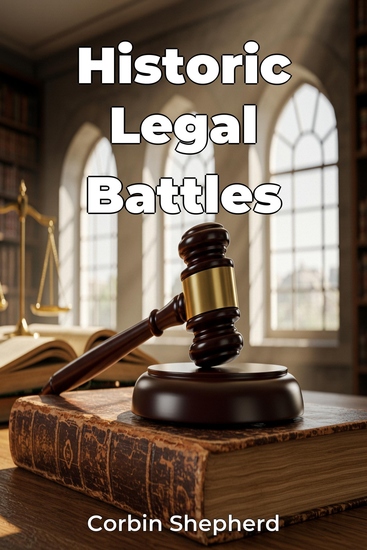
Historic Legal Battles - cover

Historic Legal Battles

Corbin Shepherd

Übersetzer A AI

Verlag: Publifye

  • 0
  • 0
  • 0

Beschreibung

Historic Legal Battles explores the dramatic stories behind landmark court cases, revealing how these pivotal moments redefined justice and shaped our world. Delving into legal history, the book examines how legal precedents are established, challenged, and transformed over time. One intriguing insight is the role of individual agency; the book highlights how individuals, from lawyers to plaintiffs, have used legal processes to advocate for change. Understanding these dynamics is crucial for informed civic engagement, allowing readers to critically assess contemporary legal debates and understand their historical roots.

 
The book unfolds in three major sections, beginning with an introduction to landmark concepts in legal history. It then presents a series of case studies, each focusing on a specific legal battle and exploring its historical context, key figures, legal arguments, and lasting impact. The final section synthesizes the lessons learned, discussing the ongoing evolution of legal systems and the challenges of achieving true justice.

 
By focusing on the human element within these battles, Historic Legal Battles offers a unique and accessible perspective on complex legal concepts.
Verfügbar seit: 03.04.2025.
Drucklänge: 67 Seiten.


Weitere Bücher, die Sie mögen werden

  • The Secret Life of Leinster House - What you really need to know about how the country is run - cover

    The Secret Life of Leinster...

    Gavan Reilly

    • 0
    • 0
    • 0
    What is it like to run for election? How do public representatives deal with the cut-throat competition from their rivals – and their own running mates? What's the Dáil bar really like? And how, given the demands of the 24-hour news cycle, does any meaningful work get done?
    Political correspondent Gavan Reilly turns his keen analytical eye to the machinations of Leinster House. With unprecedented access to political insiders, Gavan offers us a seat at the cabinet table exposing how Irish politics really works.
    'If you want to understand, really understand, how Irish politics works behind the scenes, you should read this book' SHANE COLEMAN
    'This book has it all … the ultimate behind-the-curtain guide to the world of Irish politics' JENNIFER BRAY
    'Invaluable insights into the drama, demands and drudgery of politics … essential reading for anyone with ambitions' SEAN O'ROURKE
    Zum Buch
  • A Rare Recording of Robert Baden-Powell - cover

    A Rare Recording of Robert...

    Robert Baden-Powell

    • 0
    • 0
    • 0
    In these two rare recordings of Robert Baden-Powell, founder and first Chief Scout of The Boy Scouts Association and founder of the Girl Guides, he extols the virtues of the Scout movement and that Scout duties are working for God and the King, helping other people, and keeping Scout law. 
    A Listen & Live audio production.
    Zum Buch
  • The Republic - cover

    The Republic

    Plato

    • 0
    • 0
    • 0
    The Republic (Greek: Politeia) is a Socratic dialogue, written by Plato around 380 BC, concerning the definition of (justice), the order and character of the just city-state and the just man, reason by which ancient readers used the name On Justice as an alternative title (not to be confused with the spurious dialogue also titled On Justice). The dramatic date of the dialogue has been much debated and though it must take place some time during the Peloponnesian War, "there would be jarring anachronisms if any of the candidate specific dates between 432 and 404 were assigned".    It is Plato's best-known work and has proven to be one of the most intellectually and historically influential works of philosophy and political theory. In it, Socrates along with various Athenians and foreigners discuss the meaning of justice and examine whether or not the just man is happier than the unjust man by considering a series of different cities coming into existence "in speech", culminating in a city (Kallipolis) ruled by philosopher-kings; and by examining the nature of existing regimes.    The participants also discuss the theory of forms, the immortality of the soul, and the roles of the philosopher and of poetry in society. Short Summary (Epilogue): X.1—X.8. 595a—608b. Rejection of Mimetic Art X.9—X.11. 608c—612a. Immortality of the Soul X.12. 612a—613e. Rewards of Justice in Life X.13—X.16. 613e—621d. Judgment of the Dead The paradigm of the city — the idea of the Good, the Agathon — has manifold historical embodiments, undertaken by those who have seen the Agathon, and are ordered via the vision. The centre piece of the Republic, Part II, nos. 2–3, discusses the rule of the philosopher, and the vision of the Agathon with the allegory of the cave, which is clarified in the theory of forms.    The centre piece is preceded and followed by the discussion of the means that will secure a well-ordered polis (City). Part II, no. 1, concerns marriage, the community of people and goods for the Guardians, and the restraints on warfare among the Hellenes. It describes a partially communistic polis. Part II, no. 4, deals with the philosophical education of the rulers who will preserve the order and character of the city-state. In Part II, the Embodiment of the Idea, is preceded by the establishment of the economic and social orders of a polis (Part I), followed by an analysis (Part III) of the decline the order must traverse. The three parts compose the main body of the dialogues, with their discussions of the "paradigm", its embodiment, its genesis, and its decline. The Introduction and the Conclusion are the frame for the body of the Republic.    The discussion of right order is occasioned by the questions: "Is Justice better than Injustice?" and "Will an Unjust man fare better than a Just man?" The introductory question is balanced by the concluding answer: "Justice is preferable to Injustice". In turn, the foregoing are framed with the Prologue (Book I) and the Epilogue (Book X). The prologue is a short dialogue about the common public doxai (opinions) about "Justice". Based upon faith, and not reason, the Epilogue describes the new arts and the immortality of the soul.
    Zum Buch
  • A Rare Recording of Father Charles Coughlin - Vol 1 - cover

    A Rare Recording of Father...

    Father Charles Coughlin

    • 0
    • 0
    • 0
    Father Charles Coughlin was a controversial Canadian-American Catholic priest based in Michigan. Calling for monetary reforms, the nationalization of major industries and railroads, and protection of the rights of labor, Coughlin used weekly radio broadcasts to reach a mass audience of up to thirty million listeners during the 1930s. 
     An early supporter of Franklin D. Roosevelt and his New Deal, Coughlin later became a harsh critic. Coughlin’s commentary also became more anti-semitic, and he supported some of the fascist policies of Hitler, Mussolini, and Hirohito. As a result, many American Catholic leaders, as well as the Vatican, wanted Coughlin silenced. After the outbreak of World War II in 1939, the Roosevelt administration finally forced the cancellation of his radio program and forbade the dissemination of his newspaper, Social Justice. 
     In this recording, Coughlin the plight of farmers, oppressive bankers, and a living wage for American workers.
    Zum Buch
  • Jim Crow's Pink Slip - The Untold Story of Black Principal and Teacher Leadership - cover

    Jim Crow's Pink Slip - The...

    Leslie T. Fenwick

    • 0
    • 0
    • 0
    In 1954, the Supreme Court's Brown decision ended segregated schooling in the United States, but regrettably, as documented in congressional testimony and transcripts, it also ended the careers of a generation of highly qualified and credentialed Black teachers and principals. In the Deep South and northern border states over the decades following Brown, Black schools were illegally closed and Black educators were displaced en masse. As educational policy and leadership expert Leslie T. Fenwick deftly demonstrates, the effects of these changes stand contrary to the democratic ideals of an integrated society and equal educational opportunity for all students. 


    Jim Crow's Pink Slip provides a trenchant account of how tremendous the loss to the US educational system was and continues to be. The book draws the line from the past injustices to problems that the educational system grapples with today: not simply the underrepresentation of Black teachers and principals, but also salary reductions, teacher shortages, and systemic inequality. 


    By engaging with the complicated legacy of the Brown decision, Fenwick illuminates a crucial chapter in education history. She also offers policy prescriptions aimed at correcting the course of US education, supporting educators, and improving workforce quality and diversity.
    Zum Buch
  • Consciousness - How Our Brains Turn Matter Into Meaning - cover

    Consciousness - How Our Brains...

    John Parrington

    • 0
    • 0
    • 0
    What is the material basis of the thoughts that occur inside our heads? 
     
    Where do imaginative, creative, or spiritual thoughts come from - can these really be the product of nerve impulses in the brain? And is the human mind radically different from that of other species, or is our uniqueness more superficial than real? 
     
    In this audiobook, Oxford biologist John Parrington proposes a radical new theory of human consciousness, arguing that a qualitative leap in consciousness occurred during human evolution as language and tool use transformed our brains. Rejecting outdated views of the brain as a hard-wired circuit diagram, he draws on the latest insights from neuroscience to show that meaning is created within our heads through a dynamic interaction of oscillating brain waves. 
     
    This new model of consciousness not only provides a material basis of our innermost thoughts but also explains why the mind can sometimes go wrong, causing deep mental distress.
    Zum Buch