¡Acompáñanos a viajar por el mundo de los libros!
Añadir este libro a la estantería
Grey
Escribe un nuevo comentario Default profile 50px
Grey
Suscríbete para leer el libro completo o lee las primeras páginas gratis.
All characters reduced
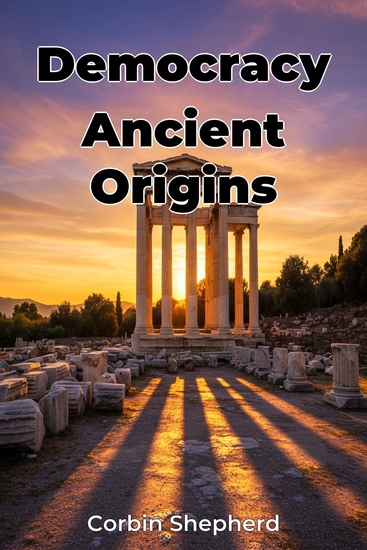
Democracy Ancient Origins - cover

Democracy Ancient Origins

Corbin Shepherd

Traductor A Ai

Editorial: Publifye

  • 0
  • 0
  • 0

Sinopsis

Democracy: Ancient Origins traces democracy's path from its beginnings in ancient Greece to its modern forms, exploring how core principles like voting systems and political equality have evolved. The book examines the successes and failures of past democratic experiments, offering insights into present-day strengths and weaknesses.

 
Did you know Athenian democracy utilized ostracism to prevent tyranny? Or that the Roman Republic contributed significantly to the concept of representative government?

 
This historical analysis emphasizes the constant adaptation of democratic ideals in response to changing social, economic, and political contexts. It navigates inherent tensions between popular will and minority rights, individual liberty and collective responsibility.

 
Beginning with direct democracy in Athens, the book progresses through the Roman Republic, the Enlightenment, and revolutionary movements. By providing a chronological account of democracy's evolution, drawing from historical sources and contemporary scholarship, the book offers a balanced view of different democratic experiments.

 
It sheds light on the challenges facing contemporary democracies, such as declining voter turnout and political polarization, making it valuable to anyone interested in understanding democracy's history and future.
Disponible desde: 02/05/2025.
Longitud de impresión: 69 páginas.

Otros libros que te pueden interesar

  • Splitting the Confederacy: The History of the Union Campaigns to Take the Mississippi River - cover

    Splitting the Confederacy: The...

    Editors Charles River

    • 0
    • 0
    • 0
    Given its importance, it’s somewhat surprising in retrospect that the Union managed to capture New Orleans in an easier manner than places like Vicksburg and Atlanta. Admiral David Farragut’s naval forces battered their shaky Confederate counterparts and were able to get over a dozen ships upriver past a couple of crucial Confederate forts along the Mississippi. By May 1862, Union forces occupied the city and General Benjamin Butler became its military governor, leaving the last true bastion of Confederate defenses on the Mississippi at Vicksburg. 
    At the start of 1863, Robert E. Lee’s Army of Northern Virginia had been frustrating the Union in the Eastern theater for several months, but the situation in the West was completely different. The Confederates had lost control of several important states throughout 1862, and after New Orleans was taken by the Union, the North controlled almost all of the Mississippi River, which Confederate general James Longstreet called “the lungs of the Confederacy”. By taking control of that vital river, the North would virtually cut the Confederacy in two, putting the South in a dire situation. 
    The only domino left to fall was the stronghold of Vicksburg, and both sides knew it. The Union Army of the Tennessee, led by Ulysses S. Grant, would spend months trying to encircle the army and eventually force John Pemberton’s Confederate army to surrender. Grant eventually succeeded on July 4, 1863, but since it came a day after the climactic finish of the Battle of Gettysburg, Vicksburg was (and still is) frequently overlooked as one of the turning points of the Civil War. In fact, had the Confederate’s military leadership listened to Longstreet, who advocated detaching soldiers from Lee’s army to head west and help the Confederates deal with Grant or Rosecrans in that theater, the Battle of Gettysburg might never have happened.
    Ver libro
  • Italian History - From Ancient Rome to Modern Italy - cover

    Italian History - From Ancient...

    History Retold

    • 0
    • 0
    • 0
    Have you ever wondered how Italy's past was? 
    Do you want to travel back in time and witness the grand roman empire? 
    If so, this is for you. 
    Embark on a captivating voyage through Italy's history, from enigmatic Etruscans to modern marvels. Unveil secrets of ancient civilizations, feel Rome's grandeur, and bask in Renaissance brilliance. Witness unification and transformative triumphs, shaping Italy's role in the modern European Union. 
    This book guides you through time, revealing Italy's vibrant past. For history enthusiasts or curious travelers, it's a treasure trove illuminating Italy's remarkable journey, consisting of:Etruscan roots and Roman Empire zenith.Renaissance brilliance ignites art and thought.Unification struggle births modern Italy.World Wars' toll and resilient revival.European Union embrace, lasting influence.Culinary legacy, fashion, cinematic allure.A tapestry of old and new, Italy thrives. 
    Don´t wait any longer! Scroll up and buy this book now!
    Ver libro
  • Young Gifted and Black - A Journey of Lament and Celebration - cover

    Young Gifted and Black - A...

    Sheila Wise Rowe

    • 0
    • 0
    • 0
    "Young, gifted and black,/ Open your heart to what I mean . . ." 


    Nina Simone's popular anthem from the civil rights movement speaks to both the celebrations and trials of the Black experience. 


    Young, Gifted, and Black gives voice to the real-life stories of Black millennials and younger adults. If life was a race, it's assumed that every runner has a fair shot at winning. However, it's not always the case for young, gifted, and Black folks. Sheila Wise Rowe goes beyond the common narrative that focuses solely on their success or struggle. Her stories of celebration and lament point toward hope, joy, and healing. 


    Drawing from her years of experience in counseling trauma and abuse survivors, she provides stories, reflections, and tools for Black listeners of all ages and their allies. These stories offer an opportunity to explore, reflect, and journey toward healing from the barriers that affect their lives, the lives of their children, and their communities.
    Ver libro
  • French Made Easy - Beginner - Volume 2 of 3 - cover

    French Made Easy - Beginner -...

    Lingo Wave

    • 0
    • 0
    • 0
    We broke our new series on learning French down into different learning stages. Start with the "Lower Beginner" books followed by the "Beginner" and "Upper Beginner" books. Next, progress to the "Intermediate" series, then test and reinforce your knowledge with the "Conversations" series. 
    This audiobook is divided into units.While it provides different learning patterns and accommodates various needs, this audiobook focuses on helping you improve your ability to understand, speak, and memorise French.  
    In Unit 1 you will hear French decoded with each syllable spoken very slowly and clearly with repetition. Immediately before each sentence is spoken, you will hear the translation, so you will always understand what is being said. 
    Unit 2 focuses solely on increasing your listening ability, which will improve your abilities to engage in dialogue with a native French speaker. This chapter requires you to listen very carefully to nuances in the language. 
    By Unit 3 you will already notice progress in your abilities to speak and understand French. The spoken translation is followed by two repetitions in French at a completely natural speed. While you are learning to process naturally spoken French, Units 3 and 4 will help you memorise new vocabulary and full sentences. 
    In Unit 5 you can test yourself on how much you have learned. If you are having difficulties, we suggest you revisit the listening, speaking, or memorisation section of Units 1, 2 3 or 4, according to what you need more help with. 
    Topics covered in this book: 
    1. Asking about family 
    2. Asking about relationship status 
    3. Expressing frequency 
    4. Talking about spare time activities and hobbies 
    5. Using quantifiers/determiners 
    6. Talking about preference 
    7. Talking about abilities 
    8. Talking about location of places 
    9. Describing appearance 
    10. Talking about personality 
    ...
    Ver libro
  • Foster the Family - Encouragement Hope and Practical Help for the Christian Foster Parent - cover

    Foster the Family -...

    Jamie C. Finn

    • 0
    • 0
    • 0
    There are great rewards that come along with being a foster parent, yet there are also great challenges that can leave you feeling depleted, alone, and discouraged. The many burdens of a foster parent's day—hurting children, struggling biological parents, and a broken system—are only compounded by the many burdens of a foster parent's heart—confusion, anxiety, heartache, anger, and fear. 


    With the compassion and insight of a fellow foster parent, Jamie C. Finn helps you see your struggles through the lens of the gospel, bringing biblical truths to bear on your unique everyday realities. In these short, accessible chapters, you'll find honest, personal stories and practical lessons that provide encouragement and direction from God's Word as you walk the journey of foster parenting.
    Ver libro
  • The Time Beneath the Concrete - Palestine Between Camp and Colony - cover

    The Time Beneath the Concrete -...

    Nasser Abourahme

    • 0
    • 0
    • 0
    In The Time beneath the Concrete, Nasser Abourahme argues that settler colonialism is always as much an attempt to conquer time as it is to conquer land. Taking as his primary object  Palestinian refugee camps, created in the fallout of the eliminatory violence of Israel's founding, Abourahme shows how these camps become the primary place where settler colonial attempts to dominate space and time encounter Indigenous refusal. Seen from the camps, Israel becomes a settler colonial project defined by its inability to move past the past—a project stuck at its foundational moment of conquest. At the same time, the Palestinian insistence on return is a refusal to abide by the closure of the past into settler futurity. Palestinian struggle does not just happen in the open time of dispossession; it happens over this time. That struggle, Abourahme demonstrates, is a form of anticolonial refusal that draws its power not from any decisive finality, but precisely from irresolution and keeping time open. 


    Duke University Press Scholars of Color First Book Award
    Ver libro