Rejoignez-nous pour un voyage dans le monde des livres!
Ajouter ce livre à l'électronique
Grey
Ecrivez un nouveau commentaire Default profile 50px
Grey
Abonnez-vous pour lire le livre complet ou lisez les premières pages gratuitement!
All characters reduced
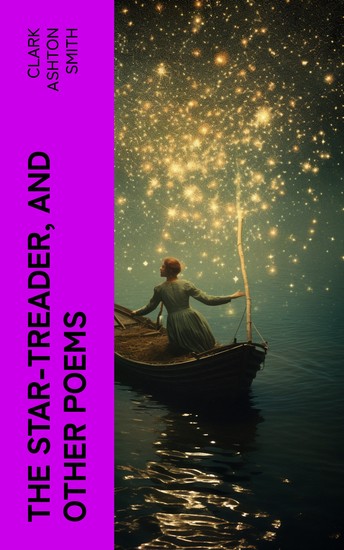
The Star-Treader and other poems - cover

The Star-Treader and other poems

Clark Ashton Smith

Maison d'édition: e-artnow

  • 0
  • 0
  • 0

Synopsis

This is a collection of poems written by Clark Ashton Smith, who achieved early local recognition, largely through the enthusiasm of George Sterling, for traditional verse in the vein of Swinburne. Featured titles in the book include 'Nero', 'Chant to Sirius', and 'The Morning Pool'.
Disponible depuis: 25/11/2023.
Longueur d'impression: 172 pages.

D'autres livres qui pourraient vous intéresser

  • Kojak - Five Star Final - cover

    Kojak - Five Star Final

    Arthur Korb

    • 0
    • 0
    • 0
    A dramatic performance by the Power Performance Players of one of Kojak's cases from the fictional files of the New York Police Department.
    Voir livre
  • The Thoughts - cover

    The Thoughts

    Sarah Barnsley

    • 0
    • 0
    • 0
    An assured and inventive debut, The Thoughts explores different manifestations of intrusive thoughts as part of obsessive-compulsive disorder (OCD) before navigating through the twists and turns of recovery and love. These poems inhabit therapists' treatment rooms, waiting rooms, and everyday documents, appearing in such varied forms as emails, research proposals and kids' puzzles. Compassionate and at times painfully humorous, The Thoughts is an act of advocacy, giving voice to critically underrepresented experiences of illness through poems that are as peculiar and creative as they are arresting.
    Voir livre
  • Folk Punk Literary Style - The Poetry of Pat ‘The Bunny’ Schneeweis AKA Johnny Hobo - cover

    Folk Punk Literary Style - The...

    Patrick Schneeweis

    • 0
    • 0
    • 0
    There are artists out there able to lift the spirits of the downtrodden, who point towards a better world with all they are. Sometimes, they do this in DIY punk style: raw, unplugged, and deeply human.Patrick Schneeweis, better known as Pat the Bunny, is an artist who chose the road less travelled, instinctively deeming it more honest and less controlling. Freer. He grew up in Vermont, where he found people liked his voice and the controversial topics he tackled, and by 16 years old, he had released his first album ‘Fire Hazard’.Pat had the courage to test his reality, and then nakedly vocalise it (in both the metaphorical and literal senses). His lyrics saw conflicting ideologies meet and fight to the death, in outlooks that were as captivating as his personal anecdotes were relatable. Pat’s journey offers direction to the lost, if only in the promise that so is he; and for all his youthful anarchism and burn-it-to-the-ground spiritedness, his commentary of the world is ironically sobering.Pat’s music career only spanned thirteen years, from 2003-2016. He reincarnated several times in different bands of his own making, and split albums with other folk-punk artists equally hungry to change the world. He fought like hell for a vision of peace, and made the battlegrounds his own state of consciousness.Like a flashfire burning everything in its wake, towards the end of his career, Pat’s had simmered down, but shoots of new life had sprung up from the ashes, a new direction for which his life could take.This book paints the picture of Pat’s fallings and risings, a final cadence before he left the punk scene behind him for good.
    Voir livre
  • Victory - cover

    Victory

    Fimalia McNoll

    • 0
    • 0
    • 0
    There was a time when I was falling, 
    My enemies surrounded me. 
    I was wounded and weary. 
    I felt so weak unable to fight anymore. 
    My eyes were dark and, 
    my strength was almost gone. 
    I prayed and cried out to God; I felt forsaken. 
    I was hurt and felt abandoned. 
    Then I reminded myself of his words 
    that he will never leave me. 
    I cried with my whole heart, 
    He heard me and save me from my enemies.
    Voir livre
  • Phantasmorgia - The writer of Alice In Wonderland in this spooky and comic poem explores our relationship with the otherworld - cover

    Phantasmorgia - The writer of...

    Lewis Carroll

    • 0
    • 0
    • 0
    Lewis Carroll was born Charles Lutwidge Dodgson on the 27th January 1832 at Daresbury, Cheshire, the eldest boy and the third child.  Another eight followed.   
     
    When Dodgson was 11, his cleric father moved his family to Croft-on-Tees in the North Riding of Yorkshire.  Although his father was active and highly conservative his son was ambivalent with those values and with the Church as a whole. 
     
    In his early years Dodgson was educated at home and by age 7 he was reading the likes of ‘The Pilgrim's Progress’.  He also spoke with a stammer which he called his ‘hesitation’. 
     
    At 12 he was dispatched to Richmond Grammar School in North Yorkshire and then on to Rugby.  He sailed through the curriculum.  He was accepted at Christ Church, Oxford but two days after arriving he was summoned home: his mother had died of ‘inflammation of the brain’ at only 47. 
     
    Dodgson was exceptionally gifted and, when not distracted, achievement came easily to him.  He remained at Christ Church studying and teaching in various capacities until his death. 
     
    In March 1856, he published the romantic poem ‘Solitude’ as by ‘Lewis Carroll’.  
     
    That same year he took up the new art of photography.  He soon excelled and became a well-known gentleman-photographer, and even toyed with the idea of making a living out of it.  When he ceased photography in 1880, he had his own studio and had created around 3,000 images. 
     
    He enjoyed moderate success with his early poems and short stories but had an array of other interests in the pre-Raphaelite circle, Psychical Research and even ordained in the Church of England in 1861.  
     
    In July 1862 he told a young Alice Liddell the story that would become his first and greatest success.  Alice begged him to write it down, and eventually he did and later presented her with a handwritten and illustrated ‘Alice's Adventures Under Ground’.  The publisher Macmillan agreed to publish it as ‘Alice's Adventures in Wonderland’ by Lewis Carroll.  
     
    It was a huge and sensational life-changing success.  Royalties quickly accumulated as did fan mail.  
     
    In 1871, the darker themed sequel ‘Through the Looking-Glass, and What Alice Found There’ was published.  A half decade later came ‘The Hunting of the Snark’, a fantastical nonsense poem, as nine tradesmen and a beaver set off to find the snark.  It was another enormous success. 
     
    He also loved to invent such delights as a writing tablet ‘the nyctograph’ that allowed note-taking in the dark as well as many word games, such as the precursor to ‘Scrabble’, and alternative systems of parliamentary voting.  Within the discipline of mathematics, he worked in geometry, linear and matrix algebra, mathematical logic, recreational mathematics and wrote nearly a dozen books on the subject.   
     
    Lewis Carroll died of pneumonia following influenza on 14th January 1898 in Guildford, Surrey.  He was 65.  
     
    01 - Phantasmagoria by Lewis Carroll - An Introduction 
    02 - Phantasmagoria -  Canto 1. The Trystyng by Lewis Carroll 
    03 - Phantasmagoria -  Canto 2. Hys Fyve Rules by Lewis Carroll 
    04 - Phantasmagoria -  Canto 3. Scarmoges by Lewis Carroll 
    05 - Phantasmagoria -  Canto 4. Hys Nouryture by Lewis Carroll 
    06 - Phantasmagoria -  Canto 5. Byckerment by Lewis Carroll 
    07 - Phantasmagoria -  Canto 6. Dyscomfyture by Lewis Carroll 
    08 - Phantasmagoria -  Canto 7. Sad Souvenaunce by Lewis Carroll
    Voir livre
  • 14 Days & 40 Years - The Little Trip & The Long Journey - cover

    14 Days & 40 Years - The Little...

    Natalie Anderson

    • 0
    • 0
    • 0
    Not all love is the same, which is one of the most peculiar truths in life. Your Love is as unique as the individual you feel it for. I think that’s one of the greatest paradoxes we will live through. It seems to me, there is little choice in how big it is, or how hard it hits. There’s no telling what it will do to you when you enter the arena, and that is why it can be a force we sometimes fight; because it has felt like a battle we’ve lost before. 
    Although it feels like you are powerless in Love, you aren’t powerless at the end of Love. You choose whether or not big Love crushes you, or if it shrinks for you to carry it in your pocket as a reminder of the greatness it once was. The desire to not be destroyed by Love is where I am. 
    This is a story of 14 days that coincided with my 40th birthday and a time I fell in Love. It was through a difficult turn of events that I got to step away from my uncomfortable life to experience turning 40 in Mexico; with someone I didn’t just love, but who I liked. So this is also a story about the importance of falling in Like. 
    For a long time I said if I ever shared this story, I’d have to call it fiction because it feels so personal. But eventually I realized it made more sense to just admit: it’s me. I’m the quiet naive girl in these pages who had barely begun to know herself and didn’t know how to communicate as well as she thought she did. I’m the one who was learning that Love can be complicated; while seeming simple to me. 
    One of the greatest lessons anyone learns, is knowing what it feels like to fall in love and experience connection. That was my greatest benefit; because I have been able to use that measure of connection ever since. One can break and fall apart in many ways, but it’s my opinion that until big love breaks you, a level of innocence remains. After that, you decide whether or not big love heals you. For me, it took this little trip of 14 days to finally benefit from the long journey of 40 years.
    Voir livre