Begleiten Sie uns auf eine literarische Weltreise!
Buch zum Bücherregal hinzufügen
Grey
Einen neuen Kommentar schreiben Default profile 50px
Grey
Jetzt das ganze Buch im Abo oder die ersten Seiten gratis lesen!
All characters reduced
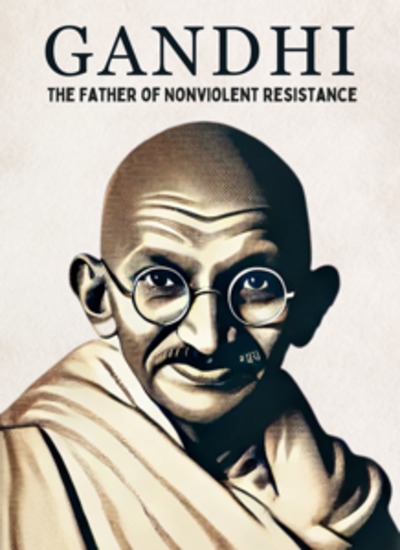
Gandhi: The Father of Nonviolent Resistance - Micro Book - C4 - Series Historical Figures Who Changed the World - cover

Gandhi: The Father of Nonviolent Resistance - Micro Book - C4 - Series Historical Figures Who Changed the World

Ciro Irmici

Verlag: Ciro Irmici

  • 0
  • 0
  • 0

Beschreibung

Mahatma Gandhi’s life was one of profound courage, unbreakable resolve, and unwavering faith in nonviolent resistance.

From his humble beginnings to his role as a global symbol of peace and justice, this book offers an in-depth exploration of Gandhi’s philosophy, his personal struggles, and his revolutionary approach to freedom and social change. “Gandhi: The Father of Nonviolent Resistance” delves into key events in Gandhi’s life, from his early experiments with truth in South Africa to the Salt March, his push for Indian independence, and his complex relationship with power and responsibility.

Perfect for history enthusiasts, social activists, and anyone seeking inspiration, this book provides a balanced view of Gandhi’s accomplishments, his limitations, and the enduring legacy of his teachings.

Readers will be moved by the humanity of a leader who believed that even the simplest acts could change the world. Discover the timeless wisdom of a man whose principles continue to guide social justice movements across the globe.
Verfügbar seit: 29.10.2024.
Drucklänge: 73 Seiten.

Weitere Bücher, die Sie mögen werden

  • The Illuminati – Real or Myth? - Uncovering the Truth Behind One of the World’s Most Mysterious Secret Societies - cover

    The Illuminati – Real or Myth? -...

    Alan Walsh

    • 0
    • 0
    • 0
    Does the Illuminati really exist, or is it just a legend fueled by speculation and fear? From hidden messages in popular culture to claims of world domination, the Illuminati has captured the imaginations of conspiracy theorists and historians alike. 
    This audiobook dives deep into historical records, conspiracy theories, and modern claims, unraveling the truth behind one of history’s most intriguing secret societies. Discover: 
    ✅ The true origins of the Bavarian Illuminati and its purpose 
    ✅ Theories linking the Illuminati to governments, corporations, and media control 
    ✅ Symbols, hidden messages, and connections to world events 
    ✅ Skeptical perspectives—why many experts believe the Illuminati is a myth 
    The Illuminati – Real or Myth? is a must-listen for history lovers, mystery seekers, and anyone fascinated by power, secrecy, and control.
    Zum Buch
  • Repeat - A Warning from History - cover

    Repeat - A Warning from History

    Dennis Glover

    • 0
    • 0
    • 0
    Are we seeing history repeat itself?
    An urgent, surprising and altogether persuasive read, Repeat: A Warning from History will open your eyes.
    We live in an age that seems eerily familiar. A time of dictators, populists, organised lying, European wars, grabs for territory, ideological extremism and antisemitism. A time when things are falling apart and the centre is struggling to hold. The insurrection on the Capitol in January 2021 evoked chilling memories of the calamity of Hitler in the 1920s and 30s. The world needs to learn the lessons of these decades, and fast. Dennis Glover retells the story of the interwar years in a series of lessons drawn from unfolding events and the unheeded omens of those who spoke out but were ignored.
    Zum Buch
  • Leadership from Bad to Worse - What Happens When Bad Festers - cover

    Leadership from Bad to Worse -...

    Barbara Kellerman

    • 0
    • 0
    • 0
    Leadership from Bad to Worse is about how leadership that is bad, invariably, inexorably, gets worse—unless it is somehow, by someone or something, stopped or slowed. 


    This work draws on four cases of bad leadership—two in political leadership, two in business leadership—to show how it goes from bad to worse. Kellerman finds that bad leadership and bad followership go through four phases of development: 1) Onward and Upward; 2) Followers Join In; 3) Leaders Start In; and 4) Bad to Worse. These findings correctly suggest that the book, in addition to being of theoretical interest, is of practical import. It is intended, deliberately, to serve as an early warning system. By breaking bad leadership and followership into phases—each more ominous and ultimately dangerous than the one preceding—their progression will be easier to predict and detect. And easier, therefore, to slow or, preferably, to stop before they turn toxic. 


    Bad leadership is a social disease. But unlike diseases that are physical or psychological, it remains at the margins of our collective concerns. Leadership from Bad to Worse is, then, a corrective. Knowing that bad leadership can be checked before it corrupts is knowing that bad and then worse can be, if not completely precluded, then sometimes short-circuited.
    Zum Buch
  • Ukraine and the Art of Strategy - cover

    Ukraine and the Art of Strategy

    Lawrence Freedman

    • 0
    • 0
    • 0
    The Russian invasion of Crimea in 2014, subsequent war in Eastern Ukraine, and economic sanctions imposed by the West transformed European politics. The conflict did not escalate to the levels originally feared but nor was either side able to bring it to a definitive conclusion. Ukraine suffered a loss of territory but was not forced into changing its policies away from the Westward course adopted as a result of the EuroMaidan uprising of February 2014. President Putin was left supporting a separatist enclave as Russia's economy suffered significant damage. 


    Ukraine and the Art of Strategy provides an account of the origins and course of the Russia-Ukraine conflict through the lens of strategy. Lawrence Freedman describes the development of President Putin's anxieties that former Soviet countries were being drawn towards the European Union, the effective pressure he put on President Yanokvych of Ukraine to turn away from the EU, and the resulting "EuroMaidan Revolution" which led to Yanukovych fleeing. He explores the reluctance of Putin to use Russian forces to do more that consolidate the insurgency in Eastern Ukraine, the failure of the Minsk peace process, and the limits of the international response. Putin's strategic-making is kept in view at all times, including his use of "information warfare" and attempts to influence the American election.
    Zum Buch
  • How to Steal a Presidential Election - cover

    How to Steal a Presidential...

    Lawrence Lessig, Matthew Seligman

    • 0
    • 0
    • 0
    From two distinguished experts on election law, an alarming look at how the American presidency could be stolen—by entirely legal means 
     
    Even in the fast and loose world of the Trump White House, the idea that a couple thousand disorganized protestors storming the U.S. Capitol might actually prevent a presidential succession was farfetched. Yet perfectly legal ways of overturning election results actually do exist, and they would allow a political party to install its own candidate in place of the true winner. 
     
    Lawrence Lessig and Matthew Seligman work through every option available for subverting a presumptively legitimate result—from vice-presidential intervention to election decertification and beyond. While many strategies would never pass constitutional muster, Lessig and Seligman explain how some might. They expose correctable weaknesses in the system, including one that could be corrected only by the Supreme Court. 
     
    Any strategy aimed at hacking a presidential election is a threat to democracy. This book is a clarion call to shore up the insecure system for electing the president before American democracy is forever compromised. 
     
    Lawrence Lessig is the Roy L. Furman Professor of Law and Leadership at Harvard Law School. Matthew Seligman is a fellow at the Constitutional Law Center at Stanford Law School and a partner at Stris & Maher LLP.
    Zum Buch
  • Understanding anarchism - cover

    Understanding anarchism

    Marcelino Viera, Maxime Foerster

    • 0
    • 0
    • 0
    What are the founding principles of anarchism? What links the philosophy of Proudhon, who introduced this notion in France in 1840, to the act of the Italian Sante Geronimo Caserio, who assassinated President Sadi Carnot in 1894?
    This introduction to anarchism helps us understand the issues and tensions that run through this movement, and to grasp why it could establish itself today as a response to the moral and economic crisis of contemporary societies.
    Zum Buch