Rejoignez-nous pour un voyage dans le monde des livres!
Ajouter ce livre à l'électronique
Grey
Ecrivez un nouveau commentaire Default profile 50px
Grey
Abonnez-vous pour lire le livre complet ou lisez les premières pages gratuitement!
All characters reduced
Wireless Radio Origins - cover

Wireless Radio Origins

Christopher Miller

Traducteur A AI

Maison d'édition: Publifye

  • 0
  • 0
  • 0

Synopsis

Wireless Radio Origins explores the fascinating beginnings of wireless radio, detailing its evolution from scientific curiosity to a cornerstone of modern communication. The book emphasizes that radio's development wasn't a singular invention but a series of incremental innovations. Early pioneers grappled with the physics of electromagnetic waves, a concept first theorized by James Clerk Maxwell, and later validated by Heinrich Hertz's experiments. Understanding these principles was crucial for inventors like Guglielmo Marconi, who achieved transatlantic transmissions, and Reginald Fessenden, who advanced continuous wave radio.

 
The book progresses chronologically, starting with the theoretical foundations laid by Maxwell and Hertz. It then transitions to the practical applications and breakthroughs achieved by Marconi and Fessenden. Finally, it examines the early commercialization of radio and its initial societal impact.

 
By examining original scientific papers, patent filings, and biographical accounts, Wireless Radio Origins provides a comprehensive look at the technological and social landscape that shaped early radio development. This historical analysis offers valuable insights into how technological innovation unfolds, emphasizing collaboration and iterative refinement.
Disponible depuis: 31/03/2025.
Longueur d'impression: 65 pages.


D'autres livres qui pourraient vous intéresser

  • Learn French while you sleep - 1000 phrases for beginners - cover

    Learn French while you sleep -...

    1000-words.com

    • 0
    • 0
    • 0
    This audiobook is narrated by an AI Voice.   
    Learn French anytime, anywhere — while you sleep, drive, walk, study, or work out.  
    1000 Words is your calm and immersive way to master French through audio.  
    Each episode helps you expand your vocabulary, improve pronunciation, and understand real French — without stress, screens, or interruptions.  
    In this audiobook, you’ll hear 1000 essential French phrases for beginners, clearly spoken with English translations.  
    Perfect for beginners, travelers, and language lovers who want to absorb French naturally through repeated listening.  
    Listen in bed, at the gym, in the car, or during your daily routine — every minute helps you grow your French effortlessly.  
    🌙 Relax. Focus. Learn French anywhere.  
    For more content, games and exclusive video lessons, visit 👉 ⁠1000-words.com⁠.
    Voir livre
  • The Sacred Way - cover

    The Sacred Way

    Stephen L. Robertson

    • 0
    • 0
    • 0
    The Sacred Way is not a map. It is not a method. It is a transmission. 
      
    In this companion to The Sacred Choice, Stephen L. Robertson offers a luminous reflection for the soul ready to embody what it has already remembered. Drawing from mystical insight, spiritual awakening, and the quiet wisdom of stillness, The Sacred Way invites readers beyond the threshold of realization—into a life of integration, gentleness, and divine simplicity. 
      
    This masterwork does not teach—it mirrors. Through poetic clarity and sacred resonance, it unveils the quiet radiance of what happens after the spark: when ego dissolves, when becoming ends, and when the flame no longer flickers but simply burns. 
      
    You are not searching anymore. 
    You are becoming the field. 
      
    This is not the beginning of your journey. 
    This is the return.
    Voir livre
  • Cheka The: The History of the Soviet Agency that Eventually Became the KGB - cover

    Cheka The: The History of the...

    Editors Charles River

    • 0
    • 0
    • 0
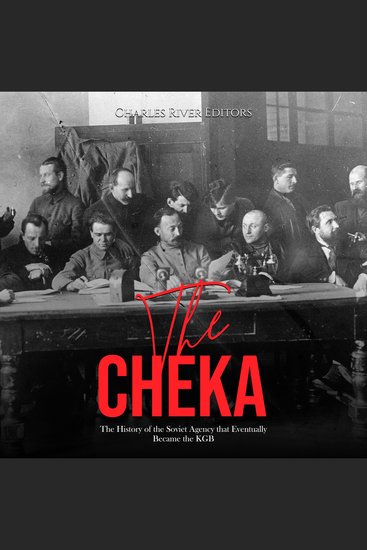
    The KGB is one of the most famous abbreviations of the 20th century, and it has become synonymous with the shadowy and often violent actions of the Soviet Union’s secret police and internal security agencies. In fact, it is often used to refer to the Soviet state security agencies throughout its history, from the inception of the inception of the Cheka (Extraordinary Commission) in 1917 to the official elimination of the KGB in 1992. Whether it’s associated with the Russian Civil War’s excesses, Stalin’s purges, and even Vladimir Putin, the KGB has long been viewed as the West’s biggest bogeyman during the second half of the 20th century. 
    	However, the KGB did not appear out of thin air. Naturally, the earliest Soviet leaders utilized intelligence agencies that collected information both abroad and within the Soviet Union, targeting foreign opponents and domestic opponents alike. Lenin did not imagine the scale of the opposition he would have to face after the revolution, and he quickly came to the conclusion that "a special system of organized violence" must be created to implement the dictatorship of the proletariat. 
    	Thus, from nearly the beginning of the Bolshevik takeover of Russia, Lenin and his successors established and relied on a particularly ruthless agency: the All-Russian Extraordinary Commission for Combating Counter-Revolution and Sabotage, later abbreviated to the Extraordinary Commission. Known colloquially as the Cheka (Extraordinary Commission), it soon became as feared by non-socialists as the Tsar’s secret police had ever been. The main means approved by the Council of People's Commissars on December 20, 1917, which the Cheka had to use to fight the counter-revolution, were "seizure of property, resettlement, deprivation of cards, publication of lists of enemies of the people, etc."
    Voir livre
  • The Joyful Wisdom - cover

    The Joyful Wisdom

    Friedrich Nietzsche

    • 0
    • 0
    • 0
    "The Joyful Wisdom," written in 1882, just before "Zarathustra," is rightly judged to be one of Nietzsche's best books. Here the essentially grave and masculine face of the poet-philosopher is seen to light up and suddenly break into a delightful smile. The warmth and kindness that beam from his features will astonish those hasty psychologists who have never divined that behind the destroyer is the creator, and behind the blasphemer the lover of life. In the retrospective valuation of his work which appears in "Ecce Homo" the author himself observes with truth that the fourth book, "Sanctus Januarius," deserves especial attention: "The whole book is a gift from the Saint, and the introductory verses express my gratitude for the most wonderful month of January that I have ever spent." Book fifth "We Fearless Ones," the Appendix "Songs of Prince Free-as-a-Bird," and the Preface, were added to the second edition in 1887.
    Voir livre
  • Applied Polyvagal Theory in Yoga - Therapeutic Practices for Emotional Health - cover

    Applied Polyvagal Theory in Yoga...

    Arielle Schwartz, Amy Weintraub

    • 0
    • 0
    • 0
    Treat trauma holistically with the combined applications of yoga and polyvagal theory. 


    This book focuses on the intersection of polyvagal theory, yoga, and psychotherapy by weaving together the wisdom tradition of yoga with neuroscience, attachment theory, somatic psychology, and traumatology. The application of polyvagal theory allows practitioners to compassionately support growth by enhancing the health of the autonomic nervous system, while therapeutic yoga allows one to attend to the interrelationships between mind, emotions, physiology, and behavior. 


    Applied polyvagal theory in yoga provides conscious breathing, vagal toning, mindful movement, and meditation practices that aid in rewiring the nervous system. Listeners will discover how to help both clients and themselves cultivate a felt sense of ease during times of safety; enhance their capacity to handle challenges with equanimity; and reclaim their ability to recover from stress swiftly and efficiently. Applied Polyvagal Theory in Yoga offers practitioners a new and effective way to support clients who are stuck in a trauma response mode.
    Voir livre
  • The Civic Bargain - How Democracy Survives - cover

    The Civic Bargain - How...

    Josiah Ober, Brook Manville

    • 0
    • 0
    • 0
    A powerful case for democracy and how it can adapt and survive—if we want it to 


    Is democracy in trouble, perhaps even dying? Pundits say so, and polls show that most Americans believe that their country's system of governance is being "tested" or is "under attack." But is the future of democracy necessarily so dire? In The Civic Bargain, Brook Manville and Josiah Ober push back against the prevailing pessimism about the fate of democracy around the world. Instead of an epitaph for democracy, they offer a guide for democratic renewal, calling on citizens to recommit to a "civic bargain" with one another to guarantee civic rights of freedom, equality, and dignity. That bargain also requires them to fulfill the duties of democratic citizenship: governing themselves with no "boss" except one another, embracing compromise, treating each other as civic friends, and investing in civic education for each rising generation. 


    Manville and Ober trace the long progression toward self-government through four key moments in democracy's history: Classical Athens, Republican Rome, Great Britain's constitutional monarchy, and America's founding. Comparing what worked and what failed in each case, they draw out lessons for how modern democracies can survive and thrive.
    Voir livre