Rejoignez-nous pour un voyage dans le monde des livres!
Ajouter ce livre à l'électronique
Grey
Ecrivez un nouveau commentaire Default profile 50px
Grey
Abonnez-vous pour lire le livre complet ou lisez les premières pages gratuitement!
All characters reduced
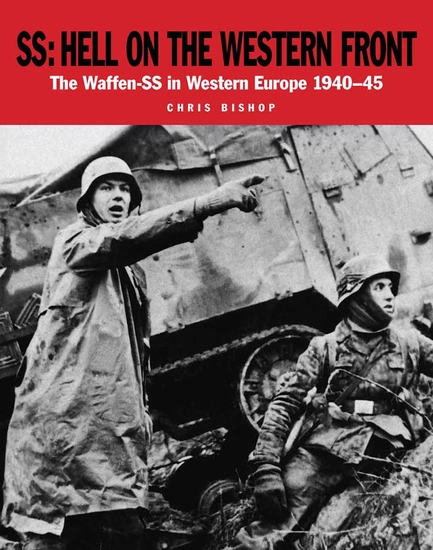
SS: Hell On The Western Front - cover

SS: Hell On The Western Front

Chris Bishop

Maison d'édition: Amber Books Ltd

  • 0
  • 0
  • 0

Synopsis

SS: Hell on the Western Front describes in vivid detail the exploits of the Waffen-SS in Western Europe from 1940 to 1945. The book begins with the formation of the Waffen-SS and its growth and development into a combat arm. The successes of 1940 are examined, as the SS troopers swept all opposition before them, as is the darker side of the organization, with the first atrocities committed against Allied prisoners. SS: Hell on the Western Front features the actions of such famous Waffen-SS divisions as the Leibstandarte Adolf Hitler, Das Reich, Hitlerjugend and Totenkopf, and provides an insight into how these ideologically motivated units consistently outfought the Allies, even when seriously disadvantaged due to lack of fuel or air support. Illustrated with rare photographs, this text is a thorough study of the Waffen-SS in the western theatre.
Disponible depuis: 24/05/2023.
Longueur d'impression: 192 pages.

D'autres livres qui pourraient vous intéresser

  • Indochina Hand - Tales of a CIA Case Officer - cover

    Indochina Hand - Tales of a CIA...

    Barry Michael Broman

    • 0
    • 0
    • 0
    Barry Broman joined the CIA in 1971 straight out of the Marine Corps, choosing a career in intelligence largely because he wanted to spend his working life in Southeast Asia. Over the next thirty years, he had the privilege of working with brave men and women who were prepared to put their lives on the line in support of the free world during the Cold War, and he enjoyed the life of adventure he had been seeking since childhood. 


    This book brings together tales from his career as a CIA case officer during the Cold War, giving fascinating insights into handling double agents, working in denied areas, assessing and recruiting Soviet targets, flying with Air America, acting to discredit Soviet agents with Moscow, and what happened when a case officer sets a "scavenger hunt" around Bangkok for fellow spies—and at least one active target. 


    A selection of stories told in engaging style proving that often the truth is more unbelievable than fiction.
    Voir livre
  • Symposium - cover

    Symposium

    Plato

    • 0
    • 0
    • 0
    Symposium is a philosophical text written by the ancient Greek philosopher Plato, believed to have been composed in the late 4th century BCE. The book is a dialogue between a group of distinguished Athenians, who have gathered together to discuss the nature of love and beauty. 
    The dialogue takes place during a symposium, or dinner party, hosted by the tragedian Agathon. The guests, including Socrates, Aristophanes, and Alcibiades, take turns giving speeches in praise of love, each offering their own unique perspective on the subject. 
    Throughout the text, Plato explores the nature of love and its role in human life, examining the ways in which it can inspire us to reach for greater heights of knowledge and understanding, while also causing us great pain and suffering. The speeches given by the various characters in the text are rich with symbolism and metaphor, and offer a wide range of interpretations and insights into the nature of love. 
    At its core, Symposium is a meditation on the human condition, and the ways in which we grapple with our own mortality and the limitations of our existence. Through its exploration of love and beauty, the book offers a profound reflection on the nature of human experience, and the search for meaning and purpose in our lives.
    Voir livre
  • Ordinary People Don't Carry Machine Guns - Thoughts on War - cover

    Ordinary People Don't Carry...

    Artem Chapeye

    • 0
    • 0
    • 0
    In Ordinary People Don't Carry Machine Guns, Artem Chapeye reveals his war, intimate and senseless, withholding nothing about his motivations, his nightmares, his new relationship with the world. Here one man, a pacifist turned fighter, a story writer turned soldier considers the reasons for and reactions to war on a very personal level. 


    Chapeye investigates his role in the Ukrainian people's defense against the Russian army and his responsibilities as a father, a writer, a soldier, and a man of conviction. An avowed pacifist until 2022, Chapeye joined the Ukrainian army in the first days of the invasion. He tries to understand the large-scale decision-making that has a defining impact on both individual citizens and society-at-large: many of his fellow soldiers never considered enlisting before finding themselves at war; others fled the country. He wonders what his young children at home are doing and what they're feeling. 


    The book has three parts, offering historical analogies and literary references throughout. Deeply thought-provoking, intelligent, and heartbreaking, this is an essential book for anyone who wants to understand the ways that war can change everything.
    Voir livre
  • May Contain Lies - How Stories Statistics and Studies Exploit Our Biases And What We Can Do About It - cover

    May Contain Lies - How Stories...

    Alex Edmans

    • 0
    • 0
    • 0
    Our lives are minefields of misinformation. It ripples through our social media feeds, our daily headlines, and the pronouncements of politicians, executives, and authors. Stories, statistics, and studies are everywhere, allowing people to find evidence to support whatever position they want. Many of these sources are flawed, yet by playing on our emotions and preying on our biases, they can gain widespread acceptance, warp our views, and distort our decisions. 


    In this eye-opening book, renowned economist Alex Edmans teaches us how to separate fact from fiction. Using colorful examples—from a wellness guru's tragic but fabricated backstory to the blunders that led to the Deepwater Horizon disaster to the diet that ensnared millions yet hastened its founder's death—Edmans highlights the biases that cause us to mistake statements for facts, facts for data, data for evidence, and evidence for proof. 


    Armed with the knowledge of what to guard against, he then provides a practical guide to combat this tide of misinformation. Going beyond simply checking the facts and explaining individual statistics, Edmans explores the relationships between statistics—the science of cause and effect—ultimately training us to think smarter, sharper, and more critically.
    Voir livre
  • Hope and Fear - Modern Myths Conspiracy Theories and Pseudo History - cover

    Hope and Fear - Modern Myths...

    Ronald H. Fritze

    • 0
    • 0
    • 0
    A myth-busting journey through the twilight world of fringe ideas and alternative facts. 


    Is a secret and corrupt Illuminati conspiring to control world affairs and bring about a New World Order? Was Donald Trump a victim of massive voter fraud? Is Elizabeth II a shapeshifting reptilian alien? Who is doing all this plotting? 


    In Hope and Fear, Ronald H. Fritze explores the fringe ideas and conspiracy theories people have turned to in order to make sense of the world around them, from myths about the Knights Templar and the Ten Lost Tribes of Israel, to Nazis and the occult, the Protocols of Zion and UFOs. As Fritze reveals, when conspiracy theories, myths, and pseudo-history dominate a society's thinking, facts, reality, and truth fall by the wayside.
    Voir livre
  • Answer to the Question An: What is Enlightenment? - cover

    Answer to the Question An: What...

    Immanuel Kant

    • 0
    • 0
    • 0
    "Answering the Question: What Is Enlightenment?" is a 1784 essay by the philosopher Immanuel Kant. In the December 1784 publication of the Berlinische Monatsschrift (Berlin Monthly), edited by Friedrich Gedike and Johann Erich Biester, Kant replied to the question posed a year earlier by the Reverend Johann Friedrich Zöllner, who was also an official in the Prussian government. Zöllner's question was addressed to a broad intellectual public community, in reply to Biester's essay entitled: "Proposal, not to engage the clergy any longer when marriages are conducted" (April 1783) and a number of leading intellectuals replied with essays, of which Kant's is the most famous and has had the most impact. Kant's opening paragraph of the essay is a much-cited definition of a lack of enlightenment as people's inability to think for themselves due not to their lack of intellect, but lack of courage.
    Kant's essay also addressed the causes of a lack of enlightenment and the preconditions necessary to make it possible for people to enlighten themselves. He held it necessary that all church and state paternalism be abolished and people be given the freedom to use their own intellect. Kant praised Frederick II of Prussia for creating these preconditions. Kant focused on religious issues, saying that "our rulers" had less interest in telling citizens what to think in regard to artistic and scientific issues.
    Voir livre