Rejoignez-nous pour un voyage dans le monde des livres!
Ajouter ce livre à l'électronique
Grey
Ecrivez un nouveau commentaire Default profile 50px
Grey
Abonnez-vous pour lire le livre complet ou lisez les premières pages gratuitement!
All characters reduced
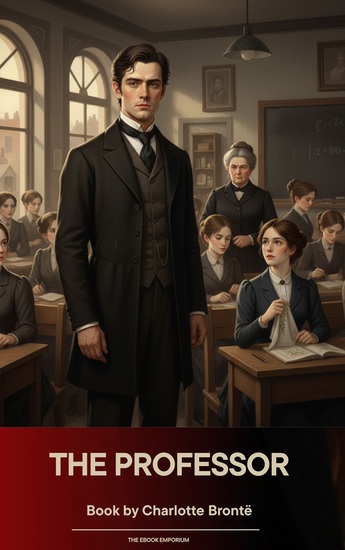
The Professor - cover

The Professor

Charlotte Brontë

Maison d'édition: The Ebook Emporium

  • 0
  • 0
  • 0

Synopsis

"I am no fixed star, but a comet rolling through space, and I must roll on until I find my orbit."

Before the fire of Jane Eyre or the sweep of Shirley, Charlotte Brontë crafted this understated masterpiece of psychological realism. William Crimsworth, a young man of integrity and modest means, rejects the oppressive world of his aristocratic relatives and the soul-crushing labor of his brother's counting-house. Seeking a new life, he travels to Belgium to take up a post as a professor in a boys' school—only to find himself entangled in the complex social and romantic webs of a Brussels pensionnat.

The Search for Sincerity: Unlike the sweeping melodramas of the era, The Professor focuses on the grit of the everyday. Brontë masterfully explores William's rivalry with the manipulative M. Pelet and his attraction to the headmistress, Mlle. Reuter. However, the true heart of the novel is his blossoming connection with Frances Henri, a humble lace-maker and pupil-teacher. Their bond is built on mutual respect and shared intellect, offering a rare Victorian look at egalitarian love.

A First Look at a Genius: Drawing directly from Brontë's own time at the Pensionnat Héger, The Professor serves as a fascinating precursor to Villette. It is a story of self-reliance and the immigrant experience, told with a masculine narrative voice that showcases Brontë's versatility. For readers who appreciate literature that values character over spectacle, this novel offers a profound look at the quiet dignity of finding one's place in the world.

Experience the foundational voice of a literary icon. Purchase "The Professor" today and discover the origin of the Brontë legacy.
Disponible depuis: 05/01/2026.
Longueur d'impression: 294 pages.

D'autres livres qui pourraient vous intéresser

  • The Tragedy of Julius Caesar - cover

    The Tragedy of Julius Caesar

    William Shakespeare

    • 0
    • 0
    • 0
    The Tragedy of Julius Caesar is a history play and tragedy by William Shakespeare first performed in 1599. It is one of several plays written by Shakespeare based on true events from Roman history, such as Coriolanus and Antony and Cleopatra.
    Set in Rome in 44 BC, the play depicts the moral dilemma of Brutus as he joins a conspiracy led by Cassius to murder Julius Caesar to prevent him from becoming dictator of Rome. Following Caesar's death, Rome is thrust into a period of civil war, and the republic the conspirators sought to preserve is lost forever.
    Although the play is named Julius Caesar, Brutus speaks more than four times as many lines as the title character; and the central psychological drama of the play focuses on Brutus' struggle between the conflicting demands of honour, patriotism, and friendship. 
    Among the most significant works William Shakespeare: Hamlet, Othello, King Lear, Macbeth, Orpheus, Romeo and Juliet, Julius Caesar, Troilus and Cressida, The Tempest, Venus and Adonis, Antony and Cleopatra, Measure for Measure, The Winter's Tale and many more.
    Voir livre
  • Bobok - From their pens to your ears genius in every story - cover

    Bobok - From their pens to your...

    Fyodor Dostoyevsky

    • 0
    • 0
    • 0
    Fyodor Mikhailovich Dostoyevsky was born in Moscow on 11th November, 1821 to distinguished multi-ethnic parents from a Lithuanian background.  
    His childhood years were at the family home in hospital grounds which also contained an orphanage, an insane asylum and a cemetery for criminals.  The young Fyodor often disobeyed his father by talking to the ill in the hospital gardens.   
    His health was compromised at age 9 when he experienced his first epileptic fit. By the time he was a teenager both parents had died and he was now enrolled in a military academy where he graduated and eventually became a Lieutenant in 1842.  He left military service the next year. 
    In 1846 he published his first novel ‘Poor Cow’ to great literary acclaim.  His next was unable to emulate that success but his short stories helped provide an income.  Life as an author was definitely difficult. As he began his next work he was arrested and incarcerated for treason and participation in the political and literary Petrashevsky Circle. Although the case was weak and unjustified he was sentenced to 4 years of hard labour followed by 5 years of military service in a Siberian regiment.  
    Despite the undoubted hardships and setbacks in his life, and whether they helped or hindered his writing, his talents produced many exceptional works of literature including ‘Crime and Punishment’, ‘The Idiot’ and ‘The Brothers Karamazov’.   
    Dostoevsky’s ability to get under the skin of his characters and show the inner workings of their mind was hugely influential and ahead of its time.  Interwoven with this was the influence of the broader social, spiritual and political forces at work in a person's psyche.   
    Fyodor Dostoevsky struggled financially and remained in poor health for much of his adult life.  He died from a lung haemorrhage on 9th February, 1881.
    Voir livre
  • The Wonderful Wizard Of Oz - cover

    The Wonderful Wizard Of Oz

    L. Frank Baum

    • 0
    • 0
    • 0
    A classic children's novel written by L. Frank Baum. The story follows the adventures of a young girl named Dorothy, who is swept away from her home in Kansas by a tornado and transported to the magical Land of Oz. With the help of her new friends, Dorothy embarks on a quest to meet the Wizard of Oz and find her way back home. Filled with colorful characters, fantastical creatures, and imaginative settings, The Wonderful Wizard of Oz is a timeless tale of friendship, courage, and self-discovery. • A timeless classic. • Enchanting characters. • Baum's imaginative world-building creates a fantastical and immersive setting. • Remains a cultural touchstone that continues to inspire and delight readers of all ages. • Imparts valuable lessons to readers.
    Voir livre
  • War and Peace (Book Nine: 1812) - cover

    War and Peace (Book Nine: 1812)

    Leo Tolstoy

    • 0
    • 0
    • 0
    War and Peace is a literary work mixed with chapters on history and philosophy by the Russian author Leo Tolstoy. It was first published serially, then published in its entirety in 1869. It is regarded as one of Tolstoy's finest literary achievements and remains an internationally praised classic of world literature.
    Book 9: 1812: From the close of the year 1811 an intensified arming and concentrating of the forces of Western Europe began, and in 1812 these forces millions of men, reckoning those transporting and feeding the army moved from the west eastwards to the Russian frontier, toward which since 1811 Russian forces had been similarly drawn.
    Voir livre
  • History of Herodotus The - Book 8: Urania (Unabridged) - cover

    History of Herodotus The - Book...

    Herodotus, George Rawlinson

    • 0
    • 0
    • 0
    One of the masterpieces of classical literature, the "Histories" describes how a small and quarrelsome band of Greek city states united to repel the might of the Persian empire. But while this epic struggle forms the core of his work, Herodotus' natural curiosity frequently gives rise to colorful digressions - a description of the natural wonders of Egypt; an account of European lake-dwellers; and far-fetched accounts of dog-headed men and gold-digging ants. With its kaleidoscopic blend of fact and legend, the "Histories" offers a compelling Greek view of the world of the fifth century BC.
    BOOK 8: URANIA: The Greeks engaged in the sea-service were the following. The Athenians
    furnished a hundred and twenty-seven vessels to the fleet, which were manned in part by the Plataeans, who, though unskilled in such matters, were led by their active and daring spirit to undertake this duty.
    Voir livre
  • Gooseberries - From their pens to your ears genius in every story - cover

    Gooseberries - From their pens...

    Anton Chekhov

    • 0
    • 0
    • 0
    Anton Pavlovich Chekhov was born on 29th January 1860 in Taganrog, on the south coast of Russia.  
    His family life was difficult; his father was strict and over-bearing but his mother was a passionate story-teller, a subject Chekhov warmed to. As he later said; ‘our talents we got from our father, but our soul from our mother’.  
    At school Chekhov was distinctly average. At 16 his father mis-managed his finances and was declared bankrupt. His family fled to Moscow. Chekhov remained and eked out a living by various means, including writing and selling short sketches to newspapers, to finish his schooling. That completed and with a scholarship to Moscow University obtained he rejoined his family. 
    He was able to help support them by selling satirical sketches and vignettes of Russian lifestyles and gradually obtained further commissions. In 1884, he qualified as a physician and, although it earned him little, he often treated the poor for free, he was fond of saying ‘Medicine is my lawful wife, and literature is my mistress.’ 
    His own health was now an issue as he began to cough up blood, a symptom of tuberculosis.  Despite this his writing success enabled him to move the family into more comfortable accommodation.  
    Chekhov wrote over 500 short stories which included many, many classics including ‘The Kiss’ and ‘The Lady with a Dog’.  His collection ‘At Dusk’ won him the coveted Pushkin Prize when was only 26.  
    He was also a major playwright beginning with the huge success of ‘Ivanov’ in 1887.   
    In 1892 Chekhov bought a country estate north of Moscow. Here his medical skills and money helped the peasants tackle outbreaks of cholera and bouts of famine. He also built three schools, a fire station and a clinic.  It left him with less time for writing but the interactions with real people gained him detailed knowledge about the peasantry and their living conditions for his stories.  
    His most famous work, ‘The Seagull’ was received disastrously at its premiere in St Petersburg. It was later restaged in Moscow to highlight its psychological aspects and was a huge success. It led to ‘Uncle Vanya’, ‘The Three Sisters’ and ‘The Cherry Orchard’.  
    Chekhov suffered a major lung hemorrhage in 1897 while visiting Moscow. A formal diagnosis confirmed tuberculosis and the doctors ordered changes to his lifestyle.  
    Despite a dread of weddings the elusive literary bachelor quietly married the actress Olga Knipper, whom he had met at rehearsals for ‘The Seagull’, on 25th May 1901. 
    By May 1904 with his tuberculosis worsening and death imminent he set off for the German town of Badenweiler writing cheerful, witty letters to his family and assuring them his health was improving.  
    On 15th July 1904 Anton Chekhov died at Badenweiler.  He was 44.
    Voir livre