Rejoignez-nous pour un voyage dans le monde des livres!
Ajouter ce livre à l'électronique
Grey
Ecrivez un nouveau commentaire Default profile 50px
Grey
Abonnez-vous pour lire le livre complet ou lisez les premières pages gratuitement!
All characters reduced
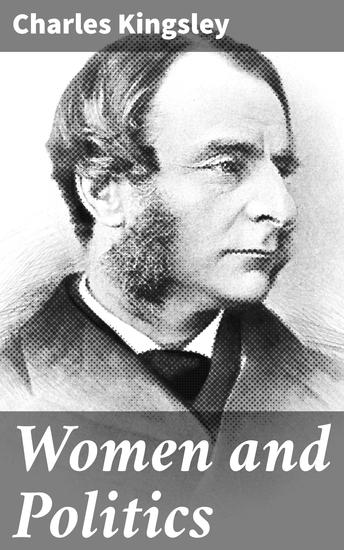
Women and Politics - Challenging Gender Norms in Political Discourse - cover

Women and Politics - Challenging Gender Norms in Political Discourse

Charles Kingsley

Maison d'édition: Good Press

  • 0
  • 0
  • 0

Synopsis

In "Women and Politics," Charles Kingsley presents a compelling examination of the intersection between gender and political agency in the 19th century. Kingsley utilizes a blend of passionate rhetoric and nuanced argumentation to challenge contemporary societal norms that restrict women's roles in public life. The book is situated within the context of the Victorian era, characterized by a burgeoning discourse on women's rights, and employs a didactic literary style that incorporates both poetic language and persuasive prose, aiming to awaken a sense of civic duty among women and inspire political activism. As a noted Victorian author, historian, and social reformer, Charles Kingsley'Äôs commitment to social justice and his engagement with progressive movements reflect the broader currents of his time. His awareness of the disparities faced by women'Äîexemplified by his involvement in various reformist causes'Äîserved as a catalyst for writing this book. Kingsley'Äôs perspective is rooted in his belief that women possess the intellectual capacity and moral authority to shape political landscapes, making his arguments both forward-thinking and revolutionary for the era. "Women and Politics" is essential reading for scholars, activists, and anyone interested in the historical foundations of feminism and political thought. Kingsley's work invites contemporary readers to reflect on ongoing dialogues around gender equality and encourages a re-examination of the role that women can and should play in shaping democratic governance.
Disponible depuis: 22/08/2023.
Longueur d'impression: 17 pages.

D'autres livres qui pourraient vous intéresser

  • Recessional - The Death of Free Speech and the Cost of a Free Lunch - cover

    Recessional - The Death of Free...

    David Mamet

    • 0
    • 0
    • 0
    NEW YORK TIMES BESTSELLER! 
    “Savagery appeased can only grow. Once you give in to it, it must escalate, like a fire searching for air.” 
    The man who won the Pulitzer Prize for GLENGARRY GLEN ROSS, who wrote the classic films THE VERDICT and WAG THE DOG sounds his alarm about the Visigoths at our gates. 
    In RECESSIONAL he calls out, skewers, mocks, and, most importantly, dissects the virus of conformity which is now an existential threat to the West. 
    A broad-ranging journey through history, the Bible, and literature, RECESSIONAL examines how politics and cultural attitudes about rebellion have shifted in the United States in the last generation. By screaming down freedom of thought and expression, Mamet explains, we kill invention and democracy – the foundations of security and growth. 
    A wickedly funny, wistful and wry appeal to the free-thinking citizen, RECESSIONAL is a vital warning that if we don’t confront the cultural thuggery now, the commissars and their dupes will transform the Land of the Free into the dictatorship at which they aim.
    Voir livre
  • How Does Change Happen? - Scenes from the Frontlines of Activism - cover

    How Does Change Happen? - Scenes...

    Sam Gonçalves

    • 0
    • 0
    • 0
    Mass protests and direct action have been familiar tactics against the many crises of the 21st century. Though methods vary, there's a collective longing for meaningful and transformative action. Some are deemed too weak, others too disruptive: from Instagram tiles to cans of soup thrown on famous paintings.
    Through conversations with activists and organisers, Sam Gonçalves recounts stories of protest and the fight for change, from a community of landless workers in Southern Brazil, to chefs unionising their workplace in Glasgow, Scotland. These narratives reveal the opportunities and challenges that are part of the difficult work of creating change, a wrestling with the question: how does change happen?
    Having a 'positive impact' in the world is often relegated to the 'personal', an individual endeavour. Gonçalves investigates that assumption and explores ways communities have resisted collectively, and fought against the individualising forces surrounding them.
    Voir livre
  • Second Treatise of Government: Book Summary & Analysis - cover

    Second Treatise of Government:...

    Briefly Summaries

    • 0
    • 0
    • 0
    This is a concise summary and analysis of Second Treatise of Government, by John Locke.
     
    It is not the original book and is not affiliated with or endorsed by John Locke.
     
    Ideal those seeking a quick and insightful overview.
     
    A foundational work in political philosophy and the Enlightenment, this text outlines a vision of a just and free society rooted in natural rights and the social contract. It argues for the legitimacy of government derived from the consent of the governed and provides a compelling case for individual liberty, property rights, and the rule of law. With its enduring influence on modern democratic systems, this work remains essential reading for understanding the principles of freedom and governance.
    Voir livre
  • The Conquest of Bread - cover

    The Conquest of Bread

    Peter Kropotkin

    • 0
    • 0
    • 0
    The Conquest of Bread  is an 1892 book by the Russian anarcho-communist Peter Kropotkin.
    Peter Kropotkin was born a Russian prince whose father owned 1,200 serfs. But he became  a Russian activist, writer, revolutionary, scientist, economist, sociologist, historian, essayist, researcher, political scientist, biologist, geographer  and philosopher.
    The Conquest of Bread has become a classic of political anarchist literature. It was heavily influential on both the Spanish Civil War and the Occupy movement.
    In the work, Kropotkin goes on to propose a more decentralized economic system based on mutual aid and voluntary cooperation, asserting that the tendencies for this kind of organization already exist, both in evolution and in human society.
    Voir livre
  • From Enlightenment To Revolution - Pitt Burke & Robespierre 1766-1794 - cover

    From Enlightenment To Revolution...

    Maximillian Robespierre, Edmund...

    • 0
    • 0
    • 0
    History is often concentrated into short bursts of change, with long periods of shifting before and waves of alteration afterwards. Nowhere is this more obvious than the thirty year interregnum between the Enlightenment and the Industrial Revolution. In this period, three figures stand tall; Pitt, the elder stateman who saw the need for genuine constitutionalism; Burke, the consummate parliamentarian, speaking for the glory of empire; and Robespierre, the legendary and controversial frontman of the French Revolution.William Pitt The Elder speaks about the need for key changes to the body politic. The first speech here predates the interregnum, being from 1738, when he was merely thirty, and covers a key factor in Britain’s colonial problems for the next two centuries, being the complete internal corruption of the army.Edmund Burke represents the height of Royalist sympathy as the age of revolution gets underway. He speaks on the need for conciliation with America after the disaster of the Stamp Act and revolution, on the need to punish Warren Hastings for treating his Asian holdings as his own empire to fill with his own corruption, and on the end of an era with the passing of Marie Antoinette.Finally, the age of revolution, both industrial and political, has begun. Robespierre argues for the dignity of man; for rejecting the divinity of royal authority in favour of that of the human spirit; against the death penalty, as being below the dignity of a truly humanist state; on enemies, internal and external, who push the people to reject their own interests for those of the powerful. This is but a small selection of the man’s incredible output - in 1791 alone, he gave three hundred and twenty-eight speeches.Spitting bile and flame in his last speech, which closes this volume, Robespierre truly inaugurates the era when revolution against centuries-old powers brought their end, and their nations found their renewal.
    Voir livre
  • To the Person Sitting in Darkness - cover

    To the Person Sitting in Darkness

    Mark Twain

    • 0
    • 0
    • 0
    “The Person Sitting in Darkness” by Mark Twain is a searing political satire that exposes the hypocrisy and brutality of imperialism at the turn of the 20th century. With his signature wit and razor-sharp critique, Twain challenges the moral justifications used by Western powers—especially the United States—in their global conquests. Written in 1901, this provocative essay attacks the exploitation of weaker nations under the guise of civilization and religion, making it as relevant today as it was over a century ago. A must-read for fans of political commentary, anti-imperialist literature, and Twain’s bolder, less-publicized works.
    Voir livre