Rejoignez-nous pour un voyage dans le monde des livres!
Ajouter ce livre à l'électronique
Grey
Ecrivez un nouveau commentaire Default profile 50px
Grey
Abonnez-vous pour lire le livre complet ou lisez les premières pages gratuitement!
All characters reduced
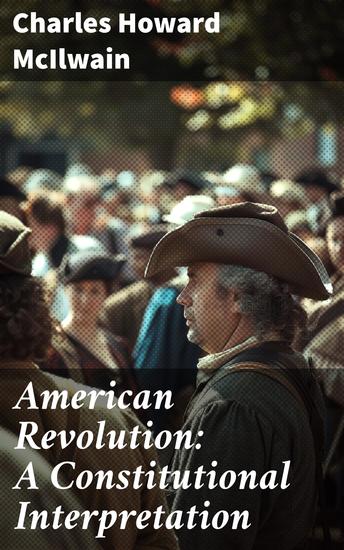
American Revolution: A Constitutional Interpretation - Constitutional Insights on Revolutionary America - cover

American Revolution: A Constitutional Interpretation - Constitutional Insights on Revolutionary America

Charles Howard McIlwain

Maison d'édition: Good Press

  • 0
  • 0
  • 0

Synopsis

In "American Revolution: A Constitutional Interpretation," Charles Howard McIlwain presents a compelling analysis that situates the American Revolution within the framework of constitutional theory. Through a meticulous examination of legal documents and political philosophies of the time, McIlwain argues that the Revolution was not merely a rebellion against tyranny but also a transformative constitutional event. His scholarly prose combines historical detail with legal analysis, allowing readers to appreciate the interplay between revolutionary fervor and the evolving understanding of governance, which characterized this pivotal era. McIlwain'Äôs work stands as a critical intervention in both American and legal history, reflecting a growing interest in the constitutional underpinnings of key historical events. Charles Howard McIlwain, a distinguished historian and scholar, was deeply influenced by the shifting landscape of early 20th-century America, marked by significant constitutional debates. His academic journey, enriched by a background in law and history, informed his perspective on the Revolution'Äôs legacy. McIlwain'Äôs dedication to elucidating the constitutional implications of American independence reflects a desire to reconcile historical narrative with legal principles, a theme that resonates in his wider scholarly oeuvre. Readers interested in the foundational principles of American democracy and the intricacies of constitutional development will find McIlwain'Äôs work indispensable. It invites a deeper reflection on the ideological motivations behind the Revolution, urging contemporary audiences to consider the delicate balance between liberty and order. For students, scholars, and enthusiasts of American history, this book is a profound exploration that enriches our understanding of the nation'Äôs formative conflicts.
Disponible depuis: 16/12/2023.
Longueur d'impression: 87 pages.


D'autres livres qui pourraient vous intéresser

  • Narcissistic Lovers - How to Cope Recover and Move On - cover

    Narcissistic Lovers - How to...

    Cynthia Zayn

    • 0
    • 0
    • 0
    This recording has been digitally produced by DeepZen Limited, using a synthesized version of an audiobook narrator’s voice under license. DeepZen uses Emotive Speech Technology to create digital narrations that offer a similar listening experience to human narration.  
     
    Drawing from her 20 years' experience as a researcher and educator, Cynthia Zayn exposes the carefully constructed narratives of the narcissist, as well as the confusion and chaos often experienced by those unwittingly "playing their role." Her conversational style and non-clinical approach to explanation put readers at ease, allowing them to absorb new information with clarity and understanding. The book's format of extensive research and in-depth interviews is woven around real-life case studies, making it relatable to the reader. If you find yourself questioning relationships with narcissistic parents, partners, siblings, friends, or co-workers, you may very well find the answers within these pages.  
     
    Narcissistic Lovers provides a revealing look at narcissists and their victims: 
     
    Danger signals that your partner is a narcissist 
     
    How destructive influences of a narcissist affect a relationship 
     
    Insights into what draws victims to narcissists and what steps to take to escape
    Voir livre
  • A Nation Again - The inside story of Scotland's journey to the European Championship - cover

    A Nation Again - The inside...

    Andy Bargh

    • 0
    • 0
    • 0
    A Nation Again is the chaotic tale of the Scotland men's team's return to a major tournament after more than 20 years in the wilderness. 
    Ten had come and gone for Scotland since they reached France '98, but the birth of UEFA's Nations League offered a new route to glory. In early 2018, after a long search for Gordon Strachan's replacement, Alex McLeish became manager for a second time. Despite successfully navigating the Nations League group stage, it wasn't plain sailing, and his tenure ended after a shocking defeat at the start of Euro 2020 qualifying. 
    With a play-off semi-final on the horizon, the Scottish FA turned to Steve Clarke, who took on the challenge of inspiring a team rooted in failure, creating a band-of-brothers mentality and figuring out how to organise this incredibly talented group of players. From a couple of the lowest lows, came the highest high. 
    With exclusive memories and audio from those who were part of the journey, such as John McGinn, Stephen O'Donnell, Lyndon Dykes, Ryan Christie and David Marshall, this is the story of how Scotland finally became a nation again.
    Voir livre
  • Am I Aware of the Process of Thinking? - Gstaad 1965 - Small Group Discussion 2 - cover

    Am I Aware of the Process of...

    Jiddu Krishnamurti

    • 0
    • 0
    • 0
    Am I aware of the process of thinking? 18 August 1965.Can I see that thought is destructive, except where it is essential? Why is it that we don't see something immediately? Do you know when you are thinking? Is the thing that we call thinking thinking at all? Do you think from the background noise when a problem arises? When the mind becomes totally aware of the background, is there thinking when a problem arises? What happens when I am aware of this hum, this noise incessantly going on? Is the background noise different from the observer? How am I to live an everyday life with complete silence?
    Voir livre
  • War Crimes - Accountability and Justice for the Atrocities of War - cover

    War Crimes - Accountability and...

    Marcus Klein

    • 0
    • 0
    • 0
    War crimes represent some of the most heinous acts of violence committed during conflict, violating the basic principles of humanity and decency. These crimes, which range from genocide to the targeting of civilians, are not only devastating to the victims but also to the social fabric of entire societies. Over the centuries, the world has witnessed numerous atrocities during wartime, but the formal recognition and prosecution of these crimes have evolved significantly, especially in the last century. 
      
    The need for accountability in the face of war crimes is critical. It is not only about bringing perpetrators to justice but also about establishing a global standard that deters such crimes in the future. The introduction of international laws and institutions aimed at prosecuting war crimes marks a pivotal shift in the international community's approach to warfare. The atrocities committed during World War II, particularly the Holocaust and other acts of genocide, were a wake-up call for the global community. This led to the creation of the Nuremberg Trials, the first real attempt to hold individuals accountable for war crimes, and set the foundation for modern international law. 
      
    The purpose of this book is to explore the concept of war crimes, the historical development of international law designed to address such crimes, and the ongoing challenges of prosecuting these atrocities. We will examine the evolution of legal frameworks, such as the Geneva Conventions and the establishment of the International Criminal Court, and discuss how these institutions work to hold individuals and states accountable for their actions during wartime.
    Voir livre
  • The Beauty Of Being Old - The Buddhist View - cover

    The Beauty Of Being Old - The...

    Sripad Jaganantha Das

    • 0
    • 0
    • 0
    As you stand before the mirror, you may glimpse something unexpected—a reflection that feels familiar and strange. The face staring back at you shows the subtle marks of time. The youthful smoothness is replaced with the creases of age, and hair that once held vibrant color now carries a shade of gray. The body that once moved with ease now speaks in aches and fatigue. With each passing day, it may feel like something is being taken away—a vitality that once felt eternal and is now slipping away. But what if this view of aging is not the full truth? What if, instead of fearing it, we could embrace it? The Buddha often spoke of impermanence, the truth that everything in life always changes. "All conditioned things are impermanent," he taught, and when we see this with wisdom, we can turn away from suffering. In Buddhist thought, aging is not something to resist, but a natural part of life's unfolding. The more we resist it, the more we suffer, because we are fighting against the natural way of the world. It is not aging that causes pain, but our attachment to the belief that things should remain as they were. The fear of aging comes from our desires, from longing for the way things once were. Time moves forward, and so must we. The Buddha reminds us that nothing in this world is permanent, and all things arise and pass away. When we accept this reality, we are free to live with grace and peace. Aging becomes a part of the natural rhythm of life, not something to fear. It is through this acceptance that we find wisdom. As we grow older, we understand that those ahead of us on this journey are simply at a different stage, not different from us. And as we age, we shed the past and move forward with deeper wisdom. The Buddha teaches that the body is not the self, and it is this deeper truth that helps us find peace in the midst of change.
    Voir livre
  • The Gauls - The People of Western Europe in Roman Times - cover

    The Gauls - The People of...

    Kelly Mass

    • 0
    • 0
    • 0
    This is a book about a people that has often been overlooked. Wallowing in the shadow of the seemingly almighty Romans, and dispersed throughout the ages into other peoples, the Gauls appear as if they had nothing going for them. Quite the opposite is true. The Gauls had a distinct culture, with habits, warfare, and so much more to offer to the intrigued historian and everyday researcher. 
    Throughout the Iron Age and the Roman period, the Gauls were a collection of Celtic tribes from Continental Europe (circa from the fifth century BC to the fifth century advertisement). Gaul was the name of the area where they used to live. Their Gaulish language is the significant branch of the Celtic languages of the continent. 
    The Gauls are worth studying. I implore you to do so.
    Voir livre