Rejoignez-nous pour un voyage dans le monde des livres!
Ajouter ce livre à l'électronique
Grey
Ecrivez un nouveau commentaire Default profile 50px
Grey
Abonnez-vous pour lire le livre complet ou lisez les premières pages gratuitement!
All characters reduced
The South Devon Coast - cover

The South Devon Coast

Charles G. Harper

Maison d'édition: DigiCat

  • 0
  • 0
  • 0

Synopsis

In "The South Devon Coast," Charles G. Harper intricately weaves a vivid tapestry of the picturesque landscapes and rich maritime history of South Devon, showcasing the region's unique charm through a blend of detailed observation and lyrical prose. Harper's writing is characterized by a painterly style that vividly captures the sights, sounds, and atmospheres of coastal life, while also delving into the cultural and historical significance of the area. The book serves as a poignant reflection of the late 19th-century British literary context, wherein regionalism and a renewed appreciation for nature were prominent themes, allowing readers to both immerse themselves in the natural beauty and understand the deeper cultural narratives of the time. Charles G. Harper, an avid traveler and keen observer, drew from his extensive explorations of the British landscape, fostering a deep connection with the locales he documented. His background as a successful illustrator and writer contributed a unique visual dimension to his work, as he expertly combines prose with illustrations, drawing readers not only into the narrative but also into the very essence of the South Devon coast. Harper's passion for capturing the fleeting beauty of nature underscores much of his writing, making his works significant in the canon of travel literature. I wholeheartedly recommend "The South Devon Coast" to readers seeking both a historical insight and a sensory exploration of one of England's most enchanting coastal regions. Harper's adept storytelling and evocative illustrations will resonate with anyone yearning for connection to the natural world, while his rich observations offer valuable context for understanding the interplay between nature and culture in the English seaside experience.
Disponible depuis: 04/09/2022.
Longueur d'impression: 187 pages.

D'autres livres qui pourraient vous intéresser

  • The Enforcers - Inside Cape Town's Deadly Nightclub Battles - cover

    The Enforcers - Inside Cape...

    Caryn Dolley

    • 0
    • 0
    • 0
    CAPE TOWN’S POPULAR high-end night spots attract an array of clientele, from young partygoers to politicians, models to moguls. In parallel with this is a sleazy underworld where control of the lucrative nightclub-security scene is the ultimate prize, for which some are prepared to pay using extortion and murder as the main currencies. 
      
    South Africa’s private-security sector is massive, an informal police force increasingly relied on as confidence in traditional policing wanes. But it’s an industry tainted by ties to underworld figures and events. 
      
    The Mother City’s security turf wars have their roots in pre-democratic South Africa, and branch into Cape Flats gang battles raging since the 1990s. Dotting this landscape are colourful and contentious figures – Yuri ‘The Russian’ Ulianitski, nightclub-security kingpin and rumoured apartheid-state operative Cyril Beeka, convicted drug dealer Radovan Krejčíř, controversial businessman Nafiz Modack and Mark Lifman. Making surprise appearances are high-ranking police officers as well as prominent members of the ANC and government. 
      
    Journalist Caryn Dolley has interviewed numerous criminal and suspects, often putting herself in danger in pursuit of the truth. Here she weaves her research into a story that lays bare the reality of Cape Town’s nightclub-security wars: a vast network of information and misinformation in which innocent members of the public enjoying a night out inadvertently rub shoulders with some of the city’s most infamous criminals.
    Voir livre
  • Gino's Contraband - Guilty Until Proven Innocent - cover

    Gino's Contraband - Guilty Until...

    Gabrielle O'Donovan

    • 0
    • 0
    • 0
    Gabrielle O’Donovan, award-winning organisational culture and change expert and author, shares her powerful memoir - Gino’s Contraband: Guilty Until Proven Innocent (The Change Press, 2025). This gripping adaptation of the award-winning print book recounts the wrongful assumption of the UK tax authority - His Majesty's Revenue & Customs (HMRC) - that Gabrielle was responsible for a shipment of over a quarter of a million contraband cigarettes and related charges, and her challenging fight to reclaim her identity and dignity and clear her good name. 
    With compelling narration, the book immerses listeners in O'Donovan’s emotional journey - from bureaucratic horror where she is presumed guilty, to resolute advocacy. As she traces her experience - alongside that of her suicidal friend who is caught up in the broader Loan Charge Scandal affecting tens of thousands - the intertwined stories of these two friends become a vital testimony for democratic accountability, mental health resilience, and the need for a Taxpayer Bill of Rights. The book ends with a chapter of recommendations for institutional reform at HMRC. 
    Vital for political watchdogs, legal reform advocates, tax specialists and memoir listeners seeking emotional truth.
    Voir livre
  • You Only Need Permission from Yourself - cover

    You Only Need Permission from...

    Jaynette M Lancaster

    • 0
    • 0
    • 0
    ‘You Only Need Permission from Yourself’ is an honest and empowering look at what it means to heal, grow, and live life on your own terms. Through personal stories and deep reflection, Jaynette Lancaster invites readers to question the silent rules they’ve been taught and to let go of the belief that anyone else holds the key to their happiness or success. This book speaks directly to those who’ve been told to stay quiet, play small, or wait for permission. Jaynette challenges that mindset with warmth and clarity, drawing from her own journey through heartbreak, emotional abuse, professional pressure, and the raw work of rebuilding. She shares how she found strength in vulnerability, clarity in solitude, and peace in choosing herself—over and over again. Each chapter explores a different piece of the healing puzzle, from understanding emotional conditioning to navigating mental health, building resilience, and reclaiming your voice. Jaynette’s message is clear: your story matters, your voice is valid, and your life belongs to you. Written with honesty, compassion, and grit, ‘You Only Need Permission from Yourself’ is both a mirror and a guide for anyone ready to stop seeking outside validation and start living with intention. It’s not just a book. It’s a call to finally choose yourself—and mean it.
    Voir livre
  • God Sees the Truth But Waits - From their pens to your ears genius in every story - cover

    God Sees the Truth But Waits -...

    Leo Tolstoy

    • 0
    • 0
    • 0
    Leo Tolstoy was born in 1828 in the Russian province of Tula to a wealthy noble family. As a child, he had private tutors but he showed little interest in any formal education. When he went to the University of Kazan in 1843 to study oriental languages and law, he left without completing his courses.  Life now was relaxed and idle but with some writing also taking place.  Gambling debts forced an abrupt change of path and he joined the army to fight in the Crimean War.  He was commended for his bravery and promoted but was appalled at the brutality and loss of life.  He recorded these and other earlier experiences in his diaries which formed the basis of several of his works. 
    In 1852 ‘Childhood’ was published to immediate success and was followed by ‘Boyhood’ and ‘Youth’. 
    His experience in the army and the horrors he witnessed resulted in ‘The Cossacks’ in 1862 and the trilogy ‘Sevastopol Tales’. After the war he travelled around Europe, visiting London and Paris and meeting such luminaries as Victor Hugo and Charles Darwin.  
    It was now that Tolstoy began his masterpiece, ‘War and Peace’. Published in 1869 it was an epic work that changed literature. He quickly followed this with ‘Anna Karenina’.  
    These successes made Tolstoy rich and helped him accomplish many of his dreams but also brought problems as he grappled with his faith and the lot of the oppressed poor. These revolutionary views became so popular that the authorities now kept him under surveillance.  
    He led a life of asceticism and vegetarianism and put his socialist ideals into practice by establishing numerous schools for the poor and food programmes. He also believed in giving away his wealth, which caused much discord with his wife.  
    His writing continued to bring forth classics such as ‘The Death of Ivan Ilyich’ and many brilliant and incisive short stories such as ‘How Much Land Does A Man Need’.  
    In 1901 Tolstoy was excommunicated from the Church and controversially deselected for the Nobel Prize for Literature. 
    Whilst undertaking a pilgrimage by train in October 1910 with his daughter Aleksandra he caught pneumonia in the nearby town of Astapovo.  Leo Tolstoy died on November 9th, 1910, he was 82.
    Voir livre
  • Migration - cover

    Migration

    Steph Matuku

    • 0
    • 0
    • 0
    Farah of Untwa joins a school for training fighters, strategic thinkers and military personnel. It means she escapes her domineering mother and the tedious duties that come with being from a Ngāti in the upper echelons of society. But at the school, Farah, an intuitive, is teamed up with fighter Lase, a boy from a lower Ngāti. Farah's condescension and disturbing hallucinations and Lase's resentment test their partnership. But just when they finally seem to be working well together, the school is attacked by other-worldly forces. Farah and Lase must use their skills to fight the alien invaders and save their people from obliteration.
    Voir livre
  • Hollywood’s Favorite Screwball Actresses: The Lives and Legacies of the Women Who Popularized the Comedy Genre - cover

    Hollywood’s Favorite Screwball...

    Editors Charles River

    • 0
    • 0
    • 0
    “If I couldn't laugh, I'd rather die.” – Claudette Colbert 
    The 1930s were the height of the classical Hollywood era, known for lavish studio productions by heavyweights like MGM, RKO, Warner Brothers, Paramount, and 20th Century Fox, which were operating at the height of their powers. Every major studio possessed a long roster of contract players, and films were released at such a rapid pace that it made for an especially competitive environment within the industry. Even while America remained in the throes of the Great Depression, the film industry continued to flourish, and movies easily supplanted the theater as the main attraction for American entertainment. Indeed, it would be no exaggeration to claim that the film industry reached its zenith during the decade precisely because it offered an affordable (if very temporary) escape from the anxieties of the economic woes of the era. 
    When the American Film Institute ranked its top 50 screen legends of the 20th century, many of the people named had careers spanning several decades, but one of them managed the feat despite living less than three decades. Ranked as the 22nd greatest actress of the 20th century, Jean Harlow was on the screen for less than 10 years, but in that time the “Blonde Bombshell” became the most popular actress of the 1930s, eclipsing superstars like Joan Crawford and Norma Shearer along the way. In fact, the platinum blonde accomplished that feat as a leading lady for just five years before her premature death of renal failure at the age of 26. 
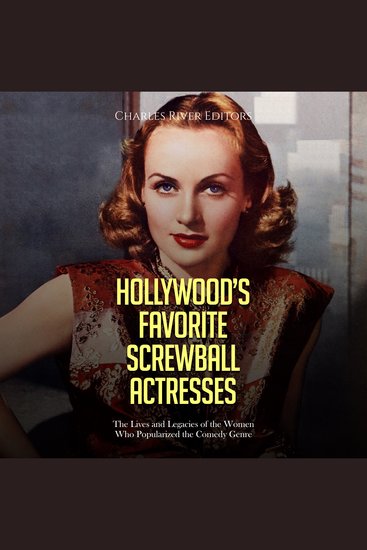
    Carole Lombard has been memorialized in many fitting ways as an actress, and one of her biggest contributions to Hollywood was the blond archetype that the film industry used successfully for decades in screwball comedies, paving the way for the success of women like Marilyn Monroe. Perhaps the most remarkable aspect of that fact is that it was actually based on Carole’s gushing personality. 
    Voir livre