Rejoignez-nous pour un voyage dans le monde des livres!
Ajouter ce livre à l'électronique
Grey
Ecrivez un nouveau commentaire Default profile 50px
Grey
Abonnez-vous pour lire le livre complet ou lisez les premières pages gratuitement!
All characters reduced
The Old Inns of Old England - A Picturesque Account of the Ancient and Storied Hostelries of England (Complete Edition: Vol 1&2) - cover

The Old Inns of Old England - A Picturesque Account of the Ancient and Storied Hostelries of England (Complete Edition: Vol 1&2)

Charles G. Harper

Maison d'édition: DigiCat

  • 0
  • 0
  • 0

Synopsis

In "The Old Inns of Old England," Charles G. Harper invites readers on a captivating journey through the historic taverns and inns that form the backbone of England's social and architectural heritage. Employing a vivid literary style rich in descriptive imagery and anecdotal storytelling, Harper artfully interweaves history, folklore, and personal reminiscence, offering a vibrant panorama of these establishments. The book is set against the backdrop of the late Victorian era, a time when nostalgia for England's past surged, and captures not just the physical spaces, but the spirited lives and stories that these inns have sheltered throughout the centuries. Charles G. Harper was an eminent English writer, illustrator, and painter, whose profound love for England's rural landscapes and cultural history motivated his exploration of its inns. His extensive travels and deep appreciation for local lore are evident in the meticulous research and intimate details captured in this work. Harper's unique perspective and personal encounters give readers an insider's view of these historic sites, blending his artistic sensibilities with a historian's rigor. This book is a must-read for history enthusiasts, architecture aficionados, and anyone with an appreciation for England's rich traditions. "The Old Inns of Old England" not only serves as a guide to these charming venues but also as a testament to the enduring legacy of hospitality and community found within their walls.
Disponible depuis: 16/11/2023.
Longueur d'impression: 345 pages.

D'autres livres qui pourraient vous intéresser

  • Contraduction - cover

    Contraduction

    Dan Barker

    • 0
    • 0
    • 0
    In a quiet and unassuming way, Contraduction is utterly brilliant. Every page has a thought so deep and unexpected that it stops you in your tracks, as you not only realize, “That’s a different, really interesting way to think about the world, exactly the opposite of how I normally view things” but also, “And it is absolutely equally valid (and enriching) to adopt this opposite way of thinking.” I loved this book. — Robert Sapolsky, author of The Blank Slate and Determined.An ingenious word for an invaluable concept. Sharp, clear, and timely. — Steven Pinker, Johnstone Professor of Psychology, Harvard University, and the author of The Blank Slate and RationalityBoth a delightful read and a penetrating argument: Barker has invented an invaluable new concept, and puts it to work with clarity, wit, and above all conclusiveness. A must-have book! — A. C. Grayling, author of The History of Philosophy and The God ArgumentI am completely down with the concept of contraduction. It fills a need. False pattern recognitions pose a real danger to our survival. Well done! — Ann Druyan, author (with Carl Sagan) of Cosmos, Contact, and Demon Haunted WorldI love it when brilliant ideas are conveyed clearly and soundly. That’s why I love this book. Dan Barker has provided a much-needed explication of a common fallacy that needs to be understood and rebutted. It is an engaging, enlightening, and insightful book.—Phil Zuckerman, author of Society Without God and What it Means to be MoralWith Contraduction, Dan Barker gives us a new word—and a new way of looking at things. I thoroughly enjoyed this! So much to think about—and it made me laugh. What else could I ask for? — Kate Cohen, contributing columnist for the Washington Post and author of We of Little FaithI love how Dan Barker offers us a new word to help us understand how to think rationally in a fun, simple way. I will never look at my reflection in the mirror the same! — Bailey Harris, author of My Name is Stardust
    Voir livre
  • The Inside Scoop on Eating Disorder Recovery - Advice from Two Therapists Who Have Been There - cover

    The Inside Scoop on Eating...

    PSYD Colleen Reichmann, LCSW-C...

    • 0
    • 0
    • 0
    The Inside Scoop on Eating Disorder Recovery is a fresh, smart, how-to book that helps people with eating disorders to heal their relationship with food, their bodies, and ultimately themselves. 


    Written from the perspective of two eating disorder therapists, both of whom are recovered from their own eating disorders, this book uses humor, personal narratives, and research-proven techniques to offer specific actionable guidelines on how to reclaim one's life from an eating disorder. The authors explain the difference between dieting and eating disorders, break down the stages of recovery, and provide tips on how to thrive in each stage. The book provides powerful myth-busting on topics that have historically not been addressed in eating disorder recovery books, such as clean eating and orthorexia, exercising in recovery, and fat positivity. Tangible exercises at the end of each chapter provide listeners with advice and tips on implementing this approach to recovery in their day-to-day lives. 


    The humorous and down-to-earth tone of the book creates an authentic and genuine feel that leaves those who struggle with chronic dieting, eating disorders, and negative body image feeling connected and heard.
    Voir livre
  • The Power of Ritual - Turning Everyday Activities into Soulful Practices - cover

    The Power of Ritual - Turning...

    Anonyme

    • 0
    • 0
    • 0
    Casper ter Kuile, a Harvard Divinity School fellow and cohost of the popular Harry Potter and the Sacred Text podcast, explores how we can nourish our souls by transforming common, everyday practices—yoga, reading, walking the dog—into sacred rituals that can heal our crisis of social isolation and struggle to find purpose—a message we need more than ever for our spiritual and emotional well-being in the age of COVID-19. 
     
    “After half a decade of research and hundreds of conversations with people around the country, I am convinced we are in the midst of a paradigm shift. That what used to hold us in community no longer works, and that the spiritual offerings of yesteryear no longer help us thrive.”–Casper ter Kuile 
    What do Soul Cycle, gratitude journals, and tech breaks have in common? For ter Kuile they offer rituals that create the foundation for our modern spiritual lives.  
    We are in crisis today. Our modern technological society has left too many of us—no matter our ages—feeling isolated and bereft of purpose. Previous frameworks for building community and finding meaning no longer support us. Yet ter Kuile reveals a hopeful new message: we might not be religious, but that doesn’t mean we are any less spiritual.   
    Instead, we are in the midst of a paradigm shift in which we seek belonging and meaning in secular practices. Today, we find connection in:CrossFit and SoulCycle, which offer a sense of belonging rooted in accountability and support much like church groupsHarry Potter and other beloved books that offer universal lessons Gratitude journals, which have replaced traditional prayer Tech breaks, which provide mindful moments of calm  
    In The Power of Ritual, ter Kuile invites us to deepen these ordinary practices as intentional rituals that nurture connection and  wellbeing. With wisdom and endearing wit, ter Kuile’s call for ritual is ultimately a call to heal our loss of connection to ourselves, to others, and to our spiritual identities. 
    The Power of Ritual reminds us that what we already do every day matters—and has the potential to become a powerful experience of reflection, sanctuary, and meaning.
    Voir livre
  • Liberty and Crisis: The History of the American Revolution during 1776 - cover

    Liberty and Crisis: The History...

    Editors Charles River

    • 0
    • 0
    • 0
    Although the Declaration of Independence is now considered one of the most important political documents in history, the men that drafted it did not initially favor such a move at the start of the American Revolution. Despite its assumption of governing duties, the Second Continental Congress never intended, at least initially, to become the governing body of a new nation. Instead, it merely hoped to transform the relationship between Britain and her colonies to allow for greater self-government on their side of the Atlantic. Separation between the two was rarely favored, and this initial sentiment coalesced into the Olive Branch Petition, which sought a reasonable motion of reconciliation between George III and the colonies. It was drafted by one of Virginia’s delegates, Thomas Jefferson.  
    	By April of 1776, talk had heated up concerning independence, and a consensus was quickly growing in Congress. However, one problem was in the way: did the Congress have the authority to declare independence for its 13 member colonies? The process was riddled with confusion across the colonies. independence. And of course, simply declaring independence did not mean the British were going to grant it, and during that time, things were looking quite dire for the cause. After the siege of Boston forced the British to evacuate that city in March 1776, Continental Army commander George Washington suspected that the British would move by sea to New York City, the next logical target in an attempt to end a colonial insurrection. He thus rushed his army south to defend the city. 
    In the summer of 1776, the British conducted the largest amphibious expedition in North America’s history at the time, landing over 20,000 troops on Long Island. They easily captured Staten Island, which Washington was incapable of defending without a proper navy. Washington’s army attempted to fight, but Washington was badly outmaneuvered, and his army was nearly cut off from escape. 
    Voir livre
  • The Birth of Tragedy - cover

    The Birth of Tragedy

    Friedrich Nietzsche

    • 0
    • 0
    • 0
    "The Birth of Tragedy" by Friedrich Nietzsche is a philosophical work that explores the origins and nature of Greek tragedy. Nietzsche argues that Greek tragedy emerged from the tension between two competing artistic impulses: the Apollonian, which is characterized by rationality, order, and form; and the Dionysian, which is characterized by emotion, chaos, and irrationality. "The Birth of Tragedy" is a provocative and influential work of philosophy that challenges traditional views on the nature of art, culture, and human existence. Read in English, unabridged.
    Voir livre
  • Tyrone Power: The Life and Legacy of One of Hollywood’s Most Famous Swashbucklers - cover

    Tyrone Power: The Life and...

    Editors Charles River

    • 0
    • 0
    • 0
    Hollywood has never lacked leading men who could captivate viewers with dramatic performances that depict them as suave romantics or dashing heroes, especially during the Golden Age of Hollywood, when stars like Humphrey Bogart, Clark Gable, and Cary Grant graced screens. But in the mid-20th century, one of the most popular stars was a man who’s been frequently overlooked.   
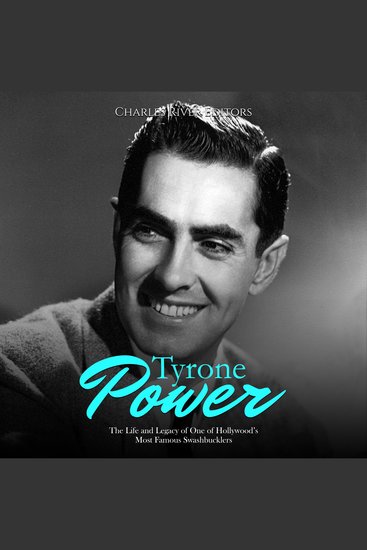
    Some actors were recruited based on their appearance alone, signing contracts before taking screen tests or ever having been on a stage or set. Others became overnight sensations, darlings of the public for decades. Only a few of these turned out to be excellent actors, but one of them was certainly Tyrone Power, one of Hollywood’s leading men from the 1930s into the 1950s. With a career spanning over 50 films, Power did not have to work through the system, rising to the top almost immediately at the age of 22.  
    Power was named “King of the Movies” for three straight years (1939 -1941) by fans, and while critics claimed that his success came from his good looks, today he is acknowledged as a good actor, among the most underestimated of this era. Power starred in a variety of film genres, and at least some contemporaries made note of his “remarkable acting range.” This included several musicals such as Alexander’s Ragtime Band, Second Fiddle, Rose of Washington Square, and The Eddy Duchin Story. He also made appearances in several dramas, including Johnny Apollo, Witness for the Prosecution, Crash Drive, and The Razor’s Edge. Power was even known for a good comedic sense in films like The Luck of the Irish, That Wonderful Urge, and Love is News.
    Voir livre