Rejoignez-nous pour un voyage dans le monde des livres!
Ajouter ce livre à l'électronique
Grey
Ecrivez un nouveau commentaire Default profile 50px
Grey
Abonnez-vous pour lire le livre complet ou lisez les premières pages gratuitement!
All characters reduced
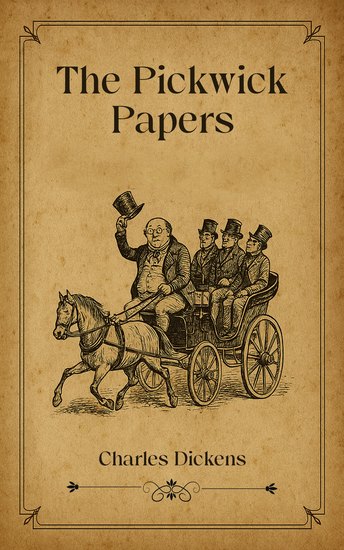
The Pickwick Papers - cover

The Pickwick Papers

Charles Dickens

Maison d'édition: CLXBX

  • 0
  • 0
  • 0

Synopsis

The Pickwick Papers is the novel that launched Charles Dickens's literary career and remains one of his most joyful and entertaining works. Bursting with humor, warmth, and vivid observation, the book offers a lively portrait of English life in the early Victorian era.

The story follows the genial and good-natured Samuel Pickwick, founder of the Pickwick Club, and his fellow members as they travel through the English countryside in search of knowledge, adventure, and amusement. Along the way, they encounter an unforgettable array of characters—eccentric lawyers, boastful soldiers, sharp-tongued widows, and ordinary people whose quirks and struggles are rendered with affectionate satire.

At the heart of the novel is Dickens's keen eye for human nature. Through comic misadventures, misunderstandings, and courtroom farces, the book gently critiques social pretensions, legal absurdities, and institutional hypocrisy. The introduction of the clever and loyal servant Sam Weller adds depth and wit, creating one of the most beloved partnerships in English literature.

The Pickwick Papers is a celebration of friendship, curiosity, and good humor. Lighthearted yet insightful, it captures the spirit of a society in transition while delighting readers with its timeless comedy and rich storytelling. Endlessly readable and irresistibly charming, the novel stands as a classic introduction to Dickens's enduring genius.
Disponible depuis: 05/02/2026.
Longueur d'impression: 1096 pages.

D'autres livres qui pourraient vous intéresser

  • Terrible Old Man The (Unabridged) - cover

    Terrible Old Man The (Unabridged)

    H. P. Lovecraft

    • 0
    • 0
    • 0
    A strange old man, "so old that no one can remember when he was young, and so taciturn that few know his real name," lives alone in an ancient house on Water Street in the town of Kingsport. Even among the locals, few know the details of the old man's life, but it is believed that he once captained East Indian clipper ships in his youth and accumulated great riches throughout his life. Those who had visited the property had seen bizarre collections of stones in the front yard and observed the old man carrying on conversations with mysterious bottles on his table, which make "certain definite vibrations as if in answer." Most locals take care to avoid the man and his house. Angelo Ricci, Joe Czanek and Manuel Silva, three robbers, learn about the old man's supposed hoard of treasure and resolve to take it. Ricci and Silva go inside to "interview" the old man about the treasure, while Czanek waits outside in the getaway car. After waiting impatiently for a long time, Czanek is startled by an outburst of horrific screaming from the house but assumes that his colleagues have been too rough with the old man during their interrogation. However, the gate of the house opens, revealing the old man "smiling hideously" at him. For the first time, Czanek takes note of the man's unsettling yellow eyes. The mutilated bodies of the three robbers are later found by the seaside, "horribly slashed as with many cutlasses, and horribly mangled as by the tread of many cruel boot-heels." The people of Kingsport talk about the discovery, as well as about the abandoned car and the screams heard in the night, but the old man shows no interest in their gossip.
    Voir livre
  • The Pit and the Pendulum - cover

    The Pit and the Pendulum

    Edgar Allan Poe

    • 0
    • 0
    • 0
    Title: The Pit and the Pendulum 
    Author: Edgar Allan Poe 
    Narrator: Jonathan Dunne 
    Original Publication: 1842 
    Public Domain: Yes 
    Series Placement: Number 32 in the Timeless Terrors series 
    Description: 
    The Pit and the Pendulum by Edgar Allan Poe is a harrowing descent into psychological and physical torment — a masterpiece of suspense that explores the extremities of fear and the indomitable will to survive. Set during the horrors of the Spanish Inquisition, a condemned man awakens in a pitch-black chamber where terror comes not from the unseen alone, but from the cruel machinery of death itself. 
    Through meticulous pacing and sensory detail, Poe transforms the simple elements of darkness, time, and confinement into instruments of unbearable dread. The swinging blade, the narrowing walls, and the unseen abyss below merge into a nightmare of pure existential terror. 
    Narrated by horror author Jonathan Dunne, this performance captures Poe’s rhythm of panic and revelation — the tightening pulse of a man struggling against both despair and death. While the text itself is in the public domain, this narration is an original performance and copyright © 2025 Jonathan Dunne. 
    Part of Timeless Terrors, a series dedicated to resurrecting the classic voices of the macabre, The Pit and the Pendulumendures as one of literature’s most visceral portrayals of horror — a story where every heartbeat echoes the pendulum’s swing, and every breath might be the last. 
    Prepare for a journey into darkness, dread, and the thin line between reason and madness — a tale that proves the greatest terror is to be conscious while facing the inevitable.
    Voir livre
  • The Bucket Rider - A poor man seeks compassion but is found wanting - cover

    The Bucket Rider - A poor man...

    Franz Kafka

    • 0
    • 0
    • 0
    Franz Kafka was born on 3rd July 1883 in Prague, then in Bohemia, the eldest of 6, into a middle-class Jewish family. 
     
    Life for the young Kafka and his passion for literature was often made an ordeal by his over-bearing and domineering entrepreneur of a father.   
     
    In 1889 Kafka was sent to the Deutsche Knabenschule, an elementary school in Prague. His father would only allow him to be educated in German-speaking schools and even went so far as to limit visits to the synagogue to four a year. 
     
    In 1901 he graduated from the classics-oriented Altstädter Gymnasium. Kafka did well there and across a large range of subjects.  He now enrolled at the Charles Ferdinand University, to study chemistry, but quickly switched to law for which he obtained his degree in June 1906 and then performed the mandatory year of unpaid service as clerk at the civil and criminal courts. 
     
    A job at an Italian insurance company left him little time to write and after a year he took another job with the Worker's Accident Insurance Institute for the Kingdom of Bohemia where he stayed until ill health led to his resignation in 1922. 
     
    Although he saw work as a means to pay the bills and to allow him time to write, he received several promotions and was noted as a good employee. 
     
    By 1917 Kafka was suffering from tuberculosis, which required frequent periods of convalescence. Interspersed with this, were several intense affairs before he settled in Berlin with Dora Diamant, a 25-year-old kindergarten teacher who herself having left the ghetto now influenced Kafka's interest in the book of Jewish law, the Talmud. 
     
    Kafka’s on-going health was littered with problems. Apart from TB there were several other ailments, including migraines, insomnia, boils, depression, all usually brought on by excessive stresses and strains. He attempted to counteract all of this by naturopathic treatments, a vegetarian diet and consuming large quantities of unpasteurized milk. 
     
    His tuberculosis still worsened. He returned to Prague, where he died on 3rd June 1924. He was 40. 
     
    His literary works are few in number but towering in influence.  His masterpieces include ‘The Trial’, ‘The Metamorphosis’ as well as a number of short stories which reveal facets of humankind that truthfully could only be born from Kafka’s brain and pen.
    Voir livre
  • Hunchback of Notre-Dame The (Book 7) - cover

    Hunchback of Notre-Dame The...

    Victor Hugo

    • 0
    • 0
    • 0
    Book 7: The Hunchback of Notre-Dame or Notre-Dame de Paris is a French Gothic novel by Victor Hugo, published in 1831. - The story is set in Paris in 1482 during the reign of Louis XI. The gypsy Esmeralda (born as Agnes) captures the hearts of many men, including those of Captain Phoebus and Pierre Gringoire, but especially Quasimodo and his guardian Archdeacon Claude Frollo. Frollo is torn between his obsessive lust for Esmeralda and the rules of Notre Dame Cathedral. He orders Quasimodo to kidnap her, but Quasimodo is captured by Phoebus and his guards, who save Esmeralda. Gringoire, who attempted to help Esmeralda but was knocked out by Quasimodo, is about to be hanged by beggars when Esmeralda saves him by agreeing to marry him for four years.
    Voir livre
  • The Tenant of Wildfell Hall - cover

    The Tenant of Wildfell Hall

    Anne Brontë

    • 0
    • 0
    • 0
    "The Tenant of Wildfell Hall" by Anne Bronte is a gripping and thought-provoking novel that delves into the themes of love, redemption, and the struggle for personal freedom in 19th-century England. Set in a society bound by strict social norms, the story follows the journey of Helen Graham, a mysterious young woman who takes up residence at the secluded Wildfell Hall. "The Tenant of Wildfell Hall" offers a searing critique of the oppressive gender roles and double standards that pervaded Victorian society. Through Helen's story, the novel explores themes of women's agency, the destructive power of addiction, and the importance of personal accountability. Anne Bronte's uncompromising portrayal of the consequences of toxic relationships serves as a powerful social commentary and a call for change. With its richly developed characters, evocative descriptions of the English countryside, and compelling exploration of moral dilemmas, "The Tenant of Wildfell Hall" is a timeless novel that examines the complexities of human nature and the transformative power of love and redemption. It is a story that resonates with readers, reminding us of the enduring struggle for personal freedom and the courage required to challenge societal norms in pursuit of a better life.
    Voir livre
  • Andaz-e-Bayaan - Beloved Urdu classics brought to life by the inimitable Zia Mohyeddin - cover

    Andaz-e-Bayaan - Beloved Urdu...

    Ismat Chughtai, Munshi...

    • 0
    • 0
    • 0
    This audio compilation has been made with love for anyone wanting to immerse themselves in the world of Urdu stories but may find it difficult to read the script. 
    Featured authors include legends like Ismat Chughtai of the ‘Taraqqii Pasand Tehreek’ (Progressive Writer’s Movement), one of the first Muslim women to write boldly about subjects such as sexuality in the 1940’s; Munshi Premchand, a Hindu writer born in 1880, who was a pioneering figure in both Hindi and Urdu short fiction and wrote on topics such as caste, which were marked by sociopolitical and religious sensitivities; Sa’adat Hassan Manto, who belonged to both Bombay & Lahore and wrote about the partition that resulted in the nations of India and Pakistan, known for stories that showed a mirror to society regardless of the discomfort caused by stark reflections; Rajinder Singh Bedi, a versatile short fiction, novel, and film writer who also amplified the social issues of rurality as they dovetailed with national and metropolitan life; Ghulam Abbas, a novelist and short fiction writer interested in bringing to light the many ironies of modernity; Noon Meem (“NM”) Rashid, a groundbreaking modernist poet who wrote primarily in free verse, exploring contrasting relationships such as those between language & meaning and self & society; Asad Muhammad Khan, whose short fiction weaves his rich life experiences into commentaries on topics such as family life and class relations; and Intizar Hussain, who was arguably the most significant Urdu literary prose writer of the contemporary era, painting epics of migration and nostalgia on an intergenerational canvas. 
    Our narrator, Mr. Zia Mohyeddin, perhaps more than any other single figure in modern times, has shaped an appreciation for Urdu literature by making it accessible in masterfully emotive and lucid audio performances to generations of listeners who may have otherwise remained deprived of such learning and aesthetic pleasure.
    Voir livre