Begleiten Sie uns auf eine literarische Weltreise!
Buch zum Bücherregal hinzufügen
Grey
Einen neuen Kommentar schreiben Default profile 50px
Grey
Jetzt das ganze Buch im Abo oder die ersten Seiten gratis lesen!
All characters reduced
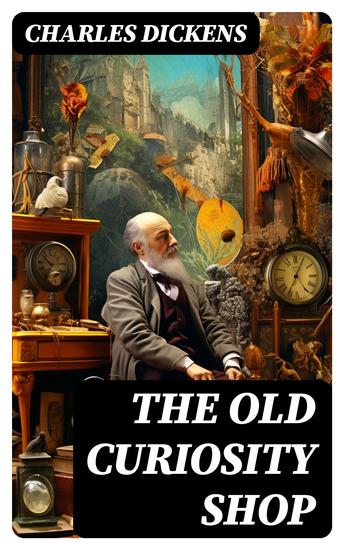
The Old Curiosity Shop - Illustrated Edition - cover

The Old Curiosity Shop - Illustrated Edition

Charles Dickens

Verlag: DigiCat

  • 0
  • 0
  • 0

Beschreibung

In "The Old Curiosity Shop," Charles Dickens weaves a richly textured narrative set against the backdrop of Victorian London, exploring themes of poverty, innocence, and the unyielding grip of fate. Through the story of Little Nell and her grandfather, Dickens employs a poignant blend of melodrama and vivid characterization, creating a powerful commentary on the societal issues of his time, particularly the harsh realities faced by the vulnerable. The novel is marked by Dickens's signature attention to detail and intricate plotting, as each character— from the avaricious Quilp to the benevolent Kit—serves to illuminate the broader human experience. Charles Dickens, a master of his craft and a chronicler of 19th-century life, was profoundly influenced by his own experiences with poverty and hardship as a child. His dedication to social reform and his acute awareness of the struggles faced by the marginalized fundamentally shaped his narrative style and thematic focus in "The Old Curiosity Shop." Dickens's deep empathy for his characters invites readers to reflect on their plights, rendering the tale both a personal and social critique of the times. This novel is highly recommended for readers seeking a compelling exploration of human resilience against adversity, as well as those interested in the evolution of narrative techniques in Victorian literature. Dickens's depth of insight and emotional resonance make "The Old Curiosity Shop" a timeless masterpiece that continues to resonate with contemporary audiences.
Verfügbar seit: 14.12.2023.
Drucklänge: 591 Seiten.
Weitere Bücher, die Sie mögen werden

  • The Nutcracker and the Mouse King - cover

    The Nutcracker and the Mouse King

    E. T. A. Hoffmann

    • 0
    • 0
    • 0
    Experience the Original Tale Behind the World's Most Beloved Christmas Ballet!
    
    Before Tchaikovsky composed his magical score, there was E. T. A. Hoffmann's enchanting, slightly darker, and wonderfully complex tale: The Nutcracker and the Mouse King.
    
    Join young Marie Stahlbaum as her simple Christmas Eve transforms into a thrilling, sometimes terrifying, adventure. When her new toy nutcracker comes to life, she is swept into a secret war against the evil Mouse King and his seven-headed army.
    
    If you love Christmas, fantasy, and the enduring power of classic children's literature, click "Buy Now" and let the adventure begin!
    Zum Buch
  • A Voice from the Pit - From their pens to your ears genius in every story - cover

    A Voice from the Pit - From...

    Bernard Capes

    • 0
    • 0
    • 0
    Bernard Edward Joseph Capes was born on the 30th August 1854 in London.  He was one of 11 children. 
    His early work was as a journalist and this developed into writing many short stories for the periodicals of the time including Blackwood's, Cassell's, Cornhill Magazine, Illustrated London News, Macmillan's Magazine, Mall Magazine, Pearson's Magazine, The Idler, and The Queen. 
    It took him many years to decide that writing full-time could be a sustainable career path.  His initial success came with ‘The Mill of Silence’.  As well as being published it garnered second prize at a competition sponsored by the Chicago Record.  He exceeded that by winning it the following year with ‘The Lake of Wine’.   
    Capes quickly became both prolific and popular.  As well as his stories and articles for the periodicals he wrote around 40 volumes across novels, poetry, history as well as romance and mystery novels. 
    Bernard Capes died on 2nd November 1918 in the flu epidemic.
    Zum Buch
  • God the Invisible King (Unabridged) - cover

    God the Invisible King (Unabridged)

    H. G. Wells

    • 0
    • 0
    • 0
    This book sets out as forcibly and exactly as possible the religious belief of the writer. That belief is not orthodox Christianity; it is not, indeed, Christianity at all; its core nevertheless is a profound belief in a personal and intimate God. There is nothing in its statements that need shock or offend anyone who is prepared for the expression of a faith different from and perhaps in several particulars opposed to his own.
    Zum Buch
  • Four Clever Brothers The - Story Time Episode 30 (Unabridged) - cover

    Four Clever Brothers The - Story...

    Brothers Grimm

    • 0
    • 0
    • 0
    The German tale of four brothers who set out to learn their crafts in the big wide world. When they return home as skilled men; a thief, an astronomer, a hunter, and a tailor their skills are challenged by their father - 'I should like to try what each of you can do in this way.
    Zum Buch
  • Bambi - A Life in the Woods - cover

    Bambi - A Life in the Woods

    Felix Salten

    • 0
    • 0
    • 0
    Bambi follows the life of the eponymous roe deer, from birth to maturity. Through the years Bambi meets friends, learns how to survive in the forest, finds love, and learns how to survive "He" - the name animals give to man. The novel gives a glimpse into forest life: dangerous, yet awe-inspiring; unforgiving, yet beautiful.
    Written by Felix Salten and published in 1923 in German, it was translated to English in 1928 by Whittaker Chambers. It is considered one of the first environmental novels, and in 1936 was banned by Nazi Germany for being a parable of the persecution of Jews in Europe.
    Although adapted into multiple movies, ballets, and plays, Bambi is perhaps most popularly remembered as the subject of Walt Disney's famous animated feature of the same name.
    Zum Buch
  • The Judgement - A kafkaesque view of a father son relationship - cover

    The Judgement - A kafkaesque...

    Franz Kafka

    • 0
    • 0
    • 0
    Franz Kafka was born on 3rd July 1883 in Prague, then in Bohemia, the eldest of 6, into a middle-class Jewish family. 
     
    Life for the young Kafka and his passion for literature was often made an ordeal by his over-bearing and domineering entrepreneur of a father.   
     
    In 1889 Kafka was sent to the Deutsche Knabenschule, an elementary school in Prague. His father would only allow him to be educated in German-speaking schools and even went so far as to limit visits to the synagogue to four a year. 
     
    In 1901 he graduated from the classics-oriented Altstädter Gymnasium. Kafka did well there and across a large range of subjects.  He now enrolled at the Charles Ferdinand University, to study chemistry, but quickly switched to law for which he obtained his degree in June 1906 and then performed the mandatory year of unpaid service as clerk at the civil and criminal courts. 
     
    A job at an Italian insurance company left him little time to write and after a year he took another job with the Worker's Accident Insurance Institute for the Kingdom of Bohemia where he stayed until ill health led to his resignation in 1922. 
     
    Although he saw work as a means to pay the bills and to allow him time to write, he received several promotions and was noted as a good employee. 
     
    By 1917 Kafka was suffering from tuberculosis, which required frequent periods of convalescence. Interspersed with this, were several intense affairs before he settled in Berlin with Dora Diamant, a 25-year-old kindergarten teacher who herself having left the ghetto now influenced Kafka's interest in the book of Jewish law, the Talmud. 
     
    Kafka’s on-going health was littered with problems. Apart from TB there were several other ailments, including migraines, insomnia, boils, depression, all usually brought on by excessive stresses and strains. He attempted to counteract all of this by naturopathic treatments, a vegetarian diet and consuming large quantities of unpasteurized milk. 
     
    His tuberculosis still worsened. He returned to Prague, where he died on 3rd June 1924. He was 40. 
     
    His literary works are few in number but towering in influence.  His masterpieces include ‘The Trial’, ‘The Metamorphosis’ as well as a number of short stories which reveal facets of humankind that truthfully could only be born from Kafka’s brain and pen.
    Zum Buch