Join us on a literary world trip!
Add this book to bookshelf
Grey
Write a new comment Default profile 50px
Grey
Subscribe to read the full book or read the first pages for free!
All characters reduced
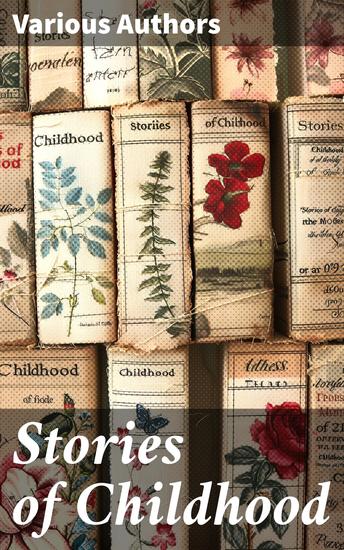
Stories of Childhood - Exploring the Multifaceted Realms of Childhood in Victorian Literature - cover

Stories of Childhood - Exploring the Multifaceted Realms of Childhood in Victorian Literature

Charles Dickens, Elizabeth Stuart Phelps, Rebecca Harding Davis, John Brown, John Ruskin, Ouida, Henry Kingsley, John Neal, S. H. DeKroyft

Publisher: Good Press

  • 0
  • 0
  • 0

Summary

Exploring the dynamic and multifaceted landscape of youth, *Stories of Childhood* is a compelling anthology that delves into the intricacies of innocence, wonder, and the transformative passage from youth to maturity. This collection encompasses a broad spectrum of literary styles ranging from stark realism to imaginative whimsy, capturing the rich tapestry of experiences that define childhood. By including both well-established and lesser-known narratives, the anthology highlights the diversity and universal resonance of childhood themes. Among the stories, some stand out for their poignant depiction of youthful resilience and the challenges faced in the social and moral landscapes of the time. With contributions from luminary figures like Charles Dickens and literary pioneers such as Rebecca Harding Davis, the anthology presents a vibrant chorus of voices. The authors hail from diverse backgrounds, lending their unique perspectives to the overarching theme. These writers engage with significant movements of their era, such as the social reform debates of the Victorian period or the burgeoning awareness of children's rights. Together, they provide a nuanced portrait of childhood that mirrors the historical and cultural complexities of the 19th century while resonating with timeless truths. A treasure trove for both literary enthusiasts and those interested in the historical and cultural conceptions of childhood, *Stories of Childhood* offers readers an unparalleled journey into the imagination and realities of youth. This collection encourages readers to appreciate the intricate dance between diverse narrative styles and thematic explorations, fostering a deeper reflection on childhood'Äôs universal yet distinctly individual experiences. Through its educational value and its wealth of insights, the anthology invites readers to engage in meaningful dialogue about the journey of growing up across different contexts and eras.
Available since: 08/12/2023.
Print length: 157 pages.

Other books that might interest you

  • Block Island - Poems Photos and Letters - cover

    Block Island - Poems Photos and...

    Daniel Berrigan

    • 0
    • 0
    • 0
    A Voice and a Poet for All Times
    It is impossible not to be gripped by the spectacular details of Daniel Berrigan's life. He was Paul Simon's "radical priest" smiling in handcuffs. The Jesuit activist excommunicated by his peers and imprisoned by the state. The unapologetic advocate for society's disempowered. The defiant vandal of objects that fed bodies and materiel to the war machine. And the earnest, yet somehow serene, face emanating from televisions denouncing the inhumanity of that very machine's deeds.
    
    Yet Daniel was first an accomplished poet, inspired in his faith by dreams of peace. It was from this profound contemplation of the world from an early age that his courageous acts of civil disobedience and humanitarianism were born.
    
    In this collection of interconnected poems, Daniel Berrigan writes about his intimate bond with his small cottage built especially for him on Block Island. We see his complete integration into the island itself in his reverence for the everyday life and ever-changing weather winding around him. Yet soon we also discover themes of God and the soul, the land and the sea, friendship and loss, time and impermanence, and the tension between society's potential and its spiritual impoverishment.
    
    Embraced by personal and scholarly writings from friends who remain students of Daniel's ideas and lifeworks, as well as images and letters that enrich our perceptions of Daniel, this ever-timely collection is an essential object for poets, activists, the faithful, and all forms of countercultural rebel alike.
    Show book
  • For the Blood is the Life - A renowned and influential early gothic vampire tale set in Italy - cover

    For the Blood is the Life - A...

    F. Marion Crawford

    • 0
    • 0
    • 0
    Francis Marion Crawford was born on August 2nd, 1854 at Bagni di Lucca, Italy. An only son and a nephew to Julia Ward Howe, the American poet and writer of ‘The Battle Hymn of the Republic’.  
     
    His education began at St Paul's School, Concord, New Hampshire, then to Cambridge University; University of Heidelberg; and the University of Rome.  
     
    In 1879 Crawford went to India, to study Sanskrit and then edited The Indian Herald. In 1881 he returned to America to continue his Sanskrit studies at Harvard University. 
     
    At this time in Boston he lived at his Aunt Julia house and in the company of his Uncle, Sam Ward. His family was concerned about his employment prospects.  After a singing career as a baritone was ruled out, he was encouraged to write.  
     
    In December 1882 his first novel, ‘Mr Isaacs’, was an immediate hit which was amplified by ‘Dr Claudius’ in 1883.  
     
    In October 1884 he married Elizabeth Berdan. They went on to have two sons and two daughters. 
     
    Encouraged by his excellent start to a literary career he returned to Italy with Elizabeth to make a permanent home, principally in Sant' Agnello, where he bought the Villa Renzi that then became Villa Crawford.  
     
    In the late 1890s, he began to write his historical works: ‘Ave Roma Immortalis’ (1898), ‘Rulers of the South’ (1900) and ‘Gleanings from Venetian History’ (1905). The Saracinesca series is perhaps his best work. ‘Saracinesca’ was followed by ‘Sant’ Ilario’ in 1889, ‘Don Orsino’ in 1892 and ‘Corleone’ in 1897, that being the first major treatment of the Mafia in literature.  
     
    Francis Marion Crawford died at Sorrento on Good Friday 1909 at Villa Crawford of a heart attack.  
     
    Set in Italy, ‘For Blood is the Life’ draws us into a world usually beyond our senses.  With Crawford’s pen the uneasy, horrific world of vampires is now upon us.
    Show book
  • How to Begin When Your World Is Ending - A Spiritual Field Guide to Joy Despite Everything - cover

    How to Begin When Your World Is...

    Molly Phinney Baskette

    • 0
    • 0
    • 0
    As a progressive parish minister, Molly Baskette has been a companion during the most vulnerable and unsettled periods of many people's lives. She has also had a front row seat to remarkable human transformation, as many of the ruptures her people lived through turned out to be the way that God got in. But when she was diagnosed with an aggressive cancer at age thirty-nine, with two small children, her theology of and relationship to God was tested more profoundly than ever. 


    Instead of becoming despondent, though, she engaged with her faith more deeply—seizing the opportunity to test the seaworthiness of the faith she had been practicing and preaching. In How to Begin When Your World Is Ending, Baskette shares the questions that confronted her along the way like: Is it true that prayer changes things? Does God care whether we live or die—and is there a damn thing God can do about it anyway? How can vulnerability, counterintuitively, be a strength? And the million-dollar question: is there life after death, and just what might it be like? 


    Weaving together her own story and the stories of those she encountered in her life of faith, Baskette mines joy from all the hardest parts of being human. In doing so she reminds us that whatever you are going through, someone has been there before you, and found meaning in the madness.
    Show book
  • Bernhard Sindberg - The Schindler of Nanjing - cover

    Bernhard Sindberg - The...

    Peter Harmsen

    • 0
    • 0
    • 0
    In December 1937, the Chinese capital, Nanjing, falls and the Japanese army unleash an orgy of torture, murder, and rape. Over the course of six weeks, hundreds of thousands of civilians and prisoners of war are killed. At the very onset of the atrocities, the Danish supervisor at a cement plant just outside the city, 26-year-old Bernhard Arp Sindberg, opens the factory gates and welcomes in 10,000 Chinese civilians to safety. He becomes an Asian equivalent of Oskar Schindler, the savior of Jews in the Holocaust. 


    This biography follows Sindberg from his childhood and on his first adventures as a sailor and a Foreign Legionnaire to the 104 days as a rescuer of thousands of helpless men, women, and children in the darkest hour of the Sino-Japanese War. After his remarkable achievement, he receded back into obscurity, spending decades at sea and becoming a naturalized American citizen, before dying of old age in Los Angeles in 1983. 


    The book sets the record straight by providing the first complete account of Sindberg's life in English. What emerges is the surprising tale of a person who was average in every respect but rose to the occasion when faced with unimaginable brutality, discovering an inner strength and courage that transformed him into one of the great humanitarian figures of the twentieth century and an inspiration for our modern age.
    Show book
  • Christmas Formula - From their pens to your ears genius in every story - cover

    Christmas Formula - From their...

    Stella Benson

    • 0
    • 0
    • 0
    Stella Benson was born on the 6th January 1892 in Easthope, Shropshire to parents who were landed gentry. 
    Her early years involved frequent household moves which was difficult for the child as she suffered from ill-health.  Some of her early education was spent at schools in Germany and Switzerland and by 10 she had developed a lifelong habit of keeping a diary. 
    In the following years her parents separated, and she rarely saw her father. When she did, he encouraged to pause her writing until she had further experience and could better make sense of the world.  When he died, she learned he had been an alcoholic. 
    A winter spent in the West Indies provided material for her first novel ‘I Pose’ published the following year in 1915. 
    During the War years she became involved in the women's suffrage movement and dedicated time outside of writing to support the troops and help the poor. 
    In 1918 she decided to travel spending much time in California, where she also tutored at the University of California, and continued to write.  In China she met her future husband and after marrying in London, journeyed with him to his various Custom postings through Nanning, Beihai, and Hong Kong and the Far East. 
    The works continued to flow novels, short stories, travel essays all helped to build a deserved and burgeoning reputation. 
    Although her works are now in the forgotten and neglected department her writing style, characters, and narratives more than capably demonstrate her obvious talents.   
    Stella Benson died of pneumonia on the 7th December 1933, at Hạ Long in the Vietnamese province of Tonkin.  She was 40.
    Show book
  • Graeme Edge The Moody Blues - Remembering A Legend - cover

    Graeme Edge The Moody Blues -...

    Cyril Taylor-Carr

    • 0
    • 0
    • 0
    Graeme Edge was born on 30th March 1941 in Rochester, Staffordshire. His mother was a pianist for the silent movies and his father, grandfather and great-grandfather were all music-hall singers. 
     
    Edge trained as a draughtsman but soon went into music full time. He never started out to be a drummer, he was, in fact the manager of a group called the Blue Rhythm Band. Graeme always watched the drummer in the group and fooled around on the drums, but never really drummed professionally until that drummer quit and he had to fill in. He then bought his first drum kit. 
     
    The first band he formed was the Silhouettes followed by The Blue Rhythm Band. He then helped to form Gerry Levene and the Avengers, who recorded a single for Decca, and appeared on TV in "Thank Your Lucky Stars". Following the collapse of this group in April 1964 Edge formed The R & B Preachers, which included Denny Laine and Clint Warwick. When that group disbanded the three of them linked up with Ray Thomas and Mike Pinder to form The M & B 5, which later changed its name to The Moody Blues.
    Show book