Begleiten Sie uns auf eine literarische Weltreise!
Buch zum Bücherregal hinzufügen
Grey
Einen neuen Kommentar schreiben Default profile 50px
Grey
Jetzt das ganze Buch im Abo oder die ersten Seiten gratis lesen!
All characters reduced
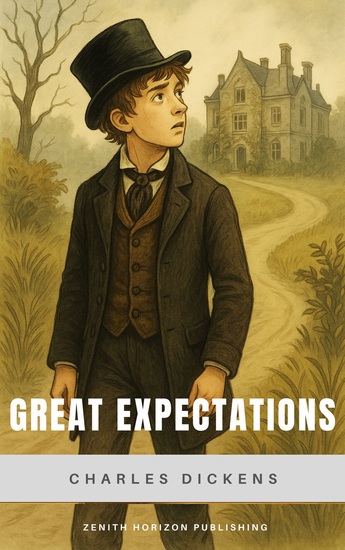
Great Expectations - A Timeless Tale of Ambition Class and Redemption by Charles Dickens - cover

Great Expectations - A Timeless Tale of Ambition Class and Redemption by Charles Dickens

Charles Dickens

Verlag: Zenith Horizon Publishing

  • 0
  • 0
  • 0

Beschreibung

🕯️ What is the price of becoming a gentleman?
From the haunting marshes of Kent to the glittering streets of London, Great Expectations follows the story of Pip—an orphan with humble beginnings—whose life changes forever after a mysterious benefactor offers him a chance at wealth and high society 🎩💼.

As Pip climbs the social ladder, he learns that appearances can deceive and that real greatness lies in compassion, not coin. Full of unforgettable characters—Miss Havisham, Estella, and Magwitch—this classic reveals the dark and dazzling corners of Victorian England.

Why readers still treasure this masterpiece:
✔ "A beautifully layered tale of ambition, regret, and personal growth."
✔ "Dickens at his most poetic and human."
✔ For fans of historical fiction, coming-of-age stories, and moral reflection 📚🌫️🎭

Included in this special edition:
🖼️ Illustrated chapters with curated visuals
📜 Historical introduction and reading guide
📱 Seamless Kindle navigation for an effortless reading experience

📥 Download Great Expectations now and rediscover the power of character, conscience, and transformation.
Verfügbar seit: 06.06.2025.
Drucklänge: 97 Seiten.
Weitere Bücher, die Sie mögen werden

  • A Lesson on a Tortoise - From their pens to your ears genius in every story - cover

    A Lesson on a Tortoise - From...

    D H Lawrence

    • 0
    • 0
    • 0
    David Herbert Lawrence was born on the 11th September 1885 in Eastwood, Nottinghamshire, a coal mining town where the reality of a harsh life was only useful as experiences for future literary works. 
    He was educated at Beauvale Board School and became the first local boy to receive a scholarship to attend Nottingham High School. After 3 years he became a junior clerk in Haywood’s surgical appliances factory. He was also attempting a literary career which, in the short term, led to a teacher training position in Eastwood and later a teaching qualification from University College, Nottingham.  
    Lawrence’s first efforts were poems, short stories and a draft of ‘The White Peacock’. Moving to London and a teaching position in Croydon his writing attracted the attention of Ford Madox Ford, editor of The English Review, and he commissioned him to write ‘Odour of Chrysanthemums’.  
    Wanting to write full-time he now began work on what would become ‘Sons and Lovers.   
    In 1912 he met the older and married mother-of-three Frieda Weekley. They eloped to Germany and here Lawrence could see for himself the growing tensions with France.  So keen was his interest that he was arrested and accused of being a British spy.  
    In early 1914 Frieda obtained her divorce and they returned to Britain to be married just days before the outbreak of war. Owing to her German parentage, and his own public dislike of militarism and violence, the couple were treated with contempt and suspicion throughout the war years.  
    Despite this he continued to write but his reputation in England was so tarnished and, mirrored by his own disdain for the country, he and Frieda left England in November 1919, first for Europe and then America via Ceylon and Australia. 
    They bought a ranch in Taos, New Mexico and visited Mexico several times. The third visit in March 1925 caused a near fatal attack of malaria. To convalesce they moved to Florence. Here he continued work on ‘Lady Chatterley’s Lover’ which for many years would cause controversy. A renewed interest in oil painting resulted in an exhibition in 1929 which was raided by the police and several works were confiscated.  
    D H Lawrence died of complications arising from a bout of tuberculosis on the 2nd of March 1930 in Vence, France.  He was 44.
    Zum Buch
  • War and Peace (Book Eight: 1811-12) - cover

    War and Peace (Book Eight: 1811-12)

    Leo Tolstoy

    • 0
    • 0
    • 0
    War and Peace is a literary work mixed with chapters on history and philosophy by the Russian author Leo Tolstoy. It was first published serially, then published in its entirety in 1869. It is regarded as one of Tolstoy's finest literary achievements and remains an internationally praised classic of world literature.
    Book 8: 1811-12: After Prince Andrew’s engagement to Natásha, Pierre without any apparent cause suddenly felt it impossible to go on living as before. Firmly convinced as he was of the truths revealed to him by his benefactor, and happy as he had been in perfecting his inner man, to which he had devoted himself with such ardor—all the zest of such a life vanished after the engagement of Andrew and Natásha and the death of Joseph Alexéevich.
    Zum Buch
  • Eveline - From their pens to your ears genius in every story - cover

    Eveline - From their pens to...

    James Joyce

    • 0
    • 0
    • 0
    James Augustine Aloysius Joyce was born on the 2nd February 1882 in Dublin into a middle-class family, and the eldest of ten surviving siblings 
    Admired as a brilliant student he briefly attended the Christian Brothers-run O'Connell School before excelling at the Jesuit schools of Clongowes and Belvedere.  From there he went on to attend University College Dublin from 1898, studying English, French and Italian 
    In 1902, Joyce was now in his early twenties, and went to Paris to study Medicine but soon abandoned his teachings.  Back in Dublin to attend to his dying Mother he met Nora Barnacle. They bonded immediately into a life-long match. Together they decided to emigrate to Europe.  The couple lived in Trieste, Rome, Paris, and finally Zürich where Joyce pursued a variety of jobs and ventures to supplement his literary pursuits but none of these paid off.  
    After publishing a poetry volume, ‘Chamber Music’, in 1907, his short story collection ‘The Dubliners’, in 1914, helped establish his talent in the rapidly changing world.  
    Although far from home Joyce’s literary heart and works were set in his recollections of Dublin.  Characters are close resemblances of family and friends and indeed enemies.  His landmark work ‘Ulysses’, published in 1922, is set in the streets and alleyways of the city as it parallels Homer’s Odyssey in a variety of styles including its famed stream of consciousness. 
    His pen continued to produce classics of the order of ‘A Portrait of the Artist as A Young Man’ and ‘Finnegan’s Wake’ together with several volumes of poetry and a play ‘The Exiles, in 1918.   
    On the 11th January 1941, Joyce underwent surgery in Zürich for a perforated duodenal ulcer. The next day he fell into a coma. On the 13th after a brief period of lucidity in which he called for his wife and son he passed.  He was 58.
    Zum Buch
  • Daisy Miller - cover

    Daisy Miller

    Henry James

    • 0
    • 0
    • 0
    "Daisy Miller" is a novella written by Henry James, first published in 1878. The story is set in the late 19th century and revolves around the experiences of a young and unconventional American woman named Daisy Miller as she travels in Europe. The novella explores themes of social class, cultural clash, and the consequences of defying societal norms.
    Zum Buch
  • Stories To Make You Cry - Sometimes you need a good cry - cover

    Stories To Make You Cry -...

    Anton Chekhov, Stephen Crane,...

    • 0
    • 0
    • 0
    When we read or listen, words can have a transforming effect.  Our mood can alter in the space of a few sentences from joy to sadness.  And not just our mood.  These words can affect us physically, they can engage our emotions and even in their sadness bring a lump to our throat and tears to our eyes.  Sometimes the relief can be palpable. 
     
    Our authors, from Anton Chekhov, Stephen Crane, Willa Cather, Katherine Mansfield and a wealth of others are well aware of what their talents will evoke.   Genius has many names.   
     
    1 - Short Stories To Make You Cry  - An Introduction 
    2 - Vanka by Anton Chekhov 
    3 - A Dark Brown Dog by Stephen Crane 
    4 - Suicides by Guy de Maupassant 
    5 - The Life of Ma Parker by Katherine Mansfield 
    6 - The District Doctor by Ivan Turgenev 
    7 - Paul's Case by Willa Cather 
    8 - Hands by Sherwood Anderson 
    9 - Silence by Leonid Andreyev 
    10 - The Stones of the Village by Alice Dunbar Nelson 
    11 - Hide And Seek or Pliatki by Fyodor Sologub
    Zum Buch
  • The Count of Monte Cristo - cover

    The Count of Monte Cristo

    Alexandre Dumas

    • 0
    • 0
    • 0
    The Count of Monte Cristo (French: Le Comte de Monte-Cristo) is an adventure novel written by French author Alexandre Dumas (père) completed in 1844. It is one of the author's most popular works, along with The Three Musketeers. Like many of his novels, it was expanded from plot outlines suggested by his collaborating ghostwriter Auguste Maquet. 
    The story takes place in France, Italy, and islands in the Mediterranean during the historical events of 1815–1839: the era of the Bourbon Restoration through the reign of Louis-Philippe of France. It begins on the day that Napoleon left his first island of exile, Elba, beginning the Hundred Days period when Napoleon returned to power. The historical setting is a fundamental element of the book, an adventure story centrally concerned with themes of hope, justice, vengeance, mercy, and forgiveness. 
    Before he can marry his fiancée Mercédès, Edmond Dantès, a French nineteen-year-old first mate of the Pharaon, is falsely accused of treason, arrested, and imprisoned without trial in the Château d'If, a grim island fortress off Marseille. A fellow prisoner, Abbé Faria, correctly deduces that romantic rival Fernand Mondego, envious crewmate Danglars, and double-dealing magistrate De Villefort are responsible. Over the course of their long imprisonment, Faria educates Dantès and tells him of a cache of treasure he found. After Faria dies, Dantès escapes and finds the treasure. As the powerful and mysterious Count of Monte Cristo, he enters the fashionable Parisian world of the 1830s to avenge himself.
    Zum Buch