Rejoignez-nous pour un voyage dans le monde des livres!
Ajouter ce livre à l'électronique
Grey
Ecrivez un nouveau commentaire Default profile 50px
Grey
Abonnez-vous pour lire le livre complet ou lisez les premières pages gratuitement!
All characters reduced
Barnaby Rudge - cover

Barnaby Rudge

Charles Dickens

Maison d'édition: CLXBX

  • 0
  • 0
  • 0

Synopsis

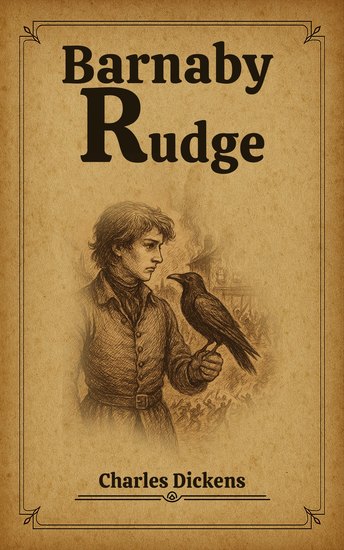
Barnaby Rudge is a powerful historical novel by Charles Dickens that combines vivid social commentary with gripping drama, set against the turbulent backdrop of the Gordon Riots of 1780. As one of Dickens's lesser-known yet deeply compelling works, the novel explores the dangers of mob violence, political fanaticism, and the human cost of social unrest.

At the heart of the story is Barnaby Rudge, a kind-hearted young man with an intellectual disability, whose innocence and vulnerability stand in stark contrast to the chaos surrounding him. Guided by his devoted mother and accompanied by his ominous raven, Grip, Barnaby becomes tragically swept up in the violent anti-Catholic riots that engulf London. His personal journey unfolds alongside a wide cast of characters, including secretive fathers, conflicted lovers, and ruthless agitators, whose lives intersect as private grievances collide with public disorder.

Dickens masterfully portrays the frightening psychology of crowds and the ease with which fear and prejudice can ignite mass violence. Through dramatic scenes of destruction and upheaval, he exposes the manipulation of ordinary people by demagogues and highlights the fragility of justice and reason in times of crisis. At the same time, the novel remains deeply human, emphasizing compassion, loyalty, and moral responsibility.

Rich in atmosphere and historical detail, Barnaby Rudge blends suspense, romance, and social criticism in Dickens's signature style. Its exploration of innocence versus corruption, order versus chaos, and individual conscience versus collective madness remains strikingly relevant.

Barnaby Rudge stands as an important work in Dickens's canon and a vivid reminder of the destructive power of intolerance and extremism. It is an essential read for lovers of classic literature, historical fiction, and novels that probe the darker currents of society while affirming the enduring value of humanity and empathy.
Disponible depuis: 04/02/2026.
Longueur d'impression: 888 pages.
D'autres livres qui pourraient vous intéresser

  • Five Weeks in a Balloon - cover

    Five Weeks in a Balloon

    Jules Verne

    • 0
    • 0
    • 0
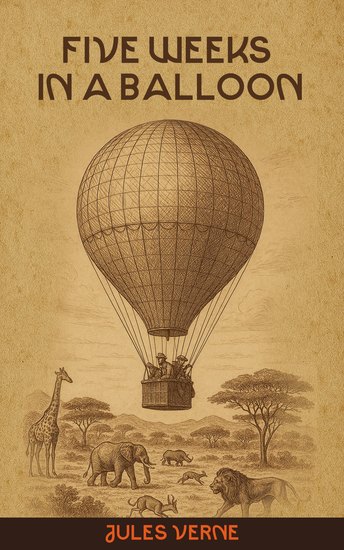
    Five Weeks in a Balloon is the groundbreaking adventure novel that launched Jules Verne's legendary career and introduced readers to his unique blend of science, imagination, and exploration. Set during the great age of discovery, the story follows Dr. Samuel Fergusson, an ingenious British scientist who proposes an audacious plan: to cross the uncharted interior of Africa in a hydrogen-powered hot air balloon.
    
    Accompanied by his loyal servant Joe and his skeptical yet courageous friend Richard Kennedy, Dr. Fergusson embarks on a breathtaking aerial journey over vast deserts, dense jungles, towering mountains, and unknown territories. As the balloon drifts across the African continent, the travelers confront violent storms, hostile wildlife, dwindling supplies, and life-threatening mechanical failures. Each challenge is met with ingenuity, scientific reasoning, and unshakable determination.
    
    More than a thrilling tale of exploration, Five Weeks in a Balloon reflects Jules Verne's deep fascination with scientific progress and humanity's drive to push beyond the limits of the known world. Rich in geographic detail and imaginative technology, the novel captures both the wonder and danger of exploration during the nineteenth century.
    
    Fast-paced, educational, and endlessly entertaining, Five Weeks in a Balloon remains a timeless classic of adventure and early science fiction, celebrating curiosity, courage, and the enduring human spirit of discovery.
    Voir livre
  • The Diary of A Plain Girl - A story that shows a glimpse into the mind of a low self esteem woman - cover

    The Diary of A Plain Girl - A...

    Amy Levy

    • 0
    • 0
    • 0
    Amy Levy was born in London, England in 1861, the second of seven in a fairly wealthy Anglo-Jewish family. The children of the family read and participated in secular literary activities becoming firmly integrated into Victorian life. 
     
    Amy was educated at Brighton High School, Brighton, and studied at Newnham College, Cambridge; she was the first Jewish student when she arrived in 1879, but left after four terms. 
     
    But her writing career was to begin early; her poem "Ida Grey" appearing when she was only fourteen. Her stories "Cohen of Trinity" and "Wise in Their Generation," were published by Oscar Wilde in his magazine “Women's World," and are considered among her best. 
     
    Her first novel Romance of a Shop, written in 1888 is based on four sisters who experience the pleasures and hardships of running a business in London during the 1880s. This was followed by Reuben Sachs (also 1888) and concerned with Jewish identity and mores in the England of her time and therefore somewhat controversial); 
     
    Her other writings reveal feminist concerns; Xantippe and Other Verses, from 1881 includes a poem in the voice of Socrates's wife; the volume A Minor Poet and Other Verse from 1884 has dramatic monologues and lyric poems. 
     
    In 1886, Levy began a series of essays on Jewish culture and literature for the Jewish Chronicle, including The Ghetto at Florence, The Jew in Fiction, Jewish Humour and Jewish Children. 
     
    That same year while travelling in Florence she met writer Vernon Lee. It is generally assumed they fell in love and this inspired the poem ‘To Vernon Lee’. 
     
    Her final book of poems, A London Plane-Tree from 1889, shows the beginnings of the influence of French symbolism. 
     
    Despite many friendships and active life, Amy had suffered for a long time with major depression and this, together with her growing deafness, led her to commit suicide by inhaling carbon monoxide on September 10, 1889, at the age of twenty-seven
    Voir livre
  • The Pleasant Husband - From their pens to your ears genius in every story - cover

    The Pleasant Husband - From...

    Marjorie Bowen

    • 0
    • 0
    • 0
    Margaret Gabrielle Vere Campbell was born on the 1st November 1885 on Hayling Island in Hampshire.  
    Her childhood was fraught with problems, her alcoholic father left early in her life and was later found dead on a London Street.  Life thereafter was poverty with an uncaring mother. 
    However, her talents took her to the Slade School of Fine Art and later to study in Paris.  
    Her first fiction, written at a mere 16, was a violent medieval historical novel, ‘The Viper of Milan’.  Initially rejected by several publishers it went on to become a best-seller  
    After this her prolific writings were the main financial support for the family.  Her literary output numbered over 150 volumes, mainly under the pseudonym of Marjorie Bowen but she also used the names Joseph Shearing, George R Preedy, John Winch, Robert Paye and Margaret Campbell.  Within this output she assigned the pseudonyms to the various genres she worked across, from Historical fiction to supernatural short stories.  
    Perhaps her best known work is the 1909 book ‘Black Magic’, a Gothic horror novel about a medieval witch. 
    Several of her works were also adapted into films.   
    She was married twice.  The first to Zefferino Emilio Constanza (they had two children), who died of tuberculosis, and then to Arthur L Long (and another two children). 
    Marjorie Bowen died on the 23rd December 1952 at St Charles Hospital in North Kensington, London after suffering a serious concussion from a fall in her bedroom.  She was 67.
    Voir livre
  • The Secret Garden - cover

    The Secret Garden

    Frances Hodgson Burnett

    • 0
    • 0
    • 0
    "The Secret Garden," written by Frances Hodgson Burnett in the late 19th century, tells the story of Mary Lennox, a spoiled and unhappy child who becomes orphaned and is sent to live with her reclusive uncle at the mysterious Misselthwaite Manor. As Mary explores the manor's enchanting yet neglected gardens, including a hidden garden that has been locked away for years, she begins a journey of self-discovery, healing, and friendship. 
    At the beginning of the book, we meet Mary Lennox, who is left alone in a foreign land after a cholera outbreak claims her parents' lives. Sent to England to live with her uncle, Mary soon realizes she is largely forgotten and left to her own devices. The opening chapters illustrate her initial experiences with the manor, highlighting her disdain for her new environment and her feelings of loneliness. This sets the stage for her growth and the adventures that lie ahead as she uncovers the garden's hidden beauty and forms connections with others, ultimately transforming her character and outlook on life.
    Voir livre
  • Dubliners - cover

    Dubliners

    James Joyce

    • 0
    • 0
    • 0
    "Dubliners" is a collection of 15 short stories by James Joyce, chronicling the lives of various characters in Dublin, Ireland, at the turn of the 20th century. Each story offers a snapshot of life, capturing moments of realization, epiphany, and the struggles of everyday Dubliners. Themes of paralysis, the search for meaning, the constraints of society, and the tensions between the desire for escape and the pull of home are recurrent. The stories culminate with "The Dead," considered one of the greatest short stories in the English language.
    Voir livre
  • Elizabeth and Her German Garden - cover

    Elizabeth and Her German Garden

    Elizabeth von Arnim

    • 0
    • 0
    • 0
    Elizabeth von Arnim, who is best known for her later novel The Enchanted April, married a Prussian aristocrat and, with their five children, lived in Nassenheide, Pomerania. Elizabeth and Her German Garden is a semi-autobiographical novel about the joy that the protagonist finds in the delights of her Pomeranian garden, which provides relief from the stifling environment of her household. The novel was originally published anonymously because von Arnim feared that her husband, whom she satirised in the book, would disapprove.Each season of the year is wittily recorded, bringing new events and visitors, conveyed through von Arnim’s idiosyncratic perspective, while the ‘kingdom of heaven’ of the garden provides a calm place where the author finds solace.
    Voir livre