Rejoignez-nous pour un voyage dans le monde des livres!
Ajouter ce livre à l'électronique
Grey
Ecrivez un nouveau commentaire Default profile 50px
Grey
Abonnez-vous pour lire le livre complet ou lisez les premières pages gratuitement!
All characters reduced
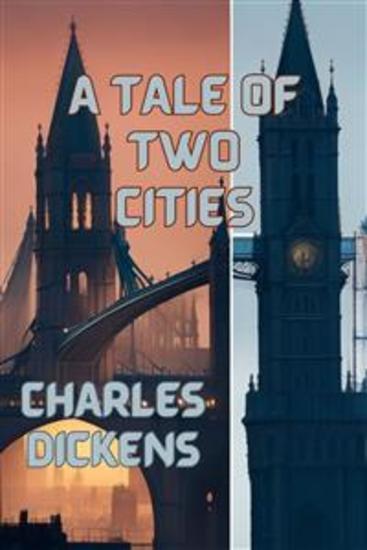
A Tale Of Two Cities(Illustrated) - cover

A Tale Of Two Cities(Illustrated)

Charles Dickens

Maison d'édition: Micheal Smith

  • 0
  • 0
  • 0

Synopsis

Features:

	 Illustrated Edition: Immerse yourself with 20 breathtaking illustrations that bring the story to life.
	 Summary Included: Dive into the heart of the story with a concise and captivating summary.
	 Character List: Get acquainted with the iconic personalities that inhabit Dickens' world.
	 Author Biography: Delve deeper into the life and times of the literary genius, Charles Dickens

Embark on a journey through the tumultuous waves of revolution and redemption, love and sacrifice, hope and despair. Set against the vivid backdrops of London and Paris, "A Tale of Two Cities" is Dickens' riveting tale of the French Revolution and its impact on a cast of memorable characters.

Meet Charles Darnay, an honorable Frenchman who must confront his aristocratic legacy, and Sydney Carton, the embittered English lawyer seeking meaning amidst the chaos. As their lives intertwine with the radiant Lucie Manette and her father's shadowed past, witness a narrative that oscillates between the grim guillotine streets of Paris and the misty avenues of London.

In this Special Illustrated Edition, the world of Dickens is brought to vibrant life, inviting readers old and new to experience the drama, passion, and resilience of its characters. Uncover the depths of human nature, the thin line between heroism and cowardice, and the eternal battle of light against darkness.

Whether you're revisiting this classic or discovering it for the first time, this edition of "A Tale of Two Cities" promises an enriched and unforgettable reading experience.


Disponible depuis: 08/12/2023.
D'autres livres qui pourraient vous intéresser

  • Sherlock Holmes The Sign of the Four - Audiobook - cover

    Sherlock Holmes The Sign of the...

    Arthur Conan Doyle, Classic...

    • 0
    • 0
    • 0
    The Sign of the Four is the second book in Sir Arthur Conan Doyle's legendary series about Sherlock Holmes, following A Study in Scarlet. This gripping novel delves into one of Holmes and Dr. Watson's most thrilling cases, featuring mysterious murders, a hidden treasure, and a pact sealed by betrayal. Set in Victorian England, the story unravels a dark and captivating tale involving a secret society, exotic intrigue, and a perilous chase through the streets of London.This book also introduces Watson's future wife, Mary Morstan, adding an emotional depth to the narrative. With its complex plot and dynamic storytelling, The Sign of the Four solidifies Sherlock Holmes's place as one of the most iconic detectives in literature.
    Voir livre
  • Emma (Volume 2) - cover

    Emma (Volume 2)

    Jane Austen

    • 0
    • 0
    • 0
    Emma (Volume 2), by Jane Austen, is a novel about youthful hubris and the perils of misconstrued romance. The story takes place in the fictional village of Highbury and the surrounding estates of Hartfield, Randalls, and Donwell Abbey and involves the relationships among individuals in those locations consisting of "3 or 4 families in a country village".
    Voir livre
  • Alpine Divorce An - From their pens to your ears genius in every story - cover

    Alpine Divorce An - From their...

    Robert Barr

    • 0
    • 0
    • 0
    Robert Barr was born in Glasgow, Scotland on the 16th September 1849.  Five years later the family emigrated to a farm near Muirkirk in Upper Canada.  
    His early years were uneventful as the family settled into their new lives and Barr began his education. 
    A career path as a teacher opened up for him and, by 1874, he had been appointed as headmaster at the Central School at Windsor.  Concurrently he also wrote travel and humourous articles for magazines.  Within two years their success in the regional periodicals encouraged him to change careers to become a reporter and columnist. 
    In August 1876, at age 27, he married Eva Bennett and they began a family. 
    A half decade later he was the exchange editor of the ‘Free Press’ but decided to relocate to London to establish an English edition and to write fiction, which both met with much success. 
    Over the years he was a prolific writer and in 1892, along with Jerome K Jerome, he established ‘The Idler’ magazine and, just after the turn of the century, became its sole proprietor. 
    Although a number of his crime novels and short stories are parodies on Sherlock Holmes and other best-selling detectives of the time, he also wrote short stories across a whole range of subjects and genres usually with intriguing ideas and many laced with wit and humour. 
    Robert Barr died at his home in Woldingham, Surrey of heart disease on the 21st October 1912.  He was 63.
    Voir livre
  • 1984 - cover

    1984

    George Orwell

    • 0
    • 0
    • 0
    "1984" is a dystopian novel that was published in 1949. The story is set in Airstrip One (formerly known as Great Britain), a province of the superstate Oceania in a world of perpetual war, government surveillance, and manipulation of truth. The novel follows the life of Winston Smith, a low-ranking member of the Party who becomes disillusioned with the oppressive regime led by the enigmatic figure known as Big Brother.
    Voir livre
  • Case of Charles Dexter Ward The (Ungekürzt) - cover

    Case of Charles Dexter Ward The...

    H. P. Lovecraft

    • 0
    • 0
    • 0
    Charles Dexter Ward is a young man from a prominent Rhode Island family who has disappeared from a mental asylum. He had been incarcerated during a prolonged period of insanity, during which he exhibited minor and inexplicable physiological changes. His empty cell is found to be very dusty. The bulk of the story concerns the investigation conducted by the Wards' family doctor, Marinus Bicknell Willett, in an attempt to discover the reason for Ward's madness and physiological changes. Willett learns that Ward had spent the past several years attempting to discover the grave of his ill-reputed ancestor, Joseph Curwen. The doctor slowly begins to reveal the truth behind the legends surrounding Curwen, an eighteenth-century shipping entrepreneur and alleged alchemist, who was in reality a necromancer and mass murderer. A raid on Curwen's farm was remarkable for the shouted incantations, lights, explosions, and some not-quite-human figures shot down by the raiders. The raiders swore any witnesses to strict secrecy about what they saw and heard. As Willett's investigations proceed, he finds that Charles had recovered Curwen's ashes, and through the use of magical formulae contained in documents found hidden in Curwen's home in Providence, was able to call forth Curwen from his "essential saltes" and resurrect him. Willett also finds that Curwen, who resembles Charles enough to pass for him, murdered and replaced his modern descendant and resumed his evil activities. Although Curwen convinces onlookers that he is Charles, his anachronistic mindset and behavior lead authorities to certify him insane and imprison him in an asylum.
    
    While Curwen is locked up, Willett's investigation leads him to a bungalow in Pawtuxet Village, which Ward had purchased while under the influence of Curwen. The house is on the site of the old farm which was Curwen's headquarters for his nefarious doings; beneath is a vast catacomb that the wizard had built as a lair during his previous lifetime. During a horrific journey through this labyrinth, in which Willett sees a deformed monster in a pit, he discovers the truth about Curwen's crimes and also the means of returning him to the grave. It is also revealed that Curwen has been engaged in a long-term conspiracy with certain other necromancers, associates from his previous life who have somehow escaped death, to resurrect and torture the world's wisest people to gain knowledge that will make them powerful and threaten the future of mankind. While in Curwen's laboratory, Willett accidentally summons an ancient entity who is an enemy of Curwen and his fellow necromancers. The doctor faints, awakening much later in the bungalow. The entrance to the vaults has been sealed as if it had never existed, but Willett finds a note from the being written in Latin instructing him to kill Curwen and destroy his body. Willett confronts Curwen at the asylum and succeeds in reversing the resurrection spell, returning the sorcerer to dust. News reports reveal that Curwen's prime co-conspirators and their households have met brutal deaths, and their lairs have been destroyed.
    Voir livre
  • A Dialogue Among Clever People - From their pens to your ears genius in every story - cover

    A Dialogue Among Clever People -...

    Leo Tolstoy

    • 0
    • 0
    • 0
    Leo Tolstoy was born in 1828 in the Russian province of Tula to a wealthy noble family. As a child, he had private tutors but he showed little interest in any formal education. When he went to the University of Kazan in 1843 to study oriental languages and law, he left without completing his courses.  Life now was relaxed and idle but with some writing also taking place.  Gambling debts forced an abrupt change of path and he joined the army to fight in the Crimean War.  He was commended for his bravery and promoted but was appalled at the brutality and loss of life.  He recorded these and other earlier experiences in his diaries which formed the basis of several of his works. 
    In 1852 ‘Childhood’ was published to immediate success and was followed by ‘Boyhood’ and ‘Youth’. 
    His experience in the army and the horrors he witnessed resulted in ‘The Cossacks’ in 1862 and the trilogy ‘Sevastopol Tales’. After the war he travelled around Europe, visiting London and Paris and meeting such luminaries as Victor Hugo and Charles Darwin.  
    It was now that Tolstoy began his masterpiece, ‘War and Peace’. Published in 1869 it was an epic work that changed literature. He quickly followed this with ‘Anna Karenina’.  
    These successes made Tolstoy rich and helped him accomplish many of his dreams but also brought problems as he grappled with his faith and the lot of the oppressed poor. These revolutionary views became so popular that the authorities now kept him under surveillance.  
    He led a life of asceticism and vegetarianism and put his socialist ideals into practice by establishing numerous schools for the poor and food programmes. He also believed in giving away his wealth, which caused much discord with his wife.  
    His writing continued to bring forth classics such as ‘The Death of Ivan Ilyich’ and many brilliant and incisive short stories such as ‘How Much Land Does A Man Need’.  
    In 1901 Tolstoy was excommunicated from the Church and controversially deselected for the Nobel Prize for Literature. 
    Whilst undertaking a pilgrimage by train in October 1910 with his daughter Aleksandra he caught pneumonia in the nearby town of Astapovo.  Leo Tolstoy died on November 9th, 1910, he was 82.
    Voir livre