Begleiten Sie uns auf eine literarische Weltreise!
Buch zum Bücherregal hinzufügen
Grey
Einen neuen Kommentar schreiben Default profile 50px
Grey
Jetzt das ganze Buch im Abo oder die ersten Seiten gratis lesen!
All characters reduced
Dare to Win - The Blueprint to Building and Leading High Performance and Championship Teams - cover

Dare to Win - The Blueprint to Building and Leading High Performance and Championship Teams

Chantal Vallée

Verlag: ECW Press

  • 0
  • 0
  • 0

Beschreibung

“This book definitely gives the blueprint for winning in sports, business, and life in general.” — Paul Jones, Sportscaster, NBA TV Canada
		 
Embark on a journey from underperformance to excellence with Dare to Win, the one-of-a-kind collaboration by Chantal Vallée and Dr. Gordon Bloom
		 
Drawing on two decades of leadership and coaching research, Vallée and Bloom reveal the proven strategies behind the University of Windsor women’s basketball team’s transformation from last place to five-time national champions. Dare to Win bridges the gap between theory and practice, blending leadership insights, real-world examples, and Vallée’s experiences as both an academic researcher and a championship-winning coach. This invaluable resource is perfect for anyone seeking to build successful teams and elevate leadership, management, and coaching skills in sports and beyond.
Verfügbar seit: 18.03.2025.
Drucklänge: 240 Seiten.

Weitere Bücher, die Sie mögen werden

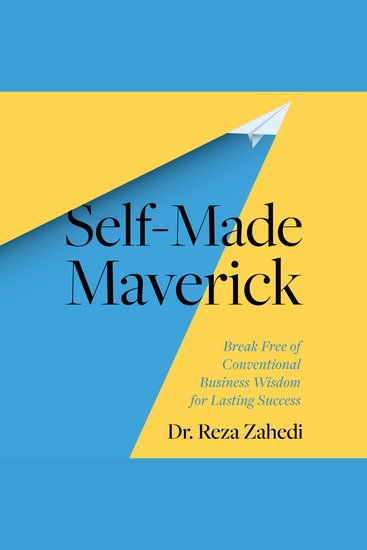
  • Self-Made Maverick - Break Free of Conventional Business Wisdom for Lasting Success - cover

    Self-Made Maverick - Break Free...

    Dr. Reza Zahedi

    • 0
    • 0
    • 0
    USA Today Bestseller
    
    The boldest entrepreneurs build empires—while others follow the rules.
    
    Most people who call themselves entrepreneurs are just playing business, following the same tired formulas that lead to predictable, ordinary results. Real success—the kind that builds wealth, power, and lasting impact—doesn’t come from following the rules. It comes from breaking them.
    
    In Self-Made Maverick, Dr. Reza Zahedi, a leading figure in international real estate, delivers a powerful manifesto for those who refuse to settle. Too many entrepreneurs believe that success requires a massive start-up budget, an ironclad business plan, and years of experience. But that’s a lie. Lasting self-made success comes from thinking differently, seizing opportunities, and embracing the unconventional path.
    
    Drawing from real-world experience, Dr. Zahedi reveals what it truly takes to build a business from the ground up, without following someone else’s blueprint. Through raw personal insights, practical exercises, and lessons from his own seven-figure businesses, he provides the tools you need to create success on your own terms.
    
    This isn’t a book about fitting in; it’s about standing out. If you’re ready to challenge outdated beliefs, think like a true entrepreneur, and build a legacy beyond limits, Self-Made Maverick is your ultimate guide.
    Zum Buch
  • The Fall of the Human Intellect - cover

    The Fall of the Human Intellect

    A. Parthasarathy

    • 0
    • 0
    • 0
    Stress, depression, disease in individuals and militancy, vandalism, terrorism in societies is threatening humanity with extinction. The book traces back the source of this impending disaster to the continual neglect of the human intellect. It highlights the fundamental difference between intelligence and intellect. Intelligence is acquired from schools and universities while the intellect is developed through one’s personal effort in thinking, reasoning, questioning before accepting anything. The book is designed to develop the intellect and save humanity from self-destruction.
    Zum Buch
  • Our Least Important Asset - Why the Relentless Focus on Finance and Accounting is Bad for Business and Employees - cover

    Our Least Important Asset - Why...

    Peter Cappelli

    • 0
    • 0
    • 0
    Real wages have stagnated or declined for most workers, job insecurity has increased, and retirement income is uncertain. Why have jobs gotten so much worse? 


    As Peter Cappelli argues, these issues and others stem from the logic of financial accounting and its fundamental flaws in dealing with human capital. Financial accounting views employee costs as fixed costs that cannot be reduced and fails to account for the costs of bad employees and poor management. The simple goal of today's executives is to drive down employment costs, even if it raises costs elsewhere. 


    In Our Least Important Asset, Cappelli argues that the financial accounting problem explains many puzzling practices in contemporary management—employers' emphasis on costs per hire over the quality of hires, the replacement of regular employees with "leased" workers, the shift to unlimited vacations, and the transition of hiring responsibilities from professional recruiters to more expensive line managers. In the process, employers undercut all the evidence about what works to improve the quality, productivity, and creativity of workers. Drawing on decades of experience and research, Cappelli provides a comprehensive and insightful critique of the modern workplace where the gaps in financial accounting make things worse for everyone, from employees to investors.
    Zum Buch
  • HBR Guide to Designing Your Retirement - cover

    HBR Guide to Designing Your...

    Harvard Business Review

    • 0
    • 0
    • 0
    Make a retirement plan that includes more than golf, mah-jongg, and grandkids. 


    When what you do is inextricably tied to who you are for so much of your life, it can be daunting to think of who you'll be if you slow down—or stop working entirely. You've charted your own career journey, made difficult choices, led teams through times of turmoil, celebrated big wins, and moved on from devastating losses. How do you just stop? What do you do without a purpose and a plan—and a crowded calendar? How do you make this next stage of your life fulfilling and satisfying? 


    While the idea of not working can be simultaneously wonderful and overwhelming, you can figure out what you want the end of your career and your retirement to look like before you submit your resignation. This book won't help you figure out whether or not you can afford to retire, but it will help you figure out what you'd like to do and who you'd like to be. You'll learn how to: assess your readiness to make a transition; make a plan to slow your pace—or stop completely; experiment with possible future selves; find new ways to apply old skills; communicate your plan to key partners; bridge your old identity to the new one you create; and keep connected to the passions and people that matter.
    Zum Buch
  • Restroom Reflections - How Communication Changes Everything - cover

    Restroom Reflections - How...

    Alison Jean Lester

    • 0
    • 0
    • 0
    These thought-provoking and entertaining essays on how to improve our communication – with ourselves, with our loved ones, with our colleagues and clients, and with strangers – offer tips on developing confidence, awareness, sensitivity, humor, effectiveness, and creativity. Communication coach and author Alison Jean Lester draws from her varied experiences as corporate coach, writer, stand-up and improvisational comedian, world traveler, mother, wife, daughter, sister and friend to bring you this series of pithy reflections on common communication hurdles, and tools for making them feel a lot smaller.
    Zum Buch
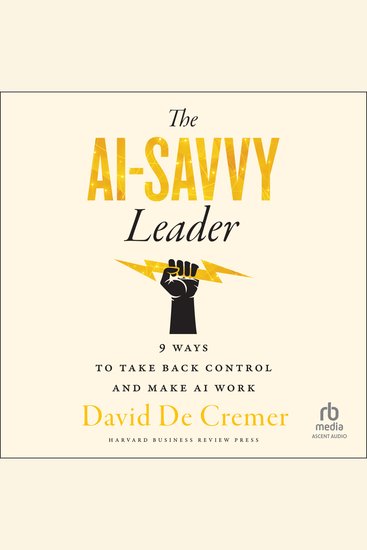
  • The AI-Savvy Leader - Nine Ways to Take Back Control and Make AI Work - cover

    The AI-Savvy Leader - Nine Ways...

    David De Cremer

    • 0
    • 0
    • 0
    Leaders, don't let AI get the best of you. 


    AI is coming fast and will affect every part of a business, including the role of the leader. And up until now, leaders have largely ceded their role in the transformation—pushing determination of strategy out to tech teams and leaving investment decisions with groups that don't have a full view of the organization. Just when responsible leadership is more imperative than ever, leaders are not stepping up to understand and execute in the new world of human-machine collaboration. A generation of AI transformation failures awaits if leaders don't connect their use of AI to their strategies. 


    This book helps leaders retake control of the wildly rapid deployment of AI across organizations. It outlines cleanly and concisely nine actions leaders need to take to successfully steward a transition to a more AI-centric future that will lead to growth for all—companies and workers—and avoid the kinds of mistakes that author David De Cremer has seen many early adopters already make. This is not a book about AI technology itself or the latest developments in machine learning but rather a clarion call for leaders to take their rightful place at the front of the AI revolution and lead their organization into the new world.
    Zum Buch