

Begleiten Sie uns auf eine literarische Weltreise!
Buch zum Bücherregal hinzufügen
Grey
Einen neuen Kommentar schreiben Default profile 50px
Grey
Jetzt das ganze Buch im Abo oder die ersten Seiten gratis lesen!
All characters reduced
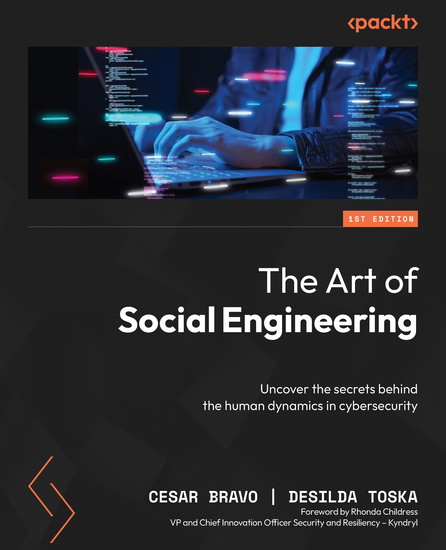
The Art of Social Engineering - Uncover the secrets behind the human dynamics in cybersecurity - cover

The Art of Social Engineering - Uncover the secrets behind the human dynamics in cybersecurity

Cesar Bravo, Desilda Toska

Verlag: Packt Publishing

  • 0
  • 0
  • 0

Beschreibung

Social engineering is one of the most prevalent methods used by attackers to steal data and resources from individuals, companies, and even government entities. This book serves as a comprehensive guide to understanding social engineering attacks and how to protect against them.
The Art of Social Engineering starts by giving you an overview of the current cyber threat landscape, explaining the psychological techniques involved in social engineering attacks, and then takes you through examples to demonstrate how to identify those attacks.
You’ll learn the most intriguing psychological principles exploited by attackers, including influence, manipulation, rapport, persuasion, and empathy, and gain insights into how attackers leverage technology to enhance their attacks using fake logins, email impersonation, fake updates, and executing attacks through social media. This book will equip you with the skills to develop your own defensive strategy, including awareness campaigns, phishing campaigns, cybersecurity training, and a variety of tools and techniques.
By the end of this social engineering book, you’ll be proficient in identifying cyberattacks and safeguarding against the ever-growing threat of social engineering with your defensive arsenal.
Verfügbar seit: 20.10.2023.
Drucklänge: 234 Seiten.
Weitere Bücher, die Sie mögen werden

  • Out of This World and Into the Next - A Physicist's Guide to Space Exploration - cover

    Out of This World and Into the...

    Adriana Marais

    • 0
    • 0
    • 0
    This is a theoretical physicist's grand tour of how life emerged on Earth and, perhaps most importantly, how human civilization will begin expanding beyond our home planet. According to Dr. Adriana Marais, living on more than one planet is an inevitability of becoming a more advanced society, but the process of getting there will provide us with the essential tools for better stewardship of our own. 


    Humanity has always looked up at the night sky and wondered what lies beyond our world. Now, we are on the precipice of stepping out among the stars, not just as lone astronauts or billionaire tech bros, but as a civilization. Our story is one of curiosity and an innate desire to explore and understand not only the world around us, but the world within us, and the worlds above us, from extremophiles to extraterrestrials, technosignatures to terraforming, DNA to Dyson Spheres. 


    In this sweeping treatise on exploration, innovation, and human ingenuity, theoretical physicist Dr. Adriana Marais seeks to answer the questions that stand at the heart of scientific endeavor: What are the building blocks of life and how does life emerge? Are we alone in the universe and if so, why? How did we get here—and where are we going next?
    Zum Buch
  • Interviewing Users 2nd Edition - How to Uncover Compelling Insights - cover

    Interviewing Users 2nd Edition -...

    Steve Portigal, PhD Jamika D. Burge

    • 0
    • 0
    • 0
    In this new and updated edition of the acclaimed classic Interviewing Users, Steve Portigal quickly and effectively dispels the myth that interviewing is trivial. He shows how research studies and logistics can be used to determine concrete goals for a business and takes the reader on a detailed journey into the specifics of interviewing techniques, best practices, fieldwork, documentation, and how to make sense of uncovered data. Then Steve takes the process even further—showing the methods and details behind asking questions—from the words themselves to the interviewer's actions and how they influence an interview. There is even a chapter on making sure that information gleaned from the research study is used by the business in such a way to make it impactful and worthwhile. Oh, and for good measure he throws in information about Research Operations. 


    But, hey, that's just the nuts and bolts of the book. The truly fun part is Steve's voice and how he portrays this information through amusing anecdotes about his career, fascinating examples from other practitioners, and tips and tricks that only the most experienced UX researchers, like Steve, could come up with. As a nod to the pandemic, he offers ideas for the best way to interview someone remotely, and he also discusses personal bias—how to identify and deal with it so that it doesn't affect interviews.
    Zum Buch
  • Concepts of Modern Physics - An Introduction to the Latest Developments in Physics - cover

    Concepts of Modern Physics - An...

    Mark Hedges

    • 0
    • 0
    • 0
    Modern physics is the study of the fundamental principles that govern the universe, focusing on concepts that emerged in the 20th and 21st centuries. Unlike classical physics, which describes motion, forces, and energy using Newtonian mechanics and Maxwell’s equations, modern physics delves into the nature of reality at both the smallest and largest scales. It is driven by two major revolutions: relativity and quantum mechanics. These theories challenged classical assumptions, revealing new insights into space, time, and the fundamental particles that make up the universe. 
    One of the key differences between classical and modern physics lies in their domains of applicability. Classical physics works well for everyday experiences, from planetary motion to the mechanics of machines. However, when dealing with extreme conditions—such as objects moving at speeds close to the speed of light, microscopic particles, or immense gravitational fields—classical theories fail. Modern physics was developed to address these limitations, providing a more complete framework for understanding nature. Albert Einstein’s theory of relativity and the development of quantum mechanics by pioneers like Max Planck, Niels Bohr, and Erwin Schrödinger revolutionized scientific thought. 
    Several key experiments shaped the foundation of modern physics. The Michelson-Morley experiment in 1887 provided strong evidence against the existence of the "luminiferous aether," leading to the development of special relativity. Einstein’s 1905 theory redefined space and time, demonstrating that they are not absolute but rather interwoven in a four-dimensional continuum. His general theory of relativity later provided a new understanding of gravity, showing that massive objects warp space-time, a concept confirmed by astronomical observations, such as the bending of starlight during a solar eclipse.
    Zum Buch
  • Hypnosis for exam success confidence and focus - A guided meditation - DST Hypno with Stu Newman - cover

    Hypnosis for exam success...

    Stuart Newman

    • 0
    • 0
    • 0
    Hypnosis for exam success, confidence and focus - DST Hypno with Stu Newman is the perfect way to help you reach your academic goals.  
    With Stu's unique approach to hypnosis, he can help you increase your concentration levels during study sessions and exams, boost self-confidence in yourself as a student and give you the mental clarity needed to stay focused on achieving success.  
    He also provides helpful tips on how to manage stress while studying or taking tests so that it doesn't negatively affect your performance.  
    This program has helped countless students achieve their desired results in school – why not give it a try today?
    Zum Buch
  • Machine Learning Unraveled - Exploring the World of Data Science and AI - cover

    Machine Learning Unraveled -...

    Alex Murphy

    • 0
    • 0
    • 0
    It is a perceptive and thorough introduction to the challenging but intriguing fields of artificial intelligence, data science, and machine learning. This book, written with depth and clarity, is a vital tool for anyone trying to comprehend and use these revolutionary technologies. 
    The first part of the book establishes a solid foundation in machine learning principles. Essential concepts like algorithms, data pretreatment, and model evaluation are presented to readers; each is carefully described to guarantee that they understand the fundamentals. Because of the writers' systematic and approachable style, even individuals who are unfamiliar with the subject may understand complex subjects. 
    The focus on real-world applications in "Machine Learning Unraveled" is one of its best qualities. The book shows how machine learning and data science are used in practical situations with thorough case studies and examples from a variety of sectors. The writers successfully close the knowledge gap between theory and reality, whether they are talking about recommendation systems in retail, autonomous cars in transportation, or predictive analytics in healthcare. This practical approach not only improves understanding but also highlights the real-world advantages and effects of these technologies. 
    The important societal and ethical questions raised by AI and machine learning are also covered in the book. In a time when worries about algorithmic bias, data privacy, and job displacement are growing, the writers offer a fair and impartial analysis of the appropriate and responsible application of these technologies. They support placing ethical issues front and center in technical development so that innovations serve society as a whole. 
     
    Zum Buch
  • Wild in Seattle - Stories at the Crossroads of People and Nature - cover

    Wild in Seattle - Stories at the...

    David Williams

    • 0
    • 0
    • 0
    For award-winning natural history writer David B. Williams, to be connected to a place you need to pause and look deeply at it. Wild in Seattle is Williams's delightful journey of discovery in this city where not only is nature all around, it's also written in the stones of the urban landscape. Explore the geologic history of glaciers, tsunamis, earthquakes, and volcanoes as well as the ways humans shape the Seattle topography. From backyards to downtown, watch for coyotes, crows, seals, otters, owls, and so much more wildlife who also call the region home. Look up at the buildings to find terra cotta eagles, stone that traveled over millions of years from Asia to the San Juan Islands, and clues to the horses who used to power the city's transportation network. Wrap your arms around a giant Douglas-fir, appreciate the unsung yet remarkable skunk cabbage, stop and listen to the spring chorus of frogs. 


    Williams's lively essays will fire up the curiosity of both residents and visitors alike, inspiring all to take a fresh look at the Emerald City.
    Zum Buch
