Rejoignez-nous pour un voyage dans le monde des livres!
Ajouter ce livre à l'électronique
Grey
Ecrivez un nouveau commentaire Default profile 50px
Grey
Abonnez-vous pour lire le livre complet ou lisez les premières pages gratuitement!
All characters reduced
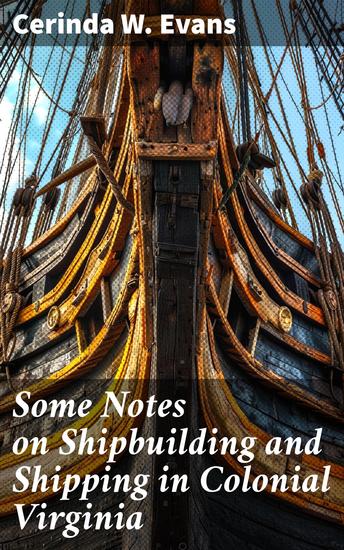
Some Notes on Shipbuilding and Shipping in Colonial Virginia - Unveiling Colonial Virginia's Maritime Legacy - cover

Some Notes on Shipbuilding and Shipping in Colonial Virginia - Unveiling Colonial Virginia's Maritime Legacy

Cerinda W. Evans

Maison d'édition: Good Press

  • 0
  • 0
  • 0

Synopsis

In "Some Notes on Shipbuilding and Shipping in Colonial Virginia," Cerinda W. Evans offers a meticulous exploration of the maritime practices that shaped the economic and cultural landscape of colonial Virginia. With a keen eye for detail, Evans blends historical accounts with rigorous analysis, illuminating the crucial role of shipbuilding in local industry and trade. The book, presented in a clear and engaging literary style, draws on primary sources and archival research, placing these practices within the broader context of colonial America'Äôs relationship with Europe and the transatlantic trade networks that flourished during this period. Cerinda W. Evans, a distinguished historian recognized for her extensive studies in colonial American history, brings a wealth of knowledge and passion to her works. Her academic background, combined with an interest in maritime history, has been pivotal in framing this book as an essential contribution to understanding the commercial dynamics of 18th-century Virginia. Evans's previous research has laid a robust foundation for this intricate examination of shipbuilding and its impacts on society, economy, and culture. This book is indispensable for scholars and enthusiasts of American history, particularly those interested in the maritime aspects of colonial life. It not only sheds light on an often-overlooked industry but also invites readers to consider the broader implications of maritime practices in shaping early American society. With its rich insights and scholarly depth, Evans'Äôs work is a significant addition to any academic library and an enlightening read for all history aficionados.
Disponible depuis: 12/10/2023.
Longueur d'impression: 84 pages.

D'autres livres qui pourraient vous intéresser

  • How to Be Curious - cover

    How to Be Curious

    Olivia Werner

    • 0
    • 0
    • 0
    [How to Be Curious] unfolds like a meditation on the art of questioning everything, weaving together the delicate threads of wonder and discovery that shape our understanding of the world. Within these pages lies an intricate exploration of what it means to remain perpetually inquisitive, told with the same careful attention to the inner workings of human nature that marks the best contemporary literary fiction. Through lyrical prose that captures the essence of intellectual awakening, this guide illuminates the subtle ways curiosity transforms ordinary moments into extraordinary revelations. Drawing from both scientific rigor and artistic sensitivity, it challenges readers to rediscover their capacity for wonder, teaching them to navigate the delicious uncertainty that lies between knowing and not knowing. This isn't just another self-help manual – it's an intimate conversation about the courage it takes to remain open to life's endless possibilities, about finding beauty in the questions themselves rather than rushing toward answers.
    Voir livre
  • Shirley Chisholm in Her Own Words - Speeches and Writings - cover

    Shirley Chisholm in Her Own...

    Zinga A. Fraser

    • 0
    • 0
    • 0
    LOOKING BEYOND HER POLITICAL SYMBOLISM TO CELEBRATE NOT ONLY WHO SHIRLEY CHISHOLM WAS BUT WHO SHE IS—A REVOLUTIONARY THINKER WITH MUCH TO TEACH US TODAY 
     
    In the midst of her groundbreaking twenty-year career in the U.S. House of Representatives, Congresswoman Shirley Chisholm once declared, “Everyone—with the exception of the black woman herself—has been interpreting the black woman.” Edited and introduced by Zinga A. Fraser, Shirley Chisholm in Her Own Words gives readers a rare opportunity to engage with the congresswoman’s powerful ideas in her own voice. 
     
    Many Americans are familiar with Chisholm’s importance as the first Black woman in Congress and the first woman and African American to run for president with either major party. This long-overdue treatment of her work establishes Chisholm as an unparalleled public intellectual, powerful orator, and Black feminist both in her time and now. It introduces a new generation to one of the most impactful proponents of democracy in America. 
     
    “A timely, detailed, and inspiring book that helps maintain the intellectual legacy of Shirley Chisholm. The book reveals new dimensions of the congresswoman’s politics, activism, and spirit.”—Regina King, Academy Award–winning actor, and producer and star of Shirley
    Voir livre
  • Pax Romana: A Captivating Guide to Ancient Rome during the Roman Peace Period - cover

    Pax Romana: A Captivating Guide...

    Captivating History

    • 0
    • 0
    • 0
    Did you know that the biggest territorial expansion in ancient Rome took place during the reign of its first emperor, who also ruled the longest out of all of the rulers prior to the fall of the Western Roman Empire? 
    The Roman Empire reached its zenith within the first two centuries of the fall of the Roman Republic, expanding its territory and spreading its influence well beyond the borders of Europe. During that time, a sort of global peace was achieved, which historians call the Pax Romana. But what exactly is the Pax Romana, and how does one delve into this huge, ever-expanding subject? 
    Like many other segments of Roman history, the Pax Romana is riddled with murky areas, contradictory information from contemporary sources, and fascinating archaeological finds. In this book, you’ll discover what made Rome tick during those roughly two hundred years of relative peace. 
    Throughout the pages of this tome, you’ll get brief glimpses of the reigns of many emperors who made the Pax Romana into what it was. Discover the Pax Romana’s long-term effects and how it managed to cement the Roman Empire as the go-to empire for many later civilizations to try and emulate. 
    Among other things, you’ll gain new knowledge on the following facts:How the empire evolved from the former republic and who the men were that brought about the changes What made the reign of each emperor uniqueWho the best emperors during the Pax Romana were, and which ones were considered the worstWhat role the provinces and territorial expansion played in the growth and development of the empireHow the imperial Romans were stratifiedWhat societal changes came about with the abolition of the republic and the return to a monarchic model 
    Scroll up, and give that “add to cart” button a click to learn more about the Pax Romana!
    Voir livre
  • Pala Empire - Guardians of Buddhism and the Legacy of Nalanda - cover

    Pala Empire - Guardians of...

    Rolf Hedger

    • 0
    • 0
    • 0
    The Pala Empire emerged in the eastern regions of the Indian subcontinent during the eighth century, marking the beginning of a powerful dynasty that would shape the cultural and political landscape of Bengal and Bihar for nearly four centuries. The empire was established in a period of political fragmentation and instability following the decline of the earlier Gupta Empire and the subsequent rule of smaller, competing kingdoms. This power vacuum set the stage for the rise of a strong and centralized authority under the leadership of Gopala, the first ruler of the Pala dynasty. 
    Gopala's ascent to power is believed to have been unique for the time, as he was reportedly chosen by local chieftains and influential figures through a process of election, rather than simply inheriting his position through lineage. This suggests that his leadership was recognized as a unifying force in a region that had suffered from prolonged disorder and internal conflicts. Once in power, Gopala took significant steps to stabilize his realm, laying the foundation for what would become one of the most enduring dynasties in Indian history. He consolidated his rule over Bengal and expanded his influence into neighboring territories, establishing control over strategic trade routes and fertile agricultural lands that contributed to the empire’s prosperity. 
    Gopala’s son, Dharmapala, proved to be an even more ambitious ruler. Under his leadership, the Pala Empire reached its zenith, with its influence stretching far beyond Bengal into northern and central India. Dharmapala was not only a military leader but also a great patron of Buddhism, playing a crucial role in the expansion of Buddhist institutions, including the famed Nalanda University. His military campaigns brought him into direct conflict with two of the other major powers of the time, the Gurjara-Pratiharas and the Rashtrakutas.
    Voir livre
  • Rest Is Resistance - Group Discussion - cover

    Rest Is Resistance - Group...

    Vines Graener

    • 0
    • 0
    • 0
    The work we do doesn’t define our worth. Imagine a world where justice includes space for rest and leisure, away from the relentless grind created by capitalism, white supremacy, and other oppressive forces. For centuries, these systems have exploited bodies for production, leading to destruction and harm by denying the inherent divinity in every human being. But now, people are waking up to this manipulation, and they’re starting to prioritize rest and healing. 
    America was built on the labor of Black and Indigenous people, whose right to rest was denied. The capitalist system grew out of violence and the theft of labor on plantations. These oppressive systems view human bodies as property, not as divine beings. We've been conditioned to believe we must work endlessly or risk falling into poverty. But there’s more beyond this narrow view.
    Voir livre
  • Storylife - On Epic Narrative and Living Things - cover

    Storylife - On Epic Narrative...

    Joel P. Christensen

    • 0
    • 0
    • 0
    Combining ancient epic and myth with analogies from biology and the natural world, Joel P. Christensen explores the creative process and how narratives develop. This bold work urges listeners to treat narratives as living things with their own agency in the world. Christensen starts by using Homeric epic to explore the way language and meaning develop alongside audiences in complex ecosystems and then moves through storytelling in the ancient Mediterranean over a thousand years. In this study, which ranges from the evolution of narratives to viral ideas, and to the dangerous side of stories in mass shootings and war, we see how narratives function as independent entities with consequences that cause lasting harm. 


    Connecting his argument to the present day, Christensen addresses contemporary cultural panics, including AI and ChatGPT, "post-truth" or alt-facts in the digital age, and free speech and cancel culture. Storylife invites listeners to rethink human creativity, the importance of collective actions, and the lives we build together with and against narrative. In an age rife with misinformation, it is time to reconsider how much control we have over stories and how to educate ourselves once we acknowledge the power that narrative exerts over us.
    Voir livre