Begleiten Sie uns auf eine literarische Weltreise!
Buch zum Bücherregal hinzufügen
Grey
Einen neuen Kommentar schreiben Default profile 50px
Grey
Jetzt das ganze Buch im Abo oder die ersten Seiten gratis lesen!
All characters reduced
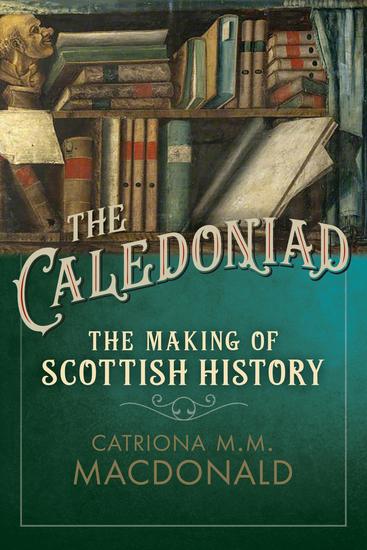
The Caledoniad - The Making of Scottish History - cover

The Caledoniad - The Making of Scottish History

Catriona M.M. MacDonald

Verlag: John Donald

  • 0
  • 0
  • 0

Beschreibung

Winner of the 2025 Frank Watson Book Prize
Why did Scots in the nineteenth and twentieth centuries know so little about their past and even less about those who controlled their history? Is the historical narrative the only legitimate medium through which the past can be made known? Are novelists and historians as far apart as convention has it? In an age when history grounds any claims to national status, these are important questions and they have implications for how Scottish history has evolved, and how Scottish identity has been understood up to the present day.
Scottish history is not simply the distillation of Scotland's past: authors shape what we know and how we judge our forebears. This book investigates who decided which Scottish voices of the past would be heard in history's pages and which would ultimately be silenced. It sketches a picture of a narrow and privileged cultural elite that responded belatedly to a more democratic age and only slowly embraced women writers and the interests of 'average' Scots. Integrating historical fiction and popular histories in its appreciation of the Scottish historical imaginary, it most importantly tells the story of why, despite the interests of politicians and others, a truly British history has never emerged.
'A brilliant, scholarly yet highly readable work which enlarges our understanding of what Scottish history is, and reinforces why it really matters' - James Robertson
Verfügbar seit: 17.10.2024.
Drucklänge: 368 Seiten.
Weitere Bücher, die Sie mögen werden

  • The Art of War - cover

    The Art of War

    Sun Tzu

    • 0
    • 0
    • 0
    "The Art of War" remains a timeless and revolutionary book due to its enduring wisdom and its ability to transcend the context of ancient warfare to provide valuable insights into human conflict and strategy throughout history and across different domains. Despite its ancient origins, the principles elucidated in the text continue to resonate with contemporary audiences, making it a lasting guide for navigating the complexities of life and competition.
    Zum Buch
  • Prayers Before the Eucharist - cover

    Prayers Before the Eucharist

    St. John Henry Cardinal Newman

    • 0
    • 0
    • 0
    When thinking of Saint John Henry Newman, many associations come to mind: scholar, writer, intellectual. But rarely do we associate “mystic” with this new saint. 
    And yet, his faith was not merely an intellectual exercise. Newman held a deep and passionate devotion to Our Lord in the Eucharist. 
    In honor of his canonization, we have collected his Prayers and Meditations before the Eucharist in order to bring his beautiful and profound love for Christ in the Sacrament to a new generation of Catholics. 
    His prayers place a singular focus on God’s mercy, perfections, and love for us that transcends the depravity of our sins, and engages God in frequent and familiar conversation, moving the heart to friendship with Christ.
    Zum Buch
  • Voices of Evangelical Preachers - Volume 2 - cover

    Voices of Evangelical Preachers...

    Gypsy Smith, J. Wilbur Chapman,...

    • 0
    • 0
    • 0
    Gipsy Smith (1860-1947) was an English evangelist who made over forty evangelistic trips abroad to such countries as the United States, Australia and South Africa. J. Wilber Chapman (1859-1918), a Presbyterian, had great success in four pastorates, but is best remembered as a powerful evangelist. William Booth (1829 –1912) was a British Methodist preacher who founded The Salvation Army. The Christian movement with a quasi-military structure and government founded in 1865 has spread from London, England to many parts of the world and is known for being one of the largest distributors of aid.
    Zum Buch
  • The Puritans - History of the English Protestants Who Tried to Purify the Church of England - cover

    The Puritans - History of the...

    Kelly Mass

    • 0
    • 0
    • 0
    The Puritans were English Protestants who emerged in the 16th and 17th centuries, deeply dissatisfied with the scope of the English Reformation. They believed that the Church of England had not fully distanced itself from Roman Catholic customs and needed further reform to become a more authentic expression of Protestant beliefs. In their view, many of the Catholic practices, such as hierarchical structures, rituals, and liturgies, had been retained within the Church of England, making it insufficiently Protestant. Their aim was to purify the Church, which led them to form various groups advocating for deeper piety in both personal worship and theological belief. 
    A central element of Puritanism was its adherence to Calvinist theology, which was rooted in Reformed Christian principles. This alignment with Calvinism marked them as part of a broader movement that sought to reject Roman Catholic influences, but also led to tension with other Protestant groups, particularly those within the Church of England who were not as radical in their reforms. Many Puritans advocated for a more decentralized church structure. Some even pushed for independent congregations, which would exist outside the framework of the established Church of England and avoid its perceived corruptions. 
    The Puritans’ influence reached a peak during the Protectorate, when the political and religious landscape of England underwent significant shifts. By the late 1630s, Puritans had developed an alliance with emerging business interests, legislative resistance to the monarchy, and Scottish Presbyterians, with whom they shared theological and political concerns. These alliances helped the Puritans gain substantial power during the First English Civil War (1642–1646). Their victory in the war and the subsequent rise of Puritan influence under Oliver Cromwell allowed them to have a profound impact on English governance and society.
    Zum Buch
  • Ain't No Place for a Hero: Borderlands - cover

    Ain't No Place for a Hero:...

    Kaitlin Tremblay

    • 0
    • 0
    • 0
    A deep dive into the groundbreaking and bestselling video game series The critically acclaimed first-person shooter franchise Borderlands knows it’s ridiculous. It’s a badge of pride. After all, Borderlands 2 was promoted with the tagline “87 bazillion guns just got bazillionder.” These space-western games encourage you to shoot a lot of enemies and monsters, loot their corpses, and have a few chuckles while chasing down those bazillion guns.  
     
    As Kaitlin Tremblay explores in Ain’t No Place for a Hero, the Borderlands video game series satirizes its own genre, exposing and addressing the ways first-person shooter video games have tended to exclude women, queer people, and people of colour, as well as contribute to a hostile playing environment. Tremblay also digs in to the way the Borderlands game franchise ― which has sold more than 26 million copies ― disrupts traditional notions of heroism, creating nuanced and compelling storytelling that highlights the strengths and possibilities of this relatively new narrative medium.  
     
    The latest entry in the acclaimed Pop Classics series, Ain’t No Place for a Hero is a fascinating read for Borderlands devotees as well as the uninitiated.
    Zum Buch
  • Great Schism and the Western Schism The: The History and Legacy of the Most Important Splits in the Catholic Church - cover

    Great Schism and the Western...

    Editors Charles River

    • 0
    • 0
    • 0
    For nearly a thousand years following its foundation, there was only one Christian Church. Centered in the city of Rome, the Church expanded and grew until it became the dominant religion in Europe and beyond. The early growth of the Church had been suppressed by the Romans until the Emperor Constantine became the first to convert the empire to Christianity, and from that point forward, the growth of the Church was inextricably linked with the Roman Empire, the most powerful military, economic, and political force in the ancient world. 
    However, once the Western Roman Empire collapsed, Rome’s preeminence was not a situation that was welcomed in Constantinople, now the center of the Byzantine Empire and a thriving and wealthy metropolis. After being sacked by outsiders, Rome had become a virtual ghost town, partially ruined and inhabited by a small number of hardy survivors, yet in the center of the crumbling city was the Vatican Borgo, the Palace of the Supreme Pontiff and the heart of the Church. In retrospect, it is easy to see that this was a situation that was bound to lead to conflict and disagreement, with the Greek-speaking Eastern Orthodox Church centered in Constantinople and being governed by Latin-speaking popes in a faraway city. 
    To many, the pope is the embodiment of godly love in its purest form. No matter the weather or the inconvenience, millions upon millions of fervid devotees brave the congested streets of their cities, all for the once-in-a-lifetime opportunity to welcome the beloved Vicar of Christ. However, the modern perception of the pope is a far cry from how things were just a couple of centuries ago. There was a time when the holiest men of the world were constantly at each other's throats, willing to go to any lengths to secure the coveted papal title. By the late 14th century, tensions within the Church reached its breaking point, resulting in the Western Schism, an infamous split of the Catholic Church.
    Zum Buch