Rejoignez-nous pour un voyage dans le monde des livres!
Ajouter ce livre à l'électronique
Grey
Ecrivez un nouveau commentaire Default profile 50px
Grey
Abonnez-vous pour lire le livre complet ou lisez les premières pages gratuitement!
All characters reduced
The Canadian Settler's Guide - cover

The Canadian Settler's Guide

Catharine Parr Traill

Maison d'édition: e-artnow

  • 0
  • 0
  • 0

Synopsis

"The Canadian Settler's Guide" by Catharine Parr Traill. Published by e-artnow. e-artnow publishes a wide range of titles that encompasses every genre. From well-known classics & literary fiction and non-fiction to forgotten−or yet undiscovered gems−of world literature, we issue the books that need to be read. Each e-artnow edition has been meticulously edited and formatted to boost readability for all e-readers and devices. Our goal is to produce eBooks that are user-friendly and accessible to everyone in a high-quality digital format.
Disponible depuis: 04/12/2023.
Longueur d'impression: 361 pages.

D'autres livres qui pourraient vous intéresser

  • Baruch Spinoza - God Nature and the Ethics of Reason - cover

    Baruch Spinoza - God Nature and...

    Hector Davidson

    • 0
    • 0
    • 0
    Baruch Spinoza's philosophy is a comprehensive system that integrates metaphysics, epistemology, ethics, and political theory into a unified framework. Central to his thought is the idea of God and nature as a single, infinite substance, which Spinoza refers to as "Deus sive Natura" (God or Nature). This concept encapsulates his pantheistic view that everything that exists is a part of this one, all-encompassing reality. 
      
    Metaphysics and Substance 
      
    Spinoza's metaphysical framework revolves around the notion of substance monism. He argues that there is only one substance in the universe, which is both God and nature. This substance possesses an infinite number of attributes, with thought and extension being the two that humans can comprehend. Everything that exists, according to Spinoza, is a mode or manifestation of this single substance. This idea challenges traditional theistic views by rejecting the notion of a personal, transcendent God who is separate from the world. 
      
    Epistemology and Knowledge 
      
    In epistemology, Spinoza emphasizes the role of reason and intuitive knowledge in understanding the nature of reality. He distinguishes between different types of knowledge: imagination, reason, and intuition. Imaginative knowledge, based on sensory experience and inadequate ideas, is unreliable and often leads to confusion. Rational knowledge, which arises from understanding the necessary connections between ideas, is more accurate. The highest form of knowledge, according to Spinoza, is intuitive knowledge—an immediate, direct understanding of the essence of things.
    Voir livre
  • Stop Laziness the Easy Way - A Practical Guide to Unlocking Your True Potential Boosting Productivity and Achieving Your Goals Daily - cover

    Stop Laziness the Easy Way - A...

    Emory Love

    • 0
    • 0
    • 0
    Ready to Stop Slacking? 
    Ditch the Excuses, Let’s Get Things Done and Start Living… 
    "I'll do it later, I promise..." 
    "I'm not in the mood..." 
    Eh, maybe I can start working on it tomorrow... Who's gonna know?" 
    Aren't you sick and tired of using the same excuses, over and over?  
    Look, I get it. We got lots of reasons to delay things, especially these past four years and we all know why that is. But if you are missing deadlines and payments and you're waist's getting rounder, don't you think it's time to get back on track ASAP? 
    Let me help you get started. My New book, "Stop Laziness The Easy Way," will help you understand what's the science behind why people delay things, how to beat them, and what to do to prevent setbacks. I made it super easy so you can follow the steps, no matter how hectic your schedule is. 
    Just promise me one thing ok? Don't be lazy and read the book from start to finish, it's for your own good anyway… 
    As the saying goes, "All work and no play makes a person dull, sick, unbalanced, and unhappy”. This is true until you let yourself go so much that your responsibilities get compromised. Just imagine all the possibilities… more money in your pocket, no more missed deadlines, and your dream body, achieved. 
    What are you waiting for? Quit whining, grab a copy, and kick those gears…
    Voir livre
  • Persian Corridor in World War II The: The History of the Allies’ Most Important Supply Route - cover

    Persian Corridor in World War II...

    Editors Charles River

    • 0
    • 0
    • 0
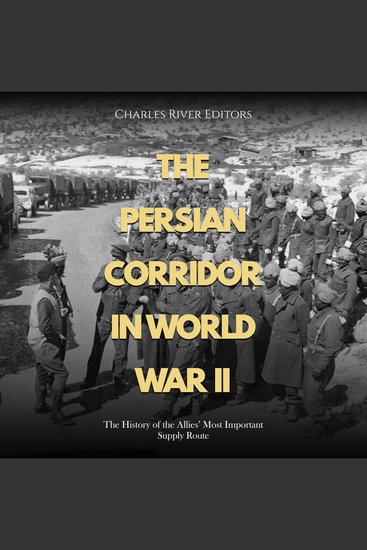
    Operation Barbarossa was the most fateful decision of World War II, and when it gave the Soviets common cause with the British (and subsequently the Americans), the purpose of the Lend-Lease Act changed in nature as well. The bulk of Germany’s formidable armed forces were committed to the offensive in the east, which relieved the pressure on the British and meant that a German attack on Britain or elsewhere in Western Europe was not going to happen, so keeping the Soviets in the war became the most essential goal of the supply program. 
    Getting supplies to the Soviets to help them resist the German armies became a strategic imperative, and Iran’s geography of bordering the Persian Gulf to the south and Soviet territory to the north brought Iran to the front and center in the strategic supply effort. The German invasion devastated much of European Russia, but also devastated Ukraine and Belarus, other member “republics” in the Soviet Union, and the portions of the Soviet Union that bordered on Iran were Armenia, Azerbaijan and east of the Caspian, Turkmenistan. 
    The Persian Corridor involved British and Dominion forces, as well as Soviet armed forces and personnel, but the operation and management of the Persian Corridor became largely an American show. Most of the immense amount of aid sent was for transshipment across Iran to the Soviets, but it also involved supplying British and Commonwealth forces in Iran, Iraq and elsewhere in the Middle East. Some was used to feed and supply Iran’s people, and some was used to modernize and maintain Iran’s infrastructure. There was also the need to supply the American troops working in the Persian Corridor. While 80% or so of the aid came from the U.S., there was also a significant amount of aid sent from Canada, Australia, South Africa and especially India. 
    Voir livre
  • Pedro Páramo by Juan Rulfo (Book Analysis) - Detailed Summary Analysis and Reading Guide - cover

    Pedro Páramo by Juan Rulfo (Book...

    Bright Summaries

    • 0
    • 0
    • 0
    Unlock the more straightforward side of Pedro Páramo with this concise and insightful summary and analysis!This engaging summary presents an analysis of Pedro Páramo by Juan Rulfo, one of the most innovative and celebrated Mexican novels ever written. It follows the son of the titular character as he travels to the town of Comala in search of his father, who was formerly the most important landowner in the area. On the way, he learns about his father's shocking brutality and mistreatment of Comala's poor inhabitants, and discovers an astonishing secret about the town. Along with the short story collection The Burning Plain, Pedro Páramo cemented Rulfo's reputation as one of the most important Latin American writers of the 20th century. He also gained recognition for his photography, which is now a subject of critical study in its own right.Find out everything you need to know about Pedro Páramo in a fraction of the time!This in-depth and informative reading guide brings you:• A complete plot summary• Character studies• Key themes and symbols• Questions for further reflectionWhy choose BrightSummaries.com?Available in print and digital format, our publications are designed to accompany you on your reading journey. The clear and concise style makes for easy understanding, providing the perfect opportunity to improve your literary knowledge in no time.See the very best of literature in a whole new light with BrightSummaries.com!
    Voir livre
  • The Heart Of China - How Mindfulness Changed My Life - cover

    The Heart Of China - How...

    Todd Cornell

    • 0
    • 0
    • 0
    Do your mindfulness readings fall short? 
    This book introduces you to knowledge through the experience of one man who continues to toil the mire of the mind. Join him, and others, on the journey that untold numbers have ventured throughout the millennia. A journey to peace of mind through the observance of breath and thoughts. Simple, yet powerful, it transforms warriors into peacemakers. 
    We achieve learning through quiet observation. First, observe the mind and the training of it should follow. When applying mindfulness, we perceive the self, nature, and our surroundings in ways that harmonize imbalance, as well as the balancing of yin-yang moments, such as comfort and discomfort.
    Voir livre
  • Taming Silicon Valley - How We Can Ensure That AI Works for Us - cover

    Taming Silicon Valley - How We...

    Gary Marcus

    • 0
    • 0
    • 0
    On balance, will AI help humanity or harm it? AI could revolutionize science, medicine, and technology, and deliver us a world of abundance and better health. Or it could be a disaster, leading to the downfall of democracy, or even our extinction. In Taming Silicon Valley, Gary Marcus, one of the most trusted voices in AI, explains that we still have a choice. And that the decisions we make now about AI will shape our next century. In this powerful manifesto, Marcus explains how Big Tech is taking advantage of us, how AI could make things much worse, and, most importantly, what we can do to safeguard our democracy, our society, and our future. 


    Marcus explains the potential—and potential risks—of AI in the clearest possible terms and how Big Tech has effectively captured policymakers. He begins by laying out what is lacking in current AI, what the greatest risks of AI are, and how Big Tech has been playing both the public and the government, before digging into why the US government has thus far been ineffective at reining in Big Tech. He then offers real tools, including eight suggestions for what a coherent AI policy should look like—from data rights to layered AI oversight to meaningful tax reform—and closes with how ordinary citizens can push for what is so desperately needed. Taming Silicon Valley is a must-listen for every concerned citizen.
    Voir livre