Join us on a literary world trip!
Add this book to bookshelf
Grey
Write a new comment Default profile 50px
Grey
Subscribe to read the full book or read the first pages for free!
All characters reduced
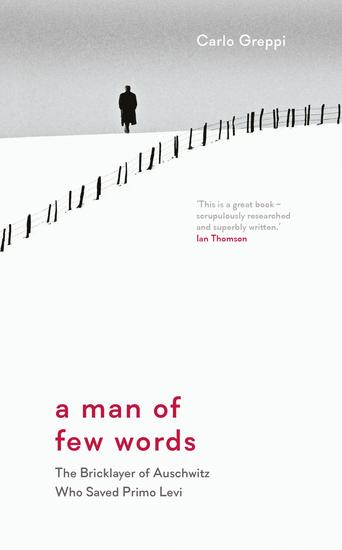
A Man of Few Words - The Bricklayer of Auschwitz Who Saved Primo Levi - cover

A Man of Few Words - The Bricklayer of Auschwitz Who Saved Primo Levi

Carlo Greppi

Translator Howard Curtis

Publisher: The Westbourne Press

  • 0
  • 0
  • 0

Summary

'Nobody knows how much I owe that man', Primo Levi said of his Italian compatriot Lorenzo Perrone, who saved his life at Auschwitz. 'I could never repay him'. Each day for a period of six months, Perrone, who worked beside Auschwitz in desperate conditions, risked his own life to smuggle part of his own soup ration to Levi, quietly leaving the mess tin by a half-constructed brick wall. Without those extra five hundred calories, Levi could not have survived, and would probably not have written If This Is a Man, the first published account by a Holocaust survivor.

In A Man of Few Words, Carlo Greppi pieces together the life of Lorenzo Perrone, a bricklayer from the Piedmontese town of Fossano, not far from Levi's native Turin. Near-destitute and with minimal formal education, Perrone left very few traces of himself. Yet despite their stark differences – Levi was a middle-class chemist – their friendship survived the Holocaust and continued until Perrone's tragic death. Levi never forgot Perrone. In every book he wrote, he mentions that he owes his life to a man named Lorenzo, and he returned persistently, in the last years of his life, to the man of few words who saved his life.

Compassionate, worldly and prescient, Greppi brings us a story that has much to say about the world we live in today, about an individual who kept hope alive in one of the darkest times and places known to humankind.
Available since: 01/23/2025.
Print length: 256 pages.

Other books that might interest you

  • Holodomor Famine: A Captivating Guide to Understanding the Ukrainian Famine and Its Impact on History - cover

    Holodomor Famine: A Captivating...

    Captivating History

    • 0
    • 0
    • 0
    A Look at Ukraine’s Tragic Famine and Its Impact on History 
    Holodomor Famine explores one of the most tragic and often forgotten events in recent history. Using historical records and personal stories, this audiobook shows how Stalin’s harsh policies crushed the Ukrainian people and how the world largely looked away. 
    What You’ll Find Inside:Stalin’s Control: Learn how far Stalin went to gain full control over Ukraine and its people.Personal Stories and New Evidence: Firsthand accounts and new documents reveal how food was used as a weapon to starve people into submission.The World’s Silence: Discover how, even with clear evidence, the global community ignored the growing crisis.Survival Against All Odds: See the tough choices Ukrainians faced in their fight to stay alive.Policies and Propaganda: Understand how government actions and messages were used to break the spirit of Ukraine’s people. 
    This audiobook not only tells the story of the Holodomor but also helps listeners connect it to the present, showing how understanding history can help shape a better future. 
    Holodomor Famine is perfect for history fans, students, and anyone who wants to learn more about how our world was shaped by past events. 
    Don’t miss out on this important story. Click the “add to cart” button to get your copy today to learn about one of the darkest times of the 20th century.
    Show book
  • Niccolò Machiavelli - The Prince and the Power - cover

    Niccolò Machiavelli - The Prince...

    Hector Davidson

    • 0
    • 0
    • 0
    Niccolò Machiavelli, the Renaissance political thinker and diplomat, remains one of the most influential figures in political philosophy, and his ideas continue to shape modern discussions on leadership, power, and governance. His most famous work, The Prince, has long been recognized as a manual for rulers navigating the complexities of political life, emphasizing pragmatic strategies over idealistic visions of statecraft. In the centuries since its publication, Machiavelli’s work has both captivated and provoked scholars, politicians, and leaders, and his theories remain as relevant today as when they were first written. 
    At the heart of Machiavelli's philosophy is his focus on the practical realities of political power. Unlike many political theorists who are concerned with how politics should be ideally structured, Machiavelli emphasized how politics actually works. The Prince offers rulers advice on how to secure and maintain power, often advocating methods that defy traditional moral or ethical considerations. His famous assertion that “the ends justify the means” has become synonymous with political maneuvering that prioritizes results over values, positioning him as both a realist and a controversial figure in political thought. 
    Machiavelli’s impact extends beyond just the realm of politics. His ideas on leadership, human nature, and the strategic use of power have influenced not only political theory but also military strategy, business practices, and even popular culture. His work on statecraft speaks to a deep understanding of human behavior, and his insights into the manipulation of public perception, the nature of fear and loyalty, and the balancing of power dynamics have resonated across various disciplines. Whether used to guide national leadership or inform business strategy, Machiavellian principles are often invoked when discussing tactics for navigating complex, power-driven environments.
    Show book
  • The Ancient World’s Most Influential Philosophers - cover

    The Ancient World’s Most...

    Editors Charles River

    • 0
    • 0
    • 0
    Although he is still one of history’s most famous philosophers, Confucius was in many respects an unremarkable man, and even his physical features were said to be unattractive. There is little evidence that he thought of himself as a harbinger of any kind, but shortly after his death, writings, sayings, and theories based on his life and ideas spread throughout China and even took hold of the imperial court of one of the most powerful and important dynasties, the Han (206 BCE-220 CE). It was during the Han Dynasty that Confucianism became closely tied to state affairs, and it would remain so until the fall of the last dynasty in 1912.  
    	None of Socrates’ works survived antiquity, so most of what is known about him came from the writings of his followers, most notably Plato. What is known about Socrates is that he seemed to make a career out of philosophy, and Plato was intent on following in his footsteps. Yet for all of the influence of Socrates’ life on his followers, it was Socrates’ death around 399 B.C. that truly shaped them. Plato was so embittered by Socrates’ trial in Athens that he completely soured on Athenian democracy, and Aristotle would later criticize politicians who relied on rhetoric; when Aristotle’s own life was threatened, he fled Greece and allegedly remarked, “I will not allow the Athenians to sin twice against philosophy." 
    	Alongside Pericles, Cicero was one of antiquity’s greatest politicians, and he has remained one of the most influential statesmen in history, relied upon by the Romans of his day, political philosophers like John Locke, Enlightenment thinkers like Rousseau, and America’s Founding Fathers. Thomas Jefferson credited Cicero as an inspiration for the Declaration of Independence, and John Adams asserted, "As all the ages of the world have not produced a greater statesman and philosopher united than Cicero, his authority should have great weight.”
    Show book
  • The World War That Changed the Story of Women - cover

    The World War That Changed the...

    Maximilian Natal

    • 0
    • 0
    • 0
    The World War That Changed the Story of Women explores the seismic shifts in women's roles brought on by the First World War. It delves into the pivotal moment in history when the seeds of modernity were planted and women stepped into the public sphere. It was the watershed event that inaugurated passports to travel, daylight-saving’s time, central banks in every country, and, alas, women in the workforce. From mothers and housewives, they became secretaries and factory workers, nurses and organizers. The reader is invited to witness a penetrating exploration of how a global conflict became a turning point in the story of women's rights and their transformation into an emerging economic powerhouse.
    Show book
  • INVASION Vol 1 - How the Conspiracy Has Infiltrated Your Community - cover

    INVASION Vol 1 - How the...

    Ben McClintock

    • 0
    • 0
    • 0
    INVASION is an eye-opening and compelling two-volume work illuminating the reader’s understanding of how their own communities have been infiltrated by this conspiracy. Utilizing documents previously available only through university, religious, and government archives, Invasion not only exposes the Conspiracy’s network, but documents their biggest fear, and what we can do to stop them. 
    INVASION: How the Conspiracy has Infiltrated Your Community discusses the existence of a vast conspiracy working to overthrow freedom and destroy people. The author emphasizes the importance of understanding and actively working to stop this conspiracy, drawing from various resources including the Holy Scriptures and the Book of Mormon. INVASION explores the origins of the conspiracy, starting with the Illuminati and its goals of obliterating Christianity and promoting sensuality. It also delves into the connection between communism and the conspiracy, as well as the emergence of other isms like socialism and anarchism. The author highlights the continued existence of the conspiracy through organizations like the Council on Formulations and the efforts of individuals like David Rockefeller and Hillary Clinton. The document concludes by discussing how the conspiracy infiltrates and directs policy at the local level, with a focus on Utah as an example. Overall, the document aims to raise awareness and empower readers to take action against the conspiracy.
    Show book
  • Ancient History - Historical Details about the Egyptian Empire and the Greek Empire (2 in 1) - cover

    Ancient History - Historical...

    Kelly Mass

    • 0
    • 0
    • 0
    This bundle consists of 2 books: 
    Ancient Greece: Thanks to ancient Greece, we know more about philosophy, politics, the democratic system, mythology, art, the Olympics, and many, many lingual references imbedded in almost every European language. Ancient Greece has had a significant impact on many concepts we still hold true today. 
    Ancient Greece was a northeastern Mediterranean society that existed from the 12th-9th centuries BC till the end of classical antiquity (c. AD 600). It was made up of a loose collection of culturally and linguistically associated city-states and other areas that were only combined once, under Alexander the Great's empire, for 13 years (336-323 BC). Classical antiquity was quickly followed by the Early Middle Ages and the Byzantine period in Western history. 
    Ancient Egypt: When we think of Ancient Egypt, we picture movies with mazes, pyramids, traps, mummies, and symbols. And although some of these things were definitely part of it, there is so much more to this ancient civilization. 
    Ancient Egypt was a North African society that grew in the lower banks of the Nile River, in what's now the nation of Egypt. Following ancient Egypt, old Egyptian civilization culminated circa 3100 BC (according to basic Egyptian chronology) with Menes' political marriage of Upper and Lower Egypt (usually related to Narmer). The Old Kingdom of the Early Bronze Age, the Middle Kingdom of the Middle Bronze Age, and the New Kingdom of the Late Bronze Age formed a series of steady kingdoms split up by periods of relative instability called Intermediate Durations.
    Show book