Begleiten Sie uns auf eine literarische Weltreise!
Buch zum Bücherregal hinzufügen
Grey
Einen neuen Kommentar schreiben Default profile 50px
Grey
Jetzt das ganze Buch im Abo oder die ersten Seiten gratis lesen!
All characters reduced
A Tale of Two Cities + Great Expectations - Enriched edition - cover

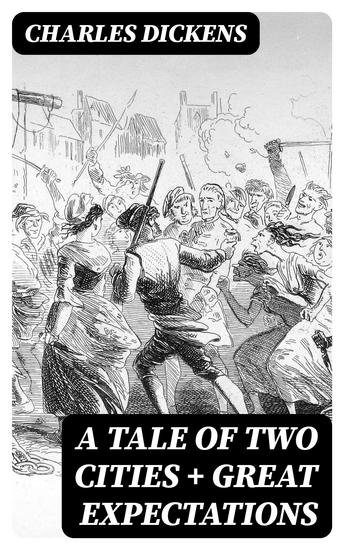
A Tale of Two Cities + Great Expectations - Enriched edition

Charles Dickens

Verlag: DigiCat

  • 0
  • 0
  • 0

Beschreibung

Charles Dickens' 'A Tale of Two Cities' and 'Great Expectations' represent two pillars of Victorian literature, showcasing his masterful storytelling, social commentary, and vivid characterizations. 'A Tale of Two Cities' is set against the tumultuous backdrop of the French Revolution, exploring themes of resurrection and sacrifice through the lives of characters caught in the throes of revolutionary fervor. In contrast, 'Great Expectations' follows the journey of Pip, a young orphan who navigates the complexities of ambition, class, and personal growth in early 19th-century England. Dickens employs a rich, emotive prose style, interspersed with sharp humor and poignant observations about society, creating a multifaceted narrative that reflects both the historical context and the psychological depths of his characters. Charles Dickens, born into poverty and experiencing the hardships of the working class, used his literary prowess to shed light on social injustices and the struggles of the underprivileged. His own life experiences deeply informed his understanding of human resilience and aspiration, themes that resonate through both novels. Enriched by his background and keen social consciousness, Dickens crafted these works as reflections of his time, making poignant critiques of class disparities and the moral complexities of human existence. This dual offering—'A Tale of Two Cities' and 'Great Expectations'—is essential reading for anyone seeking to understand the depth of human experience through the lens of history and personal transformation. Dickens's intricate plotting and profound insights invite readers to engage thoughtfully with the characters' journeys, rendering these works timeless in their relevance and emotional resonance.

In this enriched edition, we have carefully created added value for your reading experience:
- A comprehensive Introduction outlines these selected works' unifying features, themes, or stylistic evolutions.
- The Author Biography highlights personal milestones and literary influences that shape the entire body of writing.
- A Historical Context section situates the works in their broader era—social currents, cultural trends, and key events that underpin their creation.
- A concise Synopsis (Selection) offers an accessible overview of the included texts, helping readers navigate plotlines and main ideas without revealing critical twists.
- A unified Analysis examines recurring motifs and stylistic hallmarks across the collection, tying the stories together while spotlighting the different work's strengths.
- Reflection questions inspire deeper contemplation of the author's overarching message, inviting readers to draw connections among different texts and relate them to modern contexts.
- Lastly, our hand‐picked Memorable Quotes distill pivotal lines and turning points, serving as touchstones for the collection's central themes.
Verfügbar seit: 25.05.2022.
Drucklänge: 869 Seiten.
Weitere Bücher, die Sie mögen werden

  • A Thing That Glistened - From their pens to your ears genius in every story - cover

    A Thing That Glistened - From...

    Frank R Stockton

    • 0
    • 0
    • 0
    Frank Richard Stockton was born in Philadelphia on 5th April 1834.  
    His father, a Methodist minister, discouraged Stockton’s literary career from an early age.  Feeling unable to go against those wishes it was for many years that Stockton’s income was maintained as a wood engraver.   
    His first work was published in 1867 and his first collection only appeared in 1870.  Despite this late arrival Stockton’s innovative and often far-fetched stories, with a gentle ‘poking fun’ humour were very popular.  Like his contemporary Mark Twain he avoided the scolding, hectoring and moral tones of many other authors and instead gently teased and cajoled his reader to open their eyes to the ills, the greed and the ambitions of the world around them.  His sci-fi stories in particular were far-seeing and inventive including a tale of negative gravity and a bloodless Anglo-US war won by technological feats.  
    Perhaps his most enduring tale though is ‘The Lady, or the Tiger?’ from 1882.  A condemned man is given a choice of being eaten alive or marrying his princess lover.  But he has to choose which door each is behind. 
    Frank R Stockton died in Washington, DC, on 20th April 1902, of a cerebral haemorrhage.  He is buried at The Woodlands in Philadelphia.
    Zum Buch
  • A Wicked Woman - From their pens to your ears genius in every story - cover

    A Wicked Woman - From their pens...

    Jack London

    • 0
    • 0
    • 0
    John Griffith Chaney was born on January 12th, 1876 in San Francisco.   
    His father, William Chaney, was living with Flora Wellman when she became pregnant.  Chaney insisted she have an abortion.  Flora's response was to turn a gun on herself.  Although her wounds were not severe the trauma made her temporarily deranged. 
    In late 1876 his mother married John London and the young child was brought to live with them as they moved around the Bay area, eventually settling in Oakland where now, calling himself Jack, he completed grade school. 
    Jack worked hard at several jobs, sometimes 12-18 hours a day, but his dream was university.  He studied hard and borrowed the money to enrol in the summer of 1896 at the University of California in Berkeley. 
    In 1897, at 21, Jack searched out newspaper accounts of his mother's suicide attempt and for the name of his biological father. He wrote to Chaney, then living in Chicago, who claimed he could not be Jack’s father because he was impotent and casually asserted that London's mother had relations with other men.  Jack, devastated by the response, quit Berkeley and went to the Klondike. Other accounts suggest that his dire finances presented Jack with the excuse he needed to leave. 
    In the Klondike Jack began to gather material for his writing but also accumulated many health problems, including scurvy, which together with hip and leg problems he would carry for the rest of his life. 
    During the late 1890's Jack was regularly publishing short stories and by the turn of the century full blown novels. 
    By 1904 Jack had married, fathered two children and was now in the process of divorcing.  A stint as a reporter on the Russo-Japanese war of 1904 was equal amounts trouble and experience. But that experience was always put to good use in a continuing and remarkable output of work. 
    In 1905 he married Charmian Kittredge who at last was a soul and companion who brought him some semblance of peace despite his advancing alcoholism and his incurable wanderlust. 
    Twelve years later Jack had amassed both wealth and a literary reputation through such classics as ‘The Call of the Wild’, ‘White Fang’ and many others. He had a reputation as a social activist and was a tireless friend of the workers.   
    Jack London died suffering from dysentery, late-stage alcoholism and uremia, aged only 40, on November 22nd 1916 at his property in Glen Elen in California.
    Zum Buch
  • The Antichrist - cover

    The Antichrist

    Friedrich Nietzsche

    • 0
    • 0
    • 0
    Friedrich Nietzsche's "The Antichrist" is a philosophical work that presents his critical analysis of Christianity and its impact on Western culture. Written in 1888, towards the end of Nietzsche's productive life, "The Antichrist" reflects his deep-seated criticisms of traditional Christian values and morality. In the text, Nietzsche vehemently opposes what he sees as the life-denying aspects of Christianity. He argues that the Christian emphasis on otherworldly concerns, asceticism, and moral values such as humility and self-sacrifice are detrimental to the flourishing of human life. Nietzsche contends that Christianity has fostered a culture of weakness, passivity, and resentment, suppressing the natural instincts and drives that lead to individual strength and vitality. 
     
    "The Antichrist" also delves into Nietzsche's critique of the figure of Jesus Christ, whom he views as a symbol of weakness and a distortion of true strength. Nietzsche contends that the Christian notion of God represents a negation of life, promoting an idealized realm beyond this world at the expense of embracing earthly existence. Nietzsche's writing style in "The Antichrist" is often controversial and provocative, reflecting his desire to challenge established beliefs and provoke critical thinking. The work serves as a forceful critique of organized religion, morality, and the cultural influence of Christianity in Western societies. 
     
    It's essential to approach Nietzsche's "The Antichrist" within the broader context of his philosophical works, as it contributes to his overarching critique of morality, metaphysics, and the prevailing cultural values of his time. While the title may suggest a direct opposition to Christian beliefs, Nietzsche intends to provoke thought and encourage a reevaluation of existing values rather than presenting a straightforward condemnation.
    Zum Buch
  • A Haunted House - From their pens to your ears genius in every story - cover

    A Haunted House - From their...

    Virginia Woolf

    • 0
    • 0
    • 0
    Adeline Virginia Woolf was born on the 25th January 1882 in South Kensington in London. 
    Although lauded as a founder of modernist writing with such classics as ‘Orlando’, ‘Mrs Dalloway’ and ‘To the Lighthouse’ and, of course, many classic short stories, her background is filled with elements of tragedy that she somehow overcame to become such a revered writer.   Her mother died when she was 13, her half-sister Stella two years later and with it her first of several nervous breakdowns.  Appallingly it was later found that three of her half-brothers had sexually abused her so darkness must have seemed ever present.   
    She began writing professionally at age 20 but her father’s death two years later brought a complete mental collapse and she was briefly institutionalised.  Somehow she found within herself a literary career and with it great innovations in writing; she was a pioneer of “stream of consciousness”.    
    Her tight circle of friends were the founders of the Bloomsbury Group, a movement whose legacy still influences across the arts and society in many way to this day.   
    Whilst the dark periods continued to interrupt her emotional state her rate of work never ceased.  Until, on 28th March 1941, Woolf put on her overcoat, filled up its pockets with stones, and walked into the River Ouse, in Lewes, East Sussex and drowned herself.  Her body was not recovered until the 18th April.  She was 59. 
    She left behind a note which read in part “Dearest, I feel certain that I am going mad again.  I feel we can't go through another of those terrible times.  And I shan't recover this time.  I begin to hear voices, and I can't concentrate.  So I am doing what seems the best thing to do”.
    Zum Buch
  • Mary Butts - Six of the Best - Their legacy in 6 classic stories - cover

    Mary Butts - Six of the Best -...

    Mary Butts

    • 0
    • 0
    • 0
    Six has always been a number we group things around – Six of the best, six of one half a dozen of another, six feet under, six pack, six degrees of separation and a sixth sense are but a few of the ways we use this number. 
     
    Such is its popularity that we thought it is also a very good way of challenging and investigating an author’s work to give width, brevity, humour and depth across six of their very best. 
     
    In this series we gather together authors whose short stories both rivet the attention and inspire the imagination to visit their gems in a series of six, to roam across an author’s legacy in a few short hours and gain a greater understanding of their writing and, of course, to be lavishly entertained by their ideas, their narrative and their way with words. 
     
    These stories can be surprising and sometimes at a tangent to what we expected, but each is fully formed and a marvellous adventure into the world and words of a literary master. 
     
    1 - Six of the Best - Mary Butts - An Introduction 
    2 - Mary Butts - An Introduction 
    3 - With & Without Buttons by Mary Butts 
    4 - The Dinner Party by Mary Butts 
    5 - Angele Au Couvent by Mary Butts 
    6 - Brightness Falls by Mary Butts 
    7 - After the Funeral by Mary Butts 
    8 - In Bayswater - Part 1 by Mary Butts 
    9 - In Bayswater - Part 2 by Mary Butts
    Zum Buch
  • The Little Prince - cover

    The Little Prince

    Antoine de Saint-Exupéry

    • 0
    • 0
    • 0
    Audiobook The Little Prince is a novella written and illustrated by French writer and military pilot Antoine de Saint-Exupéry. It was first published in English and French in the United States by Reynal & Hitchcock in April 1943 and was published posthumously in France following liberation; Saint-Exupéry's works had been banned by the Vichy Regime. The story follows a young prince who visits various planets, including Earth, and addresses themes of loneliness, friendship, love, and loss. Despite its style as a children's book, The Little Prince makes observations about life, adults, and human nature. 
    The Little Prince became Saint-Exupéry's most successful work, selling an estimated 140 million copies worldwide, which makes it one of the best-selling in history. The book has been translated into over 505 different languages and dialects worldwide, being the second most translated work ever published, trailing only the Bible.The Little Prince has been adapted to numerous art forms and media, including audio recordings, radio plays, live stage, film, cinema television, ballet, and opera.
    Zum Buch