Rejoignez-nous pour un voyage dans le monde des livres!
Ajouter ce livre à l'électronique
Grey
Ecrivez un nouveau commentaire Default profile 50px
Grey
Abonnez-vous pour lire le livre complet ou lisez les premières pages gratuitement!
All characters reduced
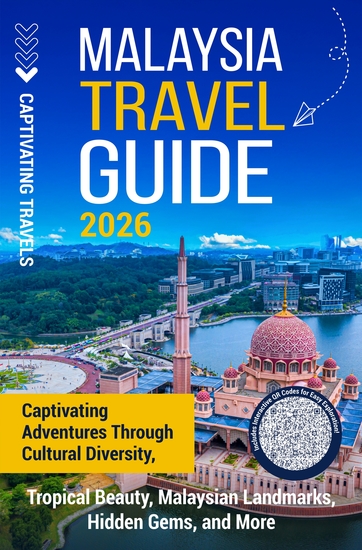
Malaysia Travel Guide - Captivating Adventures through Cultural Diversity Tropical Beauty Malaysian Landmarks Hidden Gems and More - cover

Malaysia Travel Guide - Captivating Adventures through Cultural Diversity Tropical Beauty Malaysian Landmarks Hidden Gems and More

Captivating Travels

Maison d'édition: Captivating Travels

  • 0
  • 0
  • 0

Synopsis

Explore Malaysia with Confidence — Includes Maps, QR Codes, and 90+ Images
 
This guide helps you make the most of your trip to Malaysia — from the fast pace of Kuala Lumpur to quiet mountain towns, rainforest trails, and island coastlines.

It's packed with well-researched tips, practical advice, and helpful visuals so you can plan with ease and travel without second-guessing.

What you'll find inside: 

- Easy-to-follow regional guides  — covering cities, coastal areas, and nature spots across both Peninsular Malaysia and Borneo. 
- Cultural context that matters  — a clear explanation of Malaysia's mix of Malay, Chinese, Indian, and Indigenous traditions, with etiquette pointers, local customs, and major festivals. 
- Things to do outdoors  — hiking, snorkeling, wildlife, beaches, and ideas for slow travel or day trips. 
- Big sights + smaller favorites  — from well-known places like the Petronas Towers and George Town to lesser-known spots that are worth your time. 
- Useful planning tools  — suggested itineraries, essential Malay phrases, a basic photo guide, and clear QR links to bonus resources. 
-  And more to help you stay organized and explore with confidence. 

 
Whether you're planning your first visit or coming back for more, this book is a helpful, straightforward companion for your trip.

Click "Add to Cart" to start planning your time in Malaysia. 
 
Disponible depuis: 08/08/2025.
Longueur d'impression: 135 pages.

D'autres livres qui pourraient vous intéresser

  • Thrilling Cities - Fourteen Cities Seen Through the Eyes of Ian Fleming the Creator of James Bond - cover

    Thrilling Cities - Fourteen...

    Ian Fleming

    • 0
    • 0
    • 0
    A CAPTIVATING JOURNEY AROUND THE WORLD FROM THE CREATOR OF JAMES BOND 
    Ian Fleming’s world travels and interests, as well as his journalism and wartime experiences, lent authority to everything he wrote. In 1959, the Sunday Times commissioned Fleming to write a series of dispatches from the world’s most beguiling locales. The result was Thrilling Cities, a masterpiece of well-observed travelogue that stands ably alongside the author’s Bond canon. 
    From Hong Kong to Honolulu, New York to Naples, he left the bright main streets for the back alleys, abandoning tourist sites in favor of underground haunts, and mingling with celebrities, gangsters and geishas. The result is a series of vivid snapshots of a mysterious, vanished world from a twentieth century Western perspective. 
    Just like his most famous fictional creation, Ian Fleming was a well-traveled man of the world who knew where to go to find excitement, adventure…and danger. In Thrilling Cities, he takes us along on a journey of international intrigue worthy of James Bond.
    Voir livre
  • Texas Gulf Coast Stories - cover

    Texas Gulf Coast Stories

    C. Herndon Williams

    • 0
    • 0
    • 0
    The middle Texas coast, known locally as the Coast Bend, is an area filled with fascinating stories. From as early as the days of de Vaca and La Salle, the Coastal Bend has been a site of early exploration, bloody conflicts, legendary shipwrecks, and even a buried treasure or two. However, much of the true history has remained unknown, misunderstood, and even hidden. For years, local historian C. Herndon Williams has shared his fascinating discoveries of the area's early stories through his weekly column, "Coastal Bend Chronicle." Now he has selected some of his favorites in Texas Gulf Coast Stories. Join Williams as he explores the days of early settlement and European contact, Karankawa and Tonkawa legends, and the Coastal Bend's tallest of tall tales.
    Voir livre
  • The Rise and Fall of Brazil's Economic Giants - cover

    The Rise and Fall of Brazil's...

    Anya Solace

    • 0
    • 0
    • 0
    Brazil’s industrial foundations were shaped by its colonial past, rich natural resources, and evolving economic policies. The country’s transition from an agrarian economy to an industrial powerhouse was a long and complex process influenced by global trade dynamics, government intervention, and social changes. Understanding these foundations provides insight into the rise and fall of Brazil’s economic giants. 
    The origins of Brazil’s economy date back to the colonial period under Portuguese rule. Initially, the country’s economic activities were centered around agriculture, particularly the production of sugarcane, which became the backbone of Brazil’s early commerce. The Portuguese established large sugar plantations, or engenhos, along the northeastern coast, relying heavily on enslaved labor from Africa. This agricultural-based economy set the stage for Brazil’s role as a key exporter of raw materials, a trend that would persist for centuries. As global demand for sugar declined in the 17th and 18th centuries, Brazil’s economy diversified into gold mining, particularly in the state of Minas Gerais. The discovery of gold and diamonds attracted European settlers and boosted trade, but much of the wealth was extracted by the Portuguese crown, limiting local reinvestment. The reliance on commodity exports, without substantial industrial development, created a pattern that continued into modern times. 
    Brazil’s shift toward industrialization began in the late 19th and early 20th centuries, spurred by the decline of slavery, urbanization, and increasing foreign investment. The abolition of slavery in 1888 led to significant demographic changes, with many freed individuals moving to urban centers in search of work. Around the same time, European immigrants arrived in large numbers, bringing skills that contributed to Brazil’s growing workforce. The coffee boom of the late 19th century played a crucial role in financing Brazil’s early industries.
    Voir livre
  • Zulu Kingdom - Shaka Zulu's Military Genius and the Rise of a Warrior Nation - cover

    Zulu Kingdom - Shaka Zulu's...

    Rolf Hedger

    • 0
    • 0
    • 0
    Shaka Zulu was born in 1787 to Senzangakhona, a minor chief of the Zulu clan, and Nandi, a woman of the Langeni people. His birth was unconventional and shrouded in controversy. As a child born out of wedlock, Shaka and his mother faced rejection and humiliation from Senzangakhona’s family, leading to their exile from the Zulu kingdom. They found refuge among the Langeni and later with the Mthethwa, a powerful kingdom under the leadership of Chief Dingiswayo. These early experiences of hardship, resilience, and survival shaped Shaka’s character, instilling in him a determination to rise above adversity. 
    Growing up, Shaka displayed remarkable physical strength, intelligence, and leadership abilities. Among the Mthethwa, he trained as a warrior under Dingiswayo’s command, where he was exposed to innovative military tactics that later influenced his own strategies. He quickly gained recognition for his bravery and strategic mind, earning a place of prominence within the army. It was during this period that he began developing ideas to revolutionize warfare, questioning the effectiveness of traditional long-range throwing spears and loose battle formations. 
    The political landscape of the time was volatile. Various Nguni-speaking clans, including the Zulu, were engaged in constant skirmishes for power and resources. The Mthethwa, under Dingiswayo, sought to unify smaller groups to strengthen their influence against rival factions like the Ndwandwe, led by Zwide. Shaka’s abilities as a warrior and leader caught Dingiswayo’s attention, and he became a favored protégé. This mentorship provided Shaka with the opportunity to refine his tactical skills and forge alliances that would later aid his own rise to power.
    Voir livre
  • The Science of Mummification - Techniques and Secrets Revealed - cover

    The Science of Mummification -...

    Omar Khalil

    • 0
    • 0
    • 0
    Mummification, the art and science of preserving bodies after death, has fascinated both historians and scientists for centuries. In ancient Egypt, mummification was not merely a process of preservation but also a vital part of the culture’s religious beliefs. The Egyptians believed in an afterlife, where the soul would continue to exist in a parallel realm. The preservation of the body was considered essential for the soul’s journey, as it would serve as a vessel for the soul's return. This chapter delves into the origins and purpose of mummification, shedding light on the techniques that evolved over millennia. 
    The practice of mummification is believed to have begun around 3500 BCE, initially as a natural process. Early Egyptians buried their dead in shallow graves in the hot, dry desert sands. The dry conditions naturally desiccated the bodies, preserving them for years or even centuries. However, as Egyptian society developed and religious beliefs became more complex, the need for a more deliberate and refined method of preservation emerged. Over time, the Egyptians developed techniques to prevent decomposition, ensuring that the deceased would be preserved for the afterlife. 
    Mummification’s primary purpose was to ensure the deceased’s body remained intact for the soul’s journey to the afterlife. Ancient Egyptians believed that the body was necessary for the soul to recognize and reunite with the deceased in the next world. The process, therefore, was not just about keeping the body intact; it was about ensuring the deceased's spiritual well-being. Alongside the physical mummification process, elaborate burial rituals were performed, including the offering of food, goods, and prayers to help guide the deceased through the afterlife.
    Voir livre
  • A Journey to the Western Islands of Scotland - cover

    A Journey to the Western Islands...

    Samuel Johnson

    • 0
    • 0
    • 0
    In 1773, literary giant Samuel Johnson set off with his friend James Boswell on a tour of Scotland's remote Highlands and Western Isles. What followed was a vivid travelogue capturing the landscapes, people, and customs of a region on the brink of change. With wit, insight, and curiosity, Johnson reflects on everything from ancient clan traditions to the decline of the Gaelic language—offering a rare glimpse into 18th-century Scotland through the eyes of one of England's greatest minds.
    
    Part travel diary, part cultural critique, A Journey to the Western Isles of Scotland is both a historical snapshot and a thoughtful meditation on identity, society, and the passage of time.
    Voir livre