Begleiten Sie uns auf eine literarische Weltreise!
Buch zum Bücherregal hinzufügen
Grey
Einen neuen Kommentar schreiben Default profile 50px
Grey
Jetzt das ganze Buch im Abo oder die ersten Seiten gratis lesen!
All characters reduced
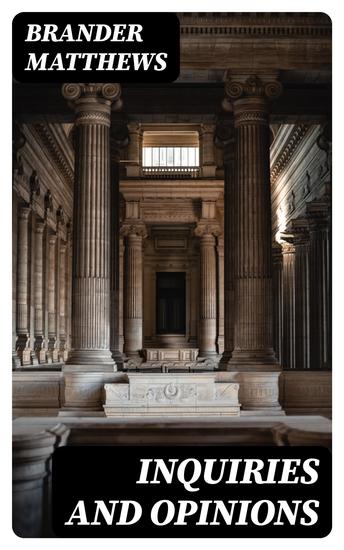
Inquiries and Opinions - cover

Inquiries and Opinions

Brander Matthews

Verlag: DigiCat

  • 0
  • 0
  • 0

Beschreibung

In "Inquiries and Opinions," Brander Matthews intricately weaves a tapestry of literary criticism and cultural commentary that reflects the shifting tides of American literature in the late 19th and early 20th centuries. Matthews, known for his articulate and engaging prose, offers readers a series of essays that probe into the aesthetic, moral, and social dimensions of literature. Through incisive analysis, he addresses the prevailing literary movements of his time, emphasizing the significance of realism and the emerging modernist trends, while advocating for the American voice in a predominantly European literary landscape. Brander Matthews is often regarded as a pivotal figure in the development of American literary criticism. A professor at Columbia University and a prolific writer, Matthews's insights stem from his deep appreciation of literature as both an art form and a cultural artifact. His extensive travels in Europe and engagements with contemporary writers enriched his perspective, enabling him to construct a nuanced framework for discussing literature that resonates well beyond his own era. Readers seeking a profound understanding of American literary evolution will find "Inquiries and Opinions" an essential addition to their intellectual journey. Matthews's articulate reflections and critical inquiries not only illuminate the complexities of literature but also invite readers to consider their own interpretations of the written word, making this work indispensable for scholars and casual readers alike.
Verfügbar seit: 16.09.2022.
Drucklänge: 156 Seiten.

Weitere Bücher, die Sie mögen werden

  • Outsourcing Duty - The Moral Exploitation of the American Soldier - cover

    Outsourcing Duty - The Moral...

    Bradley J. Strawser, Michael J....

    • 0
    • 0
    • 0
    Are contemporary soldiers exploited by the state and society that they defend? More specifically, have America's professional service members disproportionately carried the moral weight of America's war-fighting decisions since the inception of an all-volunteer force? In this volume, Michael J. Robillard and Bradley J. Strawser examine the question of whether and how American soldiers have been exploited in this way. 


    Robillard and Strawser offer an original theory of "moral exploitation"—the notion that persons or groups can be wrongfully exploited by being made to shoulder an excessive amount of moral weight. They make the case that this exploitation accurately describes the relationship between the United States and the members of its military, and offer an in-depth analysis of some of the exploitative and misleading elements of present-day military recruitment, the moral burdens soldiers often bear, and the stifling effect that a "Thank You for Your Service" and "I support the troops" culture has had on serious public engagement about America's ongoing wars. Robillard and Strawser offer a critique of the pernicious divide between military members and the civilians who direct them. They conclude by arguing for several normative and prudential prescriptions to help close this ever-widening fissure between the US and its military, and within the US itself.
    Zum Buch
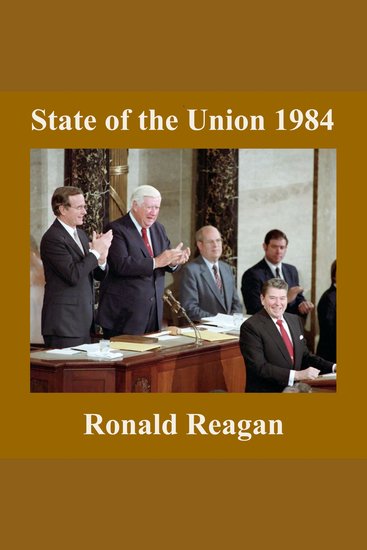
  • State of the Union 1984 - cover

    State of the Union 1984

    Ronald Reagan

    • 0
    • 0
    • 0
    The 1984 State of the Union address, delivered January 25, 1984, praises “bipartisan cooperation” and says: “For a time we forgot the American dream isn't one of making government bigger; it's keeping faith with the mighty spirit of free people under God.” “Inflation has been beaten down from 12.4 to 3.2 percent…” “Real after-tax income increased 5 percent last year.” “We're seeing rededication to bedrock values of faith, family, work, neighborhood, peace, and freedom…” 
    Let us agree on goals to keep America free and secure. Our first goal is vigorous economic growth. “We can begin by limiting the size and scope of government.” The Grace Commission has 2500 recommendations to reduce wasteful spending. Also, the line-item veto which 43 of the 50 States, including California, grant their Governors is a powerful tool against wasteful spending. 
    Additional programs are proposed including a permanently manned space station. Tuition tax credits are recommended for parents who pay private school tuition to improve education by increasing competition among schools. School prayer and a law to protect unborn children from abortion are advocated, as are enterprise zones for high-unemployment areas. 
    Finally, peace is our great goal and highest aspiration. “The future is best decided by ballots, not bullets.” We will seek concerted action to combat terrorism, and work for “freer world trade, greater competition, and more open markets.” “A nuclear war cannot be won and must never be fought.”  
    Carl Sandburg said, “I see America in the crimson light of a rising sun fresh from the burning, creative hand of God… I see great days ahead for men and women of will and vision.'' 
    Audio recording courtesy of the Ronald Reagan Presidential Library. 
    AspenLeafMedia.com
    Zum Buch
  • The Politics of Mass Violence in the Middle East - (Zones of Violence) - cover

    The Politics of Mass Violence in...

    Laura Robson

    • 0
    • 0
    • 0
    The Middle East today is characterized by an astonishingly bloody civil war in Syria, a highly racialized and militarized approach to the concept of a Jewish state in Israel and the Palestinian territories, an Iraqi state paralyzed by the emergence of class- and region-inflected sectarian identifications, a Lebanon teetering on the edge of collapse from the pressures of its huge numbers of refugees and its sect-bound political system, and the rise of a wide variety of Islamist paramilitary organizations seeking to operate outside all these states. 


    The region's emergence as a "zone of violence," characterized by a viciously dystopian politics of identity, is a relatively recent phenomenon, developing only over the past century; but despite these shallow historical roots, the mass violence and dispossession now characterizing Syria, Lebanon, Israel/Palestine, and Iraq have emerged as some of the twenty-first century's most intractable problems. In this study, Laura Robson uses a framework of mass violence—encompassing the concepts of genocide, ethnic cleansing, forced migration, appropriation of resources, mass deportation, and forcible denationalization—to explain the emergence of a dystopian politics of identity across the Eastern Mediterranean in the modern era and to illuminate the contemporary breakdown of the state from Syria to Iraq to Israel.
    Zum Buch
  • The Fortune Teller's Prophecy - A Memoir of an Unlikely Doctor - cover

    The Fortune Teller's Prophecy -...

    Lally Pia

    • 0
    • 0
    • 0
    When a military coup in Ghana leads to the abrupt closure of Lally Pia's medical school, she is stranded thousands of miles away from her family - and left with no educational prospects, no money, and a botched American Green Card. But a Sri Lankan priest told Lally's father that she will one day become a "Doctor of Doctors" - a laughable outcome, given her current predicament. 
    This multicultural roller coaster illustrates the power of self-determination as Lally takes on obstacle after obstacle - an abusive relationship, the welfare state and a gruesome job where she has to dismember human bodies - in order to fulfill her dreams. A searing examination of the immigrant experience. The Fortune Teller's Prophecy is a nail-biting, four-continent quest for ultimate triumph.
    Zum Buch
  • After Nationalism - Being American in an Age of Division - cover

    After Nationalism - Being...

    Samuel Goldman

    • 0
    • 0
    • 0
    Nationalism is on the rise across the Western world, serving as a rallying cry for voters angry at the unacknowledged failures of globalization that has dominated politics and economics since the end of the Cold War. In After Nationalism, Samuel Goldman trains a sympathetic but skeptical eye on the trend, highlighting the deep challenges that face any contemporary effort to revive social cohesion at the national level. 


    Noting the obstacles standing in the way of basing any unifying political project on a singular vision of national identity, Goldman highlights three pillars of mid-twentieth-century nationalism, all of which are absent today: the social dominance of Protestant Christianity, the absorption of European immigrants in a broader white identity, and the defense of democracy abroad. Most of today's nationalists fail to recognize these necessary underpinnings of any renewed nationalism, or the potentially troubling consequences that they would engender. 


    To secure the general welfare in a new century, the future of American unity lies not in monolithic nationalism. Rather, Goldman suggests we move in the opposite direction: go small, embrace difference as the driving characteristic of American society, and support political projects grounded in local communities.
    Zum Buch
  • What God Would Have Known - How Human Intellectual and Moral Development Undermines Christian Doctrine - cover

    What God Would Have Known - How...

    J. L. Schellenberg

    • 0
    • 0
    • 0
    Classical Christian ideas loom large in philosophy of religion today. But arguments against Christian doctrine have been neglected. J. L. Schellenberg's new book remedies this neglect. 


    The tide of human development, which the early Christians might have expected to corroborate their teaching, has in fact brought many results that run contrary to that teaching. Or at least it will be seen to have done so, says Schellenberg, when we think about the consequences of any God existent then being fully cognizant, when Christian doctrine was first formed, of all that we have laboriously learned since then. Newly discovered facts, not just about such things as evolution and the formation of the New Testament but also about mental illness, violent punishment, the relations between women and men, and the status of same-sex intimacy, suggest new arguments against the content of the Christian revelation when the prior understanding of the purported revealer is taken into account. 


    What God Would Have Known offers a thorough and incisive treatment of its subject that remains respectful and fair-minded throughout. It is not concerned with the overworked question of whether classical Christians believe irrationally, but with what overlooked arguments about human development show in relation to the truth or falsity of Christian claims about reality.
    Zum Buch