

Begleiten Sie uns auf eine literarische Weltreise!
Buch zum Bücherregal hinzufügen
Grey
Einen neuen Kommentar schreiben Default profile 50px
Grey
Jetzt das ganze Buch im Abo oder die ersten Seiten gratis lesen!
All characters reduced
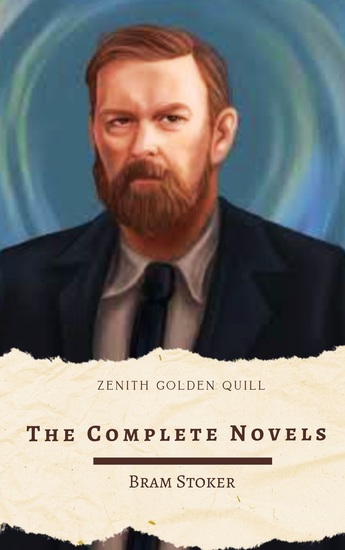
The Complete Novels of Bram Stoker - Definitive Gothic Horror Collection from the Master of the Macabre - cover

The Complete Novels of Bram Stoker - Definitive Gothic Horror Collection from the Master of the Macabre

Bram Stoker, Zenith Golden Quill

Verlag: Zenith Golden Quill

  • 0
  • 0
  • 0

Beschreibung

🧛 Darkness awaits. Dare to enter the mind of a master.

The Complete Novels of Bram Stoker gathers the most chilling, mysterious, and unforgettable tales from the legendary author of Dracula. Beyond the iconic vampire, Stoker's fiction explores ancient curses, supernatural horrors, and psychological terror that still haunts readers over a century later 🩸📖.

This definitive edition includes:

Dracula

The Jewel of Seven Stars

The Lair of the White Worm

The Lady of the Shroud

The Man

With bonus short stories and gothic commentary

Perfect for fans of classic horror, dark romance, and supernatural thrillers, this collection features beautiful formatting, restored text, and illustrations that amplify the eerie atmosphere.

"Stoker was more than just Dracula—this collection proves his genius for fear and fascination." — Gothic Review
"The original vampire, and still the best." — Dark Reads Digest

📘 Click Buy Now to own the full gothic legacy of Bram Stoker in one complete volume.
Verfügbar seit: 23.05.2025.
Drucklänge: 3951 Seiten.

Weitere Bücher, die Sie mögen werden

  • The Love Song of J Alfred Prufrock - cover

    The Love Song of J Alfred Prufrock

    T. S. Eliot

    • 0
    • 0
    • 0
    "The Love Song of J. Alfred Prufrock", commonly known as "Prufrock", is the first professionally published poem by American-born British poet T. S. Eliot (1888–1965). Eliot began writing "Prufrock" in February 1910, and it was first published in the June 1915 issue of Poetry.Eliot narrates the experience of Prufrock using the stream of consciousness technique developed by his fellow Modernist writers. The poem, described as a "drama of literary anguish", is a dramatic interior monologue of an urban man, stricken with feelings of isolation and an incapability for decisive action that is said "to epitomize frustration and impotence of the modern individual" and "represent thwarted desires and modern disillusionment".Prufrock laments his physical and intellectual inertia, the lost opportunities in his life and lack of spiritual progress, and he is haunted by reminders of unattained carnal love. With visceral feelings of weariness, regret, embarrassment, longing, emasculation, sexual frustration, a sense of decay, and an awareness of mortality, "Prufrock" has become one of the most recognised voices in modern literature.
    Zum Buch
  • Far from the Madding Crowd - cover

    Far from the Madding Crowd

    Thomas Hardy

    • 0
    • 0
    • 0
    "Far from the Madding Crowd," published in 1874, is one of Thomas Hardy's most celebrated novels and the first to introduce readers to the fictional county of Wessex. The story follows the independent and headstrong Bathsheba Everdene, who inherits her uncle's farm and decides to manage it herself, which was unusual for a woman of her time. Throughout the narrative, Bathsheba attracts three very different suitors: the loyal shepherd Gabriel Oak, the mature and prosperous farmer Mr. Boldwood, and the dashing but reckless Sergeant Troy. As the story unfolds, it delves deep into themes of love, honor, and betrayal against the backdrop of the pastoral English countryside.
    Zum Buch
  • The Murder of Roger Ackroyd - cover

    The Murder of Roger Ackroyd

    Agatha Christie

    • 0
    • 0
    • 0
    Despite his best efforts to retire, the fourth book in Agatha Christie's famous detective series sees Detective Hercule Poirot returning for his next intriguing case.Detective Poirot is enjoying a quiet, peaceful retirement in a small village where he can focus on gardening and daily life. His plans are rudely disrupted when Roger Ackroyd, a wealthy widower, is murdered in his study shortly after the suspicious death of his fiancée. Ackroyd's niece and Poirot's new neighbor, Flora, begs for the detective's help on the investigation, and he can't bring himself to refuse. Poirot quickly finds himself pulled into another intriguing case filled with impossible alibis and dark secrets that he will have to unravel if he wants to discover who killed Roger Ackroyd.
    Zum Buch
  • The Voyage of Copley Banks - cover

    The Voyage of Copley Banks

    Arthur Conan Doyle

    • 0
    • 0
    • 0
    The Voyage of Copley Banks is a short story written by Arthur Conan Doyle first published in the Pearson's Magazine in may 1897. 3rd story of the Captain Sharkey saga.Copley Banks, of Kingston, had been one of the leading sugar merchants of the West Indies. The pirate John Sharkey killed his wife and two children when they were sailing from England. Since then Banks is gathering information to locate Sharkey. Two years after his misfortunes, he decides to prepare the brig Ruffling Harry for a slaving venture to Whydah in Africa. However, the ship is heavily armed like a warship rather than a merchant. And he hires the scum of the port, instead of the usual sailors from the firm. After the departure Copley Banks reveals his plans to the crew. He explains that he chooses the pirate's life. Among the 46 men only 4 decide to return to the port. After a year of piracy Copley Banks becomes as famous as Sharkey. And one day in Cuba they both meet while careening their boats. They become good friends and sunked ships together for a long while. Sharkey knew nothing of the evil that he had done to his new boon companion. One day, in the captain's cabin Banks and Sharkey are alone face to face. Banks tells him the story of his murdered wife and sons and captures Sharkey. He ties him securely around a powder barrel and lit a slow powder line while he leaves the boat. From the shore he sees the boat exploding with all his captain and crew.
    Zum Buch
  • Mutiny - A womans quest for social advancement meets a reporter investigating the truth aboard a ship - cover

    Mutiny - A womans quest for...

    Dorothy Edwards

    • 0
    • 0
    • 0
    Dorothy Edwards, an only child, was born on the 18th August 1902 at Ogmore Vale in Glamorgan. 
     
    Her father was a headmaster and an early activist in the Independent Labour Party.  At age 9 Dorothy, dressed in red, welcomed Keir Hardy on to the stage at Tonypandy during the national coal strike of 1912. She was taught that revolution was at hand, that class barriers would be a thing of the past. 
      
    Dorothy won a scholarship and boarded at Howell's School for Girls in Llandaff before moving to University College of South Wales and Monmouthshire where she read Greek and philosophy. 
     
    Her early hopes to be an opera singer were set to one side after graduating and the death of her father. Instead she took on part-time work to supplement her mother’s pension with whom she now lived. 
     
    Dorothy managed to write a number of short stories which appeared in the literary journals of the day.  She spent several months with her mother in Vienna, all the time revising or writing before embarking on ‘Winter Sonata’, a short novel published in 1928. 
     
    Introductions to several members of the Bloomsbury Group meant a move to London and a division of her time between child-care for the family of Bloomsbury author David Garnett and the promise of an advance payment for her work on a new volume of stories. 
     
    However, Dorothy’s life was starting to spiral out of control; she was attracted to the Welsh nationalist movement but felt that her Welsh provincialism made her, in London at least, feel socially inferior. Leaving her mother dependent on a hired companion consumed her with guilt as did the end of an affair with a married musician. 
     
    On the 5th January 1934, having spent the morning burning her papers, Dorothy Edwards threw herself in front of a train near Caerphilly railway station.  
     
    Her suicide note read: "I am killing myself because I have never sincerely loved any human being all my life. I have accepted kindness and friendship and even love without gratitude, and given nothing in return."
    Zum Buch
  • Troilus and Cressida - cover

    Troilus and Cressida

    William Shakespeare

    • 0
    • 0
    • 0
    Troilus and Cressida is a tragedy by William Shakespeare, believed to have been written in 1602. It was described by Frederick S. Boas as one of Shakespeare's problem plays. The play ends on a very bleak note with the death of the noble Trojan Hector and destruction of the love between Troilus and Cressida. The work has in recent years "stimulated exceptionally lively critical debate".
    Throughout the play, the tone lurches wildly between bawdy comedy and tragic gloom, and readers and theatre-goers have frequently found it difficult to understand how one is meant to respond to the characters. Several characteristic elements of the play (the most notable being its constant questioning of intrinsic values such as hierarchy, honour and love) have often been viewed as distinctly "modern". 
    Among the most significant works William Shakespeare: Hamlet, Othello, King Lear, Macbeth, Orpheus, Romeo and Juliet, Julius Caesar, Troilus and Cressida, The Tempest, Venus and Adonis, Antony and Cleopatra, Measure for Measure, The Winter's Tale and many more.
    Zum Buch
