Join us on a literary world trip!
Add this book to bookshelf
Grey
Write a new comment Default profile 50px
Grey
Subscribe to read the full book or read the first pages for free!
All characters reduced
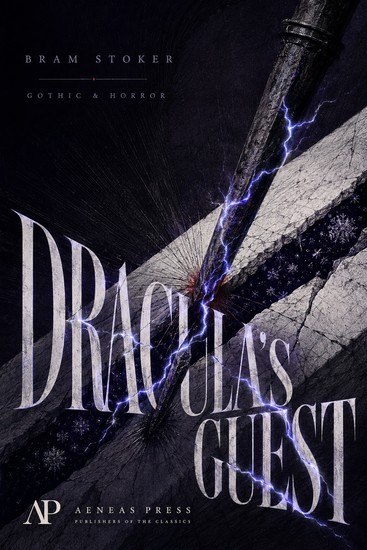
Dracula's Guest - cover

Dracula's Guest

Bram Stoker

Publisher: Aeneas Press

  • 0
  • 0
  • 0

Summary

The chapter cut from Dracula and eight other tales, published by Stoker's widow two years after his death: a traveller stranded on Walpurgis Night among the tombs, a house that takes its rent in visitors, a squaw and a cat. Whether the title story was ever really part of the novel is still argued; either way, it is the coldest thing he wrote.
Available since: 08/19/2026.
Print length: 143 pages.

Other books that might interest you

  • A Profitable Weakness - From their pens to your ears genius in every story - cover

    A Profitable Weakness - From...

    George Gissing

    • 0
    • 0
    • 0
    George Robert Gissing was born on November 22nd, 1857 in Wakefield, Yorkshire.  
    He was educated at Back Lane School in Wakefield. Gissing loved school. He was enthusiastic with a thirst for learning and always diligent.  By the age of ten he was reading Dickens, a lifelong hero. 
    In 1872 Gissing won a scholarship to Owens College. Whilst there Gissing worked hard but remained solitary. Unfortunately, he had run short of funds and stole from his fellow students. He was arrested, prosecuted, found guilty, expelled and sentenced to a month's hard labour in 1876. 
    On release he decided to start over.  In September 1876 he travelled to the United States. Here he wrote short stories for the Chicago Tribune and other newspapers. On his return home he was ready for novels. 
    Gissing self-published his first novel but it failed to sell.  His second was acquired but never published. His writing career was static.  Something had to change.  And it did. 
    By 1884 The Unclassed was published.  Now everything he wrote was published. Both Isabel Clarendon and Demos appeared in 1886. He mined the lives of the working class as diligently as any capitalist. 
    In 1889 Gissing used the proceeds from the sale of The Nether World to go to Italy. This trip formed the basis for his 1890 work The Emancipated. 
    Gissing's works began to command higher payments. New Grub Street (1891) brought a fee of £250.  
    Short stories followed and in 1895, three novellas were published; Eve's Ransom, The Paying Guest and Sleeping Fires. Gissing was careful to keep up with the changing attitudes of his audience.  
    Unfortunately, he was also diagnosed as suffering from emphysema. The last years of his life were spent as a semi-invalid in France but he continued to write. 1899; The Crown of Life. Our Friend the Charlatan appeared in 1901, followed two years later by The Private Papers of Henry Ryecroft. 
    George Robert Gissing died aged 46 on December 28th, 1903 after catching a chill on a winter walk.
    Show book
  • Stories I Told My Dead Lover - cover

    Stories I Told My Dead Lover

    Jo Paquette

    • 0
    • 0
    • 0
    Perfect for fans of Carmen Maria Machado and Kelly Link 
    Stories I Told My Dead Lover  
    Eight searing tales of psychological horror that probe the darkest and most deeply buried parts of the human psyche … 
    A child is forced to grow up too soon. 
    A woman trusts her doctor too much. 
    An abandoned woman isn’t as alone as she thinks. 
    An idyllic holiday masks an unspeakable act of violence. 
    Driven, desperate, fighting for the power to choose their own fate, Paquette’s characters dare to push back at the walls that hold them in. 
    Come watch them burn.
    Show book
  • Northanger Abbey - cover

    Northanger Abbey

    Jane Austen

    • 0
    • 0
    • 0
    Jane Austen's first novel—published posthumously in 1818—tells the story of Catherine Morland and her dangerously sweet nature, innocence, and sometime self-delusion. Though Austen's fallible heroine is repeatedly drawn into scrapes while vacationing at Bath and during her subsequent visit to Northanger Abbey, Catherine eventually triumphs, blossoming into a discerning woman who learns truths about love, life, and the heady power of literature. The satirical novel pokes fun at the gothic novel while earnestly emphasizing caution to the female sex.
    Show book
  • The Birth-Mark - cover

    The Birth-Mark

    Nathaniel Hawthorne

    • 0
    • 0
    • 0
    The Birth-Mark by Nathaniel Hawthorne is a hauntingly thought-provoking short story that explores the dark side of perfectionism, science, and obsession. With rich symbolism and moral complexity, Hawthorne crafts a powerful narrative that continues to resonate with readers today. Ideal for fans of classic literature, psychological fiction, and philosophical allegory.
    Show book
  • The Disinterment - cover

    The Disinterment

    H.P. Lovecraft, Duane W. Rimel

    • 0
    • 0
    • 0
    This audiobook is narrated by an AI Voice. A doctor who treats a person afflicted with leprosy using macabre methods is an unstable physician. 
     
    Although Rimel admitted that he wrote the story himself and Lovecraft only made stylistic corrections, the work is characterized by the very distinct style of the latter. Even though the writer from Providence congratulated his junior colleague on the text and claimed to have made only minor corrections, it could have been a typical courtesy on his part. A supporter of the hypothesis of Lovecraft's authorship is that Rimel did not create anything else in a similar style.
    Show book
  • Thirst for War - An allegory of perpetual war - cover

    Thirst for War - An allegory of...

    Osman Gjepali

    • 0
    • 0
    • 0
    Across the vast plains of central Africa, three ancient kingdoms — lions, hyenas, and wild dogs — have fought for centuries to control the land. It is a war older than memory, inherited like a curse, deciding who lives, who dies, and who rules. In this world is born Leo, a fragile cub shaped by hunger, suspicion, and the fading voice of a mother who once whispered: “War has no victors, only orphans.” Against all odds, Leo grows into a majestic lion, admired for his courage and revered for his ideals. As the pride prepares to crown a new king, he dares to dream of what no one has ever imagined: a future without bloodshed. But the savannah has its own laws. And those who draw power from conflict rarely surrender it willingly. Leo will soon learn that war is not merely tradition — it is a flawless machine, feeding on itself. Breaking it carries a cost few are willing to bear. Thirst for War is a powerful, timeless allegory about the true price of pursuing peace in a world sustained by war.
    Show book