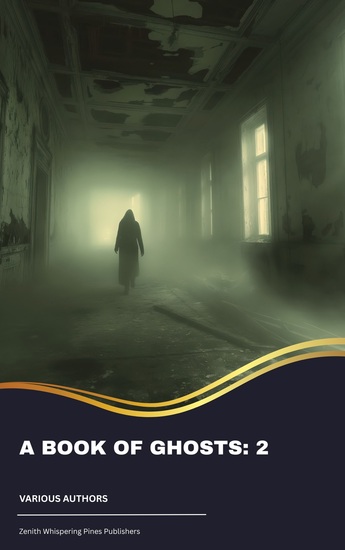
"Some Spirits Return Not for Rest, but for Reckoning."
The journey into the twilight world of S. Baring-Gould continues. In this second volume of his celebrated supernatural works, the master of the Victorian "weird tale" delves even deeper into the shadows of the English countryside. These are stories for the dead of winter—narratives where the past is a living, breathing entity that refuses to stay buried beneath the floorboards of history.
The Architect of Atmospheric Terror: Baring-Gould remains unsurpassed in his ability to find terror in the everyday. Volume 2 elevates his signature style, blending his expertise as an antiquarian with a dark, psychological insight into the human condition. Here, the haunting is often a social or moral consequence; a ghost is not just a spirit, but a debt that must be paid. Whether exploring the silent corridors of a crumbling manor or the windswept desolation of a country churchyard, Baring-Gould crafts an atmosphere of "uncomfortable reality" that has influenced generations of supernatural writers.
As a peer to the great ghost story writers of the late 19th century, Baring-Gould provides a crucial link between traditional folklore and modern psychological horror. This volume is an essential cornerstone for collectors of classic ghost stories, Victorian literature, and British folk horror.
The candles are dimming. Buy "A Book of Ghosts: Volume 2" today and settle in for a night of elegant, bone-chilling terror.
"The Secret Garden" is a short story by G. K. Chesterton. It was originally published in The Story-Teller in October, 1910. It is the second story in the collection The Innocence of Father Brown. It is the second story about the French detective Valentin and completes his plot arch, begun in The Blue Cross.
Dorothy Kathleen Broster was born on 2nd September 1877 at Devon Lodge in Grassendale Park, Garston, Liverpool.
At 16, the family moved to Cheltenham, where she attended Cheltenham Ladies' College and then on to St Hilda’s College, Oxford to read history, where she was one of the first female students, although at this time women were not awarded degrees.
Broster served as secretary to Charles Harding Firth, a Professor of History for several years, and collaborated on several of his works. Her first two novels were co-written with a college friend, Gertrude Winifred Taylor.
With the Great War interrupting her literary ambitions she served as a Red Cross nurse at a Franco-American hospital, but returned to England with a knee infection in 1916.
After the war, she moved near to Battle in East Sussex and took up writing full-time.
In 1920 she at last received her Bachelor of Arts and Master of Arts from Oxford.
Her novels, mainly historical fiction, peaked in popularity with ‘The Flight of the Heron’, in 1925, a best-seller followed up by two sequels.
As well as poetry and various articles she also wrote several short stories, the best known of which is a classic of weird fiction ‘The Couching at the Door’ in which an artist appears to be haunted by a mysterious entity.
An intensely private individual many readers deduced from her name that she was both a man and Scottish.
D K Broster died in Bexhill Hospital on 7th February 1950. She was 73.
The story relates the plight of a nine-year-old orphan boy, Vanka, who has been apprenticed to a cobbler in Moscow. He writes a letter to his grandfather in the countryside, begging to be rescued from his cruel master. "Vanka" was published in 1886.
Herbert George "H. G." Wells (1866 - 1946) was an English writer.
He was prolific in many genres, including the novel, history, politics, social commentary, and textbooks and rules for war games. Wells is now best remembered for his science fiction novels and is called a "father of science fiction"
BOOK THE FIRST: THE MAKING OF A MAN: Since I came to this place I have been very restless, wasting my energies in the futile beginning of ill-conceived books. One does not
settle down very readily at two and forty to a new way of living, and I have found myself with the teeming interests of the life I have abandoned still buzzing like a swarm of homeless bees in my head.
Six has always been a number we group things around – Six of the best, six of one half a dozen of another, six feet under, six pack, six degrees of separation and a sixth sense are but a few of the ways we use this number.
Such is its popularity that we thought it is also a very good way of challenging and investigating an author’s work to give width, brevity, humour and depth across six of their very best.
In this series we gather together authors whose short stories both rivet the attention and inspire the imagination to visit their gems in a series of six, to roam across an author’s legacy in a few short hours and gain a greater understanding of their writing and, of course, to be lavishly entertained by their ideas, their narrative and their way with words.
These stories can be surprising and sometimes at a tangent to what we expected, but each is fully formed and a marvellous adventure into the world and words of a literary master.
1 - Six of the Best - Edgar Allan Poe - An Introduction
2 - Edgar Allan Poe - An Introduction
3 - The Fall of the House of Usher - Part 1 by Edgar Allan Poe
4 - The Fall of the House of Usher - Part 2 by Edgar Allan Poe
5 - The Pit and the Pendulum by Edgar Allan Poe
6 - The Tell Tale Heart by Edgar Allan Poe
7 - The Premature Burial by Edgar Allan Poe
8 - The Masque of the Red Death by Edgar Allan Poe
9 - The Murders in the Rue Morgue - Part 1 by Edgar Allan Poe
10 - The Murders in the Rue Morgue - Part 2 by Edgar Allan Poe
'Once' was written by D H Lawrence in 1912. The story is largely autobiographical, written when Lawrence and Frieda (Anita in the Story) had fled England together to live in Austria and Italy. Frieda had had an affair while they were in Austria and she told Lawrence about it. 'Once' explores Lawrence's reactions to being betrayed while still being in love and desiring the betrayer.
Ihr Account wird momentan auf einem anderen Gerät benutzt.
Es ist bereits eine Sitzung auf einem anderen Gerät geöffnet.
Abmelden
Erneut verbinden
Ihr Account wird momentan auf einem anderen Gerät benutzt.
Um darauf zugreifen zu können, müssen die Berechtigungen und obligatorischen Richtlinien (markiert mit *) überprüft und akzeptiert werden.
Wenn Sie Hilfe oder weitere Informationen benötigen, schreiben Sie an support@24symbols.com
Akzeptieren
Ihr Account wird momentan auf einem anderen Gerät benutzt.
OK
Bestätigungs-E-Mail noch einmal schicken
Ihr Account wird momentan auf einem anderen Gerät benutzt.
Wir haben versucht, Ihr Abo abzubuchen, aber es ist uns nicht gelungen. Das teilt uns Ihre Bank/Karte mit:
Wenn Sie weiterlesen möchten, müssen Sie sich möglicherweise an Ihre Bank wenden oder Ihre Zahlungsinformationen hier ändern:
Ich möchte meine Karte aktualisieren!
Haben Sie Fragen? Schreiben Sie uns an support@24symbols.com und wir werden Ihnen weiterhelfen.
Cookies helfen uns bei der Bereitstellung unserer Dienste. Durch die Nutzung unserer Dienste erklären Sie sich damit einverstanden, dass wir Cookies setzen.Mehr erfahren