Begleiten Sie uns auf eine literarische Weltreise!
Buch zum Bücherregal hinzufügen
Grey
Einen neuen Kommentar schreiben Default profile 50px
Grey
Jetzt das ganze Buch im Abo oder die ersten Seiten gratis lesen!
All characters reduced
Pascal's Pensées - Apology for the Christian Religion - cover

Pascal's Pensées - Apology for the Christian Religion

Blaise Pascal

Übersetzer William Finlayson Trotter

Verlag: DigiCat

  • 0
  • 0
  • 0

Beschreibung

In "Pascal's Pensées," Blaise Pascal offers a profound exploration of faith, reason, and the human condition, encapsulated in a series of reflections that blend philosophical discourse with theological inquiry. Written in the 17th century, this work stands out for its fragmented structure and epistolary style, evoking the essence of a meditative journal rather than a systematic treatise. Pascal's style is notable for its use of aphorisms and paradoxes, challenging readers to confront the complexities of belief and the limitations of human rationality in the face of divine mystery. Blaise Pascal was not only a mathematician and scientist but also a deeply contemplative religious thinker. His experiences with personal crises of faith and his involvement in the Jansenist movement significantly influenced his reflections in the "Pensées," as he grappled with the interplay between intellect and spirituality. The work remains a testament to his struggle between skepticism and belief, illuminated by his famous assertion of the heart's reason. This book is highly recommended for readers interested in existential philosophy, theology, and the human experience of doubt and belief. Pascal's insights remain remarkably relevant, inviting readers to engage with the timeless questions of existence and the search for truth.
Verfügbar seit: 26.11.2023.
Drucklänge: 262 Seiten.


Weitere Bücher, die Sie mögen werden

  • HOW TO LOVE THE DIFFICULT PEOPLE - 10 Easy & Proven Ways to Loving People Who Are Hard to Love Unleashing the Power of Love & Strengthen Your Relationship by Learning to Love Unconditionally - cover

    HOW TO LOVE THE DIFFICULT PEOPLE...

    Crystal Hill

    • 0
    • 0
    • 0
    ★ Find out how to deal with the difficult people in your life by learning effective strategies ★ 
    Are you sick of trying to love those who are difficult to love? 
    Do you struggle to love without conditions? 
    Would you wish to discover the art of unconditional love? 
    Love is quite possibly the most complicated thing in existence. 
    It can make someone more joyful than at any time and experience the most profound degree of pain. It's hard to accept the imperfections that people have and the imperfections you have in yourself. In any case, the power of love covers weaknesses and faults. 
    The incredible power of love allows you to persevere through things you never felt you could do. Sometimes people do such items that may urge outrage in us. 
    How can we love when things are difficult? 
    Learn to protect your well-being and personal space with this ultimate LOVING guide! 
    Learn how to love, understand, and communicate with difficult people with innovative and refreshing strategies 
    You will acquire the information: 
    · The Intriguing Power of love 
    · The Nature of Love 
    · Major Aspects of Love 
    · The True Love 
    · Love in Relationships 
    · Secrets of Love 
    · How to Cultivate Self-Love 
    · How to Practice the Power of Unconditional Love 
    and a lot more! 
    This book is for you! Waste no additional time! 
    Now it's your turn to take action! 
    Scroll up, Click "BUY NOW with 1-Click", and discover how to set the power of love free in your day-to-day existence.
    Zum Buch
  • Fear and Trembling - cover

    Fear and Trembling

    Søren Kierkegaard

    • 0
    • 0
    • 0
    Soren Kierkegaard was a Danish philosopher, theologian, and religious author interested in human psychology. He is regarded as a leading pioneer of existentialism and one of the greatest philosophers of the 19th Century.
    
    In Fear and Trembling, Kierkegaard aimed to understand the anxiety that must have been present in Abraham when God commanded him to offer his son as a human sacrifice. Abraham had a choice to complete the task or to forget it. He resigned himself to the loss of his son, acting according to his faith. In other words, one must be willing to give up all his or her earthly possessions in infinite resignation and must also be willing to give up whatever it is that he or she loves more than God. Abraham had passed the test -- his love for God proved greater than anything else in him. And because a good and just Creator would not want a father to kill his son, God intervened at the last moment to prevent the sacrifice.
    Zum Buch
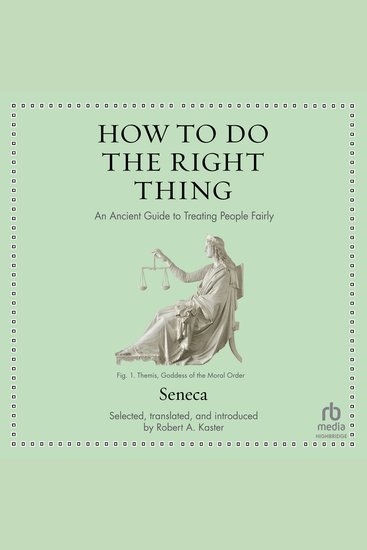
  • How to Do the Right Thing - An Ancient Guide to Treating People Fairly - cover

    How to Do the Right Thing - An...

    Seneca, Robert A. Kaster

    • 0
    • 0
    • 0
    How ancient Stoicism can help teach us to treat others—and ourselves—more fairly and mercifully 


    There are times when we've all felt that we haven't been treated as we deserve—that we've been misjudged, shortchanged, or given a raw deal. And, at one time or another, other people have probably felt that we've treated them just as unfairly. How to Do the Right Thing draws on the principles of ancient Stoicism as articulated by the Roman statesman and philosopher Seneca to help listeners better navigate one of the most important practical questions of daily life—how to do right by others. 


    Starting from the virtue of magnanimity—the opposite of small-mindedness—How to Do the Right Thing draws together lessons from Seneca's writings that stress the importance of calm and clear thinking, of judging oneself fairly before judging others, and of cutting people slack, with a bias toward mercy—all delivered in crisp and lively new translations.
    Zum Buch
  • Maiden Arc The: Coming of Age - Archetypal Character Guided Meditation for Writers - cover

    Maiden Arc The: Coming of Age -...

    K.M. Weiland

    • 0
    • 0
    • 0
    Archetypes can help you write stories that tap the depths of the human experience. This 45-minute guided meditation will help you dive deep into your subconscious creativity and write a resonant Maiden Arc story.  
    As the first archetypal journey in the cycle of life arcs, the Maiden represents a crucial initiatory experience. This coming-of-age arc will take you and your characters on a journey through all the challenges of growing up, individuating from authority figures, and finding an identity and role in a wider world that often seems overwhelming and even dangerous.  
    This meditation will help you visualize and imagine important characters and settings. It gives you the opportunity to explore every vital beat while offering all the space you need to find your own unique story. It will show you how your character may interact with corresponding archetypal antagonists (Authority and Predator) and grapple with a thematic Lie and Truth (Submission vs. Sovereignty) in order to evolve from Innocent to Individual.   
    (Note: Although a feminine arc, this journey may be taken by any character of any gender. Gender-neutral terms are used throughout the meditation to help you apply its imagery to the specifics of your own story.) 
    K.M. Weiland’s book Writing Archetypal Character Arcs taught writers how to identify and structure the six most important initiatory journeys of the human experience (Maiden, Hero, Queen, King, Crone, and Mage). These “life arcs” include the youthful Hero’s Journey as one of six, but go so much deeper to explore little-known feminine and elder arcs as well. 
    Now you can explore these archetypal journeys yourself by accessing the potent tool of “dreamzoning.” Just sit back and let your imagination take over as these audio adventures guide you through every important beat in the archetypal arcs.
    Zum Buch
  • A Man of Bad Reputation - The Murder of John Stephens and the Contested Landscape of North Carolina Reconstruction - cover

    A Man of Bad Reputation - The...

    Drew A. Swanson

    • 0
    • 0
    • 0
    Five years after the Civil War, North Carolina Republican state senator John W. Stephens was found murdered inside the Caswell County Courthouse. Stephens fought for the rights of freedpeople, and his killing by the Ku Klux Klan ultimately led to insurrection, Governor William W. Holden's impeachment, and the early unwinding of Reconstruction in North Carolina. In recounting Stephens's murder, the subsequent investigation and court proceedings, and the long-delayed confessions that revealed what actually happened at the courthouse in 1870, Drew A. Swanson tells a story of race, politics, and social power shaped by violence and profit. The struggle for dominance in Reconstruction-era rural North Carolina, Swanson argues, was an economic and ecological transformation. Arson, beating, and murder became tools to control people and landscapes, and the ramifications of this violence continued long afterward. The failure to prosecute anyone for decades after John Stephens's assassination left behind a vacuum, as each side shaped its own memory of Stephens and his murder. 


    The malleability of and contested storytelling around Stephens's legacy presents a window into the struggle to control the future of the South.
    Zum Buch
  • The human machine - cover

    The human machine

    Arnold Bennett

    • 0
    • 0
    • 0
    "The Human Machine" by Arnold Bennett is a classic self-help book published in 1908. In this work, Bennett explores the intricacies of human psychology and behavior, offering insights into how individuals can better understand and control their thoughts, emotions, and actions to lead more fulfilling lives. Through practical advice and philosophical reflections, Bennett delves into the inner workings of the human mind, examining topics such as habit formation, willpower, concentration, and personal development.
    Zum Buch