Begleiten Sie uns auf eine literarische Weltreise!
Buch zum Bücherregal hinzufügen
Grey
Einen neuen Kommentar schreiben Default profile 50px
Grey
Jetzt das ganze Buch im Abo oder die ersten Seiten gratis lesen!
All characters reduced
Writing and Publishing a Book - Secrets of a Christian Author - cover

Writing and Publishing a Book - Secrets of a Christian Author

Bill Vincent

Verlag: RWG Publishing

  • 0
  • 0
  • 0

Beschreibung

Have you considered writing a book? Do you need advice on what to do now that you've written it?
Writing and Publishing a Book: Secrets of a Christian Author is a concise but informative guide to writing and publishing your own books. Bill Vincent, successful Christian author and owner of a publishing company, uses his own experience in writing and publishing to help you. His unique writing style evokes the feeling of a one-on-one conversation with personal advice.
This book covers topics such as manuscript submission, seeking endorsements, traditional publishing versus self-publishing, and more. Written from a Christian writer's perspective, this guide can help anyone looking to publish in any genre.
Find your passion and get your book out there with help from Writing and Publishing a Book: Secrets of a Christian Author!
 
Verfügbar seit: 22.03.2023.

Weitere Bücher, die Sie mögen werden

  • Nothing Wasted - Struggling Well through Difficult Seasons - cover

    Nothing Wasted - Struggling Well...

    Kim Patton, Jenn Hesse

    • 0
    • 0
    • 0
    Difficult seasons catch us off guard and make us feel like life won’t ever make sense again. 
    On our worst days, it’s hard to believe that God will guide us through the mess. Even on our good days, when we feel we have done all the right things, we may wonder: 
    Why am I working this job? 
    Am I making a difference? 
    How do I know the way to go? 
    Why can’t I seem to be content? 
    In Nothing Wasted, we see how we mature in time. Like fog dissipating, we recognize how God is gently leading us through each season of our lives. We may be struggling, but we are moving forward. 
    Our faith is not unseen. 
    Our moments are not wasted. 
    All the pain that comes in these seasons does lead to a full, rich life, growing in relationship with God and with others.
    Zum Buch
  • Slavery By Consent Interviews & Purports - Talks by Aldous Huxley - cover

    Slavery By Consent Interviews &...

    Geoffrey Giuliano

    • 0
    • 0
    • 0
    "There is only one corner of the universe you can be certain of improving, and that's your own self.""One of the great attractions of patriotism - it fulfills our worst wishes.""The secret of genius is to carry the spirit of the child into old age, which means never losing your enthusiasm." Aldous HuxleyAldous Huxley was an English writer and philosopher. He wrote nearly fifty books, both novels and non-fiction works—as well as wide-ranging essays, narratives, and poems.Born into the prominent Huxley family, he graduated from Oxford, with an undergraduate degree in English literature. Early in his career, he published short stories and poetry and edited the literary magazine Oxford Poetry, before going on to publish travel writing, satire, and screenplays. Huxley spent the latter part of his life in the United States, living in Los Angeles from 1937 until his death. By the end of his life, Huxley was widely acknowledged as one of the foremost intellectuals of his time. He was nominated for the Nobel Prize in Literature nine times and was elected Companion of Literature by the Royal Society of Literature in 1962.Includes a rare treasury of ultra-rare previously unheard conversations with the esteemed intellectual.©2022 Eden Garret Giuliano (P) 2022 Eden Garret GiulianoGeoffrey Giuliano is the author of over thirty internationally bestselling biographies, including the London Sunday Times bestseller 'Blackbird: The Life and Times of Paul McCartney' and 'Dark Horse: The Private Life of George Harrison'. He can be heard on the Westwood One Radio Network and has written and produced over seven hundred original spoken word albums and documentaries on various aspects of popular culture.
    Zum Buch
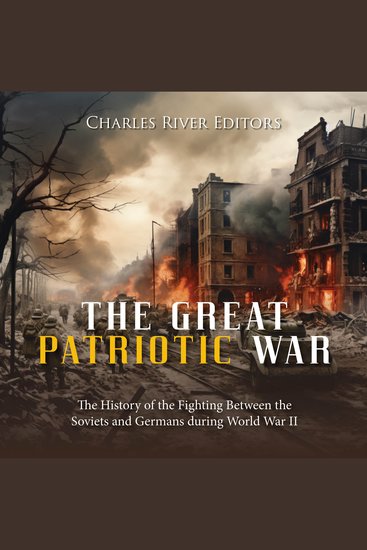
  • Great Patriotic War The: The History of the Fighting Between the Soviets and Germans during World War II - cover

    Great Patriotic War The: The...

    Editors Charles River

    • 0
    • 0
    • 0
    In the warm predawn darkness of June 22, 1941, 3 million men waited along a front hundreds of miles long, stretching from the Baltic coast of Poland to the Balkans. Ahead of them in the darkness lay the Soviet Union, its border guarded by millions of Red Army troops echeloned deep throughout the huge spaces of Russia. This massive gathering of Wehrmacht soldiers from Adolf Hitler's Third Reich and his allied states – notably Hungary and Romania – stood poised to carry out Operation Barbarossa, Hitler's surprise attack against the country of his putative ally, Soviet dictator Joseph Stalin.  
    	Though Germany was technically Russia’s ally, Stalin had no delusions that they were friends. Instead, he used this time to build up his forces for what he saw as an inevitable invasion. First, on the heels of the German invasion of Poland in September 1939, Stalin had his troops invade and reclaim the land Russia had lost in World War I. Next he turned his attention to Finland, which was only 100 miles from the newly named Leningrad.  He initially tried to negotiate with the Finnish government for some sort of treaty of mutual support. When this failed he simply invaded. While the giant Russian army ultimately won, the fact that little Finland held them off for three months demonstrated how poorly organized the bigger force was. 
    What Stalin did not realize was that Hitler had simply overstretched himself in Yugoslavia and only planned to delay the invasion by a few weeks.  The Soviets were so caught by surprise at the start of the attack that the Germans were able to push several hundred miles into Russia across a front that stretched dozens of miles long, reaching the major cities of Leningrad and Sevastopol in just three months. 
    Zum Buch
  • Logic of Collective Action The: Book Summary & Analysis - cover

    Logic of Collective Action The:...

    Briefly Summaries

    • 0
    • 0
    • 0
    This is a concise summary and analysis of The Logic of Collective Action, by Mancur Olson.
     
    It is not the original book and is not affiliated with or endorsed by Mancur Olson.
     
    Ideal those seeking a quick and insightful overview.
     
    The Logic of Collective Action is a groundbreaking exploration of the paradoxical dynamics behind group behavior. This influential work dissects how individuals, acting in their own self-interest, often fail to act collectively—even when it benefits the entire group. From labor unions to environmental movements, the book reveals why smaller, more focused groups often achieve their goals, while larger groups face significant obstacles. Blending economic theory, sociology, and political science, this analysis provides a compelling framework for understanding cooperation, free-riding, and the challenges of organizing collective efforts. A must-read for anyone seeking to comprehend the forces shaping social, political, and economic groups.
    Zum Buch
  • SPEAK Your Way to Unforgettable Influence in Any Room - "Elevate your influence! Unlock powerful audio lessons for unforgettable speaking in any room" - cover

    SPEAK Your Way to Unforgettable...

    Sullivan Ravenscroft

    • 0
    • 0
    • 0
    Audiobook Title: SPEAK Your Way to Unforgettable Influence in Any Room  
    ⭐⭐ Simplified Guide & Explanations Included ⭐⭐ 
    Are you eager to advance in your career and enhance your expertise in mastering communication?  
    Looking for a comprehensive resource that covers all the vital elements to captivate audiences and leave lasting impressions?  
    Your quest ends here! 
    This guide is your ultimate companion for deepening your understanding, applying your skills, and engaging in practical exercises. With this, you’re poised for success. 
    Updated for the Latest Communication Strategies. 
    Key Features of this Enhanced Guide: 
    - In-depth insights on mastering communication techniques  
    - Thorough explanations of strategies to engage audiences  
    - Effective approaches for preparation and implementation  
    Our guide stands out through its extensive coverage, crucial for your success. Concepts are not just touched upon; they are explored with precision and clarity. 
    Please note, this guide is independent and not affiliated with any official communication entities. 
    Crafted with a clear structure and accessible language, our guide ensures smooth transitions between topics. Say farewell to complex jargon and embrace concise, clear, and technically accurate content. 
    So, why delay? Click the BUY NOW button, secure your guide, and start your journey towards unforgettable influence! 
    Embark on your journey now and master the skills that will set you apart!
    Zum Buch
  • Early History of Montenegro The: The History of the Region from Antiquity to Autonomy - cover

    Early History of Montenegro The:...

    Editors Charles River

    • 0
    • 0
    • 0
    Much has been written about Western intervention during the breakup of Yugoslavia, and whether it made matters worse, prevented worse atrocities, or was simply ineffective. In early 1992, however, what was clear was that Europe was hopelessly divided over the best course of action to take towards Yugoslavia, and after several years of fighting, the Bosnian War was one of the most violent conflagrations in Europe since the end of World War II. 
    That war had been the byproduct of centuries of tensions in the Balkans, and an attempt in the wake of World War I to redraw the political boundaries of Europe and the Middle East. That included forming the Kingdom of Yugoslavia, initially known as the Kingdom of Serbs, Croats and Slovenes, a particularly fragile enterprise, and there was almost constant tension between the majority Serbs and the other Yugoslav nationalities, especially the Croats. As a result, the Kingdom was a land of political assassinations, underground terrorist organizations, and ethnic animosities. In 1929, King Alexander I suspended democracy and ruled as a dictator until he himself was assassinated in 1934. 
    Depending on the source, many authors have focused on different catalysts for Yugoslavia’s demise, but Vesna Drapac may have succinctly summed the situation up when he wrote that by the end, the state “lacked a reason to exist.” There is certainly something in this sentiment, but the disintegration came at an enormous cost. 
    Given what happened in Yugoslavia, it should be little surprise the area that eventually became the modern nation of Montenegro has had a turbulent history for millennia, with shifting borders, different degrees of autonomy, and various conflicts occurring within it.
    Zum Buch