Rejoignez-nous pour un voyage dans le monde des livres!
Ajouter ce livre à l'électronique
Grey
Ecrivez un nouveau commentaire Default profile 50px
Grey
Abonnez-vous pour lire le livre complet ou lisez les premières pages gratuitement!
All characters reduced
The inverted pyramid - cover

The inverted pyramid

Bertrand W. Sinclair

Maison d'édition: Good Press

  • 0
  • 0
  • 0

Synopsis

In "The Inverted Pyramid," Bertrand W. Sinclair masterfully explores the complexities of human emotion and societal structures through an intricate narrative woven with rich symbolism. The novel employs a modernist literary style, marked by its innovative structure and deep psychological insights, reminiscent of the works of contemporaries like Virginia Woolf and James Joyce. Sinclair artfully deconstructs the traditional narrative arc, instead opting for an 'inverted' model that mirrors the chaotic nature of characters' lives, reflecting the disorientation of early 20th-century society as it grapples with the rapidly changing world around it. Bertrand W. Sinclair, a prominent figure in Canadian literature, draws on his diverse experiences as a journalist, novelist, and playwright. His firsthand observations of societal struggles and the human condition ignite the themes explored in this novel, marrying his understanding of the zeitgeist with a profound empathy for his characters. Sinclair's unique perspective, forged through personal and societal trials, imbues "The Inverted Pyramid" with a relatable authenticity, inviting readers to unpack their own emotional landscapes. This thought-provoking novel is not only a testament to Sinclair's literary prowess but also a compelling invitation for readers to introspect. For those intrigued by the intersections of narrative form and psychological depth, "The Inverted Pyramid" promises to challenge conventional storytelling while illuminating the intricate dance of life and identity.
Disponible depuis: 02/03/2025.
Longueur d'impression: 220 pages.

D'autres livres qui pourraient vous intéresser

  • Genesis of 'The Master of Ballantrae' The (Unabridged) - cover

    Genesis of 'The Master of...

    Robert Louis Stevenson

    • 0
    • 0
    • 0
    Robert Louis Stevenson was a Scottish novelist, essayist, poet and travel writer. Born and educated in Edinburgh, Stevenson suffered from serious bronchial trouble for much of his life, but continued to write prolifically and travel widely in defiance of his poor health. As a young man, he mixed in London literary circles, receiving encouragement from Andrew Lang, Edmund Gosse, Leslie Stephen and W. E. Henley, the last of whom may have provided the model for Long John Silver in Treasure Island.
    THE GENESIS OF 'THE MASTER OF BALLANTRAE': I was walking one night in the verandah of a small house in which I lived, outside the hamlet of Saranac. It was winter; the night was very dark; the air extraordinary clear and cold, and sweet with the purity of forests.
    Voir livre
  • A Case of Identity - cover

    A Case of Identity

    Arthur Conan Doyle

    • 0
    • 0
    • 0
    A Case of Identity is one of the 56 short Sherlock Holmes stories written by Sir Arthur Conan Doyle and is the third story in The Adventures of Sherlock Holmes.The story revolves around the case of Miss Mary Sutherland, a woman with a substantial income from the interest on a fund set up for her. She is engaged to a quiet Londoner who has recently disappeared. Sherlock Holmes' detective powers are barely challenged as this turns out to be quite an elementary case for him, much as it puzzles Watson.The fiancé, Mr. Hosmer Angel, is a peculiar character, rather quiet, and rather secretive about his life. Miss Sutherland only knows that he works in an office in Leadenhall Street, but nothing more specific than that. All his letters to her are typewritten, even the signature, and he insists that she write back to him through the local Post Office.The climax of the sad liaison comes when Mr. Angel abandons Miss Sutherland at the altar on their wedding day.Famous works of the author Arthur Conan Doyle's: "A Study in Scarlet", "Silver Blaze", "The Hound of the Baskervilles", "The Yellow Face", "A Scandal in Bohemia", "The Red-Headed League", A Case of Identity", "The Boscombe Valley Mystery", "The Five Orange Pips", "The Man with the Twisted Lip", "The Blue Carbuncle", "The Speckled Band", "The Engineer's Thumb", "The Noble Bachelor", "The Beryl Coronet", "The Copper Beeches" and many more.
    Voir livre
  • The Story of Dr Dolittle - cover

    The Story of Dr Dolittle

    Hugh Lofting

    • 0
    • 0
    • 0
    Written by the British author Hugh Lofting, is the first of his Doctor Dolittle books, a series of children's novels about a man who learns to talk to animals and becomes their champion around the world. In this book, we are told how Dr John Dolittle came to learn the language of animals, and become and animal doctor. His journey to Africa to treat the sick Monkeys, and his return back to England. 
    Narrated by Michael Ward.
    Voir livre
  • Utopia - cover

    Utopia

    Thomas Moore

    • 0
    • 0
    • 0
    'For if you suffer your people to be ill-educated and their manners to be corrupted from their infancy, and then punish them for those crimes to which their first education disposed them, what else is to be concluded from this, but that you first make thieves and then punish them.'
    
    A classic work of socio-political satire and still widely read and studied to this day, Utopia sees a fictional traveller describe an ideal society; a vehicle for More to highlight the flaws of sixteenth-century Europe.
    
    First published in 1516, Utopia is a political and philosophical satire presented as a dialogue between More and the traveller Raphael Hythlodaeus. Raphael recounts his time visiting the island of Utopia, where private property ceases to exist, all citizens work, and the laws promote equality, education and religious tolerance. Through this imagined society, More indirectly challenges the injustices of European politics, and cleverly reflects on the meaning of justice, governance and what it takes to create a 'perfect' society.
    Thomas More (1478 – 1535) was an English philosopher, statesman, lawyer and author. Venerated in the Catholic Church, More served Henry VIII as Lord Chancellor from 1529 to 1532. Today, he is noted for being a Renaissance humanist, and is best known for his political work, Utopia.
    Voir livre
  • Bellerophon To Anteia - From their pens to your ears genius in every story - cover

    Bellerophon To Anteia - From...

    Mary Butts

    • 0
    • 0
    • 0
    Mary Frances Butts was born on 13th December 1890 in Poole, Dorset. 
    Her early years were spent at Salterns, an 18th-century house overlooking Poole Harbour.  Sadly in 1905 her father died, and she was sent for boarding at St Leonard's school for girls in St Andrews. 
    Her mother remarried and, from 1909, Mary studied at Westfield College in London, and here, first became aware of her bisexual feelings.  She was sent down for organising a trip to Epsom races and only completed her degree in 1914 when she graduated from the London School of Economics.  By then Mary had become an admirer of the occultist Aleister Crowley and she was given a co-authorship credit on his ‘Magick (Book 4)’. 
    In 1916, she began the diary which would now detail her future life and be a constant reference point for her observations and her absorbing experiences. 
    During World War I, she was doing social work for the London County Council in Hackney Wick, and involved in a lesbian relationship.  Life changed after meeting the modernist poet, John Rodker and they married in 1918. 
    In 1921 she spent 3 months at Aleister Crowley's Abbey of Thelema in Sicily; she found the practices dreadful and also acquired a drug habit.  Mary now spent time writing in Dorset, including her celebrated book of short stories ‘Speed the Plough’ which saw fully develop her unique Modernist prose style. 
    Europe now beckoned and several years were spent in Paris befriending many artists and writing further extraordinary stories.   
    She was continually sought after by literary magazines and also published several short story collections as books. Although a Modernist writer she worked in other genres but is essentially only known for her short stories.  Mary was deeply committed to nature conservation and wrote several pamphlets attacking the growing pollution of the countryside. 
    In 1927, she divorced and the following year her novel ‘Armed with Madness’ was published.  A further marriage followed in 1930 and time was spent attempting to settle in London and Newcastle before setting up home on the western tip of Cornwall.  By 1934 the marriage had failed. 
    Mary Butts died on 5th March 1937, at the West Cornwall Hospital, Penzance, after an operation for a perforated gastric ulcer. She was 46.
    Voir livre
  • Count of Monte Cristo The - Volume 2 (Unabridged) - cover

    Count of Monte Cristo The -...

    Alexandre Dumas

    • 0
    • 0
    • 0
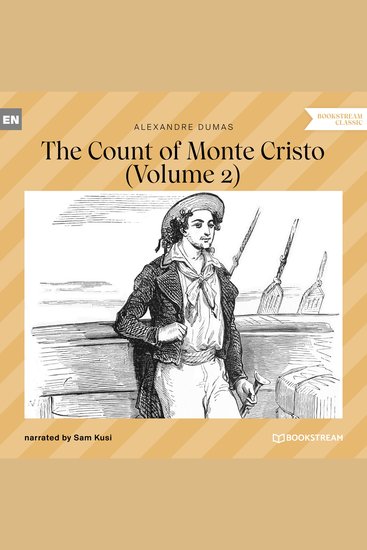
    Thrown in prison for a crime he has not committed, Edmond Dantes is confined to the grim fortress of If. There he learns of a great hoard of treasure hidden on the Isle of Monte Cristo and he becomes determined not only to escape, but also to unearth the treasure and use it to plot the destruction of the three men responsible for his incarceration. Dumas' epic tale of suffering and retribution, inspired by a real-life case of wrongful imprisonment, was a huge popular success when it was first serialized in the 1840s.
    VOLUME 2: The day after that in which the scene we have just described had taken place on the road between Bellegarde and Beaucaire, a man of about thirty or two-and-thirty, dressed in a bright blue frock coat, nankeen trousers, and a white waistcoat, having the appearance and accent of an Englishman, presented himself before the mayor of Marseilles.
    Voir livre