Rejoignez-nous pour un voyage dans le monde des livres!
Ajouter ce livre à l'électronique
Grey
Ecrivez un nouveau commentaire Default profile 50px
Grey
Abonnez-vous pour lire le livre complet ou lisez les premières pages gratuitement!
All characters reduced
Instead of a Book - Enriched edition - cover

Instead of a Book - Enriched edition

Benjamin Ricketson Tucker

Maison d'édition: DigiCat

  • 0
  • 0
  • 0

Synopsis

In "Instead of a Book," Benjamin Ricketson Tucker presents a compelling exploration of individualism and anarchism as a philosophical framework. This seminal work encapsulates Tucker's unique literary style, marked by its conversational tone and a blend of polemical argumentation with personal insight. The text emerges from the late 19th-century American libertarian movement, engaging critically with contemporary socio-political issues while advocating for personal liberty and economic justice. Tucker utilizes a rich tapestry of anecdotes and theoretical discourse to challenge prevailing ideologies, aiming not merely to articulate an anarchist vision but to inspire action towards its realization. Benjamin Ricketson Tucker, a prominent figure in the American anarchist movement, drew upon his diverse experiences and extensive readings in philosophy and economics to craft this influential work. His position as the editor of "Liberty," a significant anarchist publication, allowed him to refine his ideas and engage with leading thinkers of his time. Tucker's criticisms of capitalism and the state were deeply informed by his commitment to individual freedom and a profound skepticism of authority, stemming from his own struggles against societal constraints. For readers interested in political philosophy, anarchism, or the evolution of socio-economic thought, "Instead of a Book" serves as a foundational text that invites introspection and dialogue. Tucker's eloquent and passionate presentation challenges readers to consider the implications of their beliefs about freedom and the state, making this work a critical addition to any scholarly exploration of libertarian thought.

In this enriched edition, we have carefully created added value for your reading experience:
- A comprehensive Introduction outlines these selected works' unifying features, themes, or stylistic evolutions.
- A Historical Context section situates the works in their broader era—social currents, cultural trends, and key events that underpin their creation.
- A concise Synopsis (Selection) offers an accessible overview of the included texts, helping readers navigate plotlines and main ideas without revealing critical twists.
- A unified Analysis examines recurring motifs and stylistic hallmarks across the collection, tying the stories together while spotlighting the different work's strengths.
- Reflection questions inspire deeper contemplation of the author's overarching message, inviting readers to draw connections among different texts and relate them to modern contexts.
- Lastly, our hand‐picked Memorable Quotes distill pivotal lines and turning points, serving as touchstones for the collection's central themes.
Disponible depuis: 20/07/2022.
Longueur d'impression: 601 pages.


D'autres livres qui pourraient vous intéresser

  • The Hidden Holocaust - The Holodomor and Its Legacy - cover

    The Hidden Holocaust - The...

    Sarah Willards

    • 0
    • 0
    • 0
    The Holodomor, a man-made famine that devastated Ukraine between 1932 and 1933, has its roots in the policies of the Soviet Union under Joseph Stalin. While the famine itself was a tragedy of immense proportions, its causes can be traced to the larger political and economic strategies of the Soviet regime. 
    The Soviet Union, in its quest for rapid industrialization, implemented harsh agricultural policies, which included forced collectivization. The idea was to consolidate small farms into larger collective farms, thereby increasing agricultural output and facilitating the redistribution of food to feed the growing industrial centers. However, this policy had disastrous effects on Ukraine, where agriculture was the backbone of the economy. 
    Collectivization forced Ukrainian peasants, who were traditionally independent farmers, into state-run collective farms. This not only disrupted agricultural production but also led to widespread resistance, as many Ukrainians viewed this as a direct attack on their way of life. The Soviets, determined to break this resistance, responded with brutal force. Those who opposed collectivization were often punished or executed, and the fertile lands of Ukraine were systematically confiscated. 
    Stalin’s government implemented the policy of grain requisitioning, where large amounts of grain were forcibly taken from Ukraine to support other areas of the Soviet Union. Ukraine, known as the “breadbasket” of the Soviet Union, became the primary target of these requisitions. The grain was not only taken for export but also used to fuel the industrial ambitions of the Soviet state. This left the Ukrainian population without sufficient food for survival, pushing them into a state of extreme deprivation.
    Voir livre
  • The World of Juliet Kinzie - Chicago before the Fire - cover

    The World of Juliet Kinzie -...

    Ann Durkin Keating

    • 0
    • 0
    • 0
    When Juliette Kinzie first visited Chicago in 1831, it was anything but a city. An outpost in the shadow of Fort Dearborn, it had no streets, no sidewalks, no schools, no river-spanning bridges. And with two hundred disconnected residents, it lacked any sense of community. In the decades that followed, not only did Juliette witness the city’s transition from Indian country to industrial center, but she was instrumental in its development. 
     
    Juliette is one of Chicago’s forgotten founders. Early Chicago is often presented as “a man’s city,” but women like Juliette worked to create an urban and urbane world, often within their own parlors. With The World of Juliette Kinzie, we finally get to experience the rise of Chicago from the view of one of its most important founding mothers. 
     
    Ann Durkin Keating offers a moving portrait of a trailblazing and complicated woman. Keating takes us to the corner of Cass and Michigan (now Wabash and Hubbard), Juliette’s home base. Through Juliette’s eyes, our understanding of early Chicago expands from a city of boosters and speculators to include the world that women created in and between households. We see the development of Chicago society, first inspired by cities in the East and later coming into its own midwestern ways. We also see the city become a community, as it developed its intertwined religious, social, educational, and cultural institutions. Keating draws on a wealth of sources, including hundreds of Juliette’s personal letters, allowing Juliette to tell much of her story in her own words. 
     
    The World of Juliette Kinzie offers a new perspective on Chicago’s past and is a fitting tribute to one of the first women historians in the United States.
    Voir livre
  • The Chevron Doctrine - Its Rise and Fall and the Future of the Administrative State - cover

    The Chevron Doctrine - Its Rise...

    Thomas W. Merrill

    • 0
    • 0
    • 0
    The Constitution makes Congress the principal federal lawmaker. Power has inevitably shifted to the executive branch agencies that interpret laws already on the books and to the courts that review the agencies' interpretations. 


    Since the Supreme Court's 1984 decision in Chevron v. Natural Resources Defense Council, this judicial review has been highly deferential: courts must uphold agency interpretations of unclear laws as long as these interpretations are "reasonable." But the Chevron doctrine faces backlash from constitutional scholars and, now, from Supreme Court justices who insist that courts, not administrative agencies, have the authority to say what the law is. Recognizing that Congress cannot help relying on agencies to carry out laws, Merrill rejects the notion of discarding the administrative state. Instead, he focuses on what should be the proper relationship between agencies and courts in interpreting laws, given the strengths and weaknesses of these institutions. Courts are better at enforcing the rule of law and constitutional values; agencies have more policy expertise and receive more public input. 


    The best solution, Merrill suggests, is not of the either-or variety. Neither executive agencies nor courts alone should pick up the slack of our increasingly ineffectual legislature.
    Voir livre
  • Manipulation - What It Is Why It's Bad What to Do About It - cover

    Manipulation - What It Is Why...

    Cass R. Sunstein

    • 0
    • 0
    • 0
    New technologies are offering companies, politicians, and others unprecedented opportunity to manipulate us. Sometimes we are given the illusion of power—of freedom—through choice, yet the game is rigged, pushing us in specific directions that lead to less wealth, worse health, and weaker democracy. In Manipulation, nudge theory pioneer and New York Times bestselling author Cass Sunstein offers a new definition of manipulation for the digital age, explains why it is wrong, and shows what we can do about it. He reveals how manipulation compromises freedom and personal agency, while threatening to reduce our well-being; he explains the difference between manipulation and unobjectionable forms of influence, including "nudges"; and he lifts the lid on online manipulation and manipulation by artificial intelligence, algorithms, and generative AI, as well as threats posed by deepfakes, social media, and "dark patterns," which can trick people into giving up time and money. Drawing on decades of groundbreaking research in behavioral science, this landmark book outlines steps we can take to counteract manipulation in our daily lives and offers guidance to protect consumers, investors, and workers.
    Voir livre
  • Forensic Affairs - cover

    Forensic Affairs

    Thomas Kennedy

    • 0
    • 0
    • 0
    Liam, a quiet unassuming Accountant, depressed, with marriage difficulties and recently made redundant, impulsively rescues two people from a knife attack. The consequences change his life forever. His action brings People Trafficking and Drug smuggling to his door. The man he rescued is an International Criminal and the girl he rescued is given him as a reward for his actions. He must navigate this and his normal life including his rocky marriage.
    Voir livre
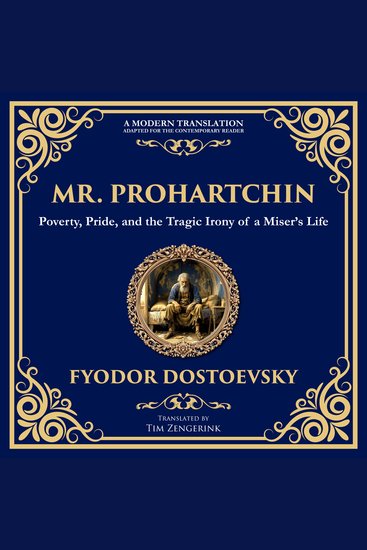
  • Mr Prohartchin - Poverty Pride and the Tragic Irony of a Miser’s Life - cover

    Mr Prohartchin - Poverty Pride...

    Fyodor Dostoevsky, Tim Zengerink

    • 0
    • 0
    • 0
    He lived simply. He died quietly. Then the truth came out. 
    In Mr. Prohartchin, Fyodor Dostoevsky reveals the inner life of a lonely, tight-fisted man scorned by his neighbors. Through subtle storytelling and emotional detail, the story explores how poverty, shame, and pride shape the way we live—and how we’re remembered after we’re gone. 
    This modern audiobook adaptation brings fresh clarity and rhythm to Dostoevsky’s understated tale, preserving its quiet intensity while making it accessible for today’s listeners. 
    What You’ll Hear in This Modern Translation: 
    •	A revealing story about a reclusive man’s misunderstood life 
    •	Rich insights into human judgment, insecurity, and secret generosity 
    •	A quiet tragedy wrapped in subtle irony and deep empathy 
    Included in This Edition: 
    Updated for clarity and modern sensibilities, this audiobook presents Dostoevsky’s tale with emotional nuance and accessibility—perfect for fans of psychological fiction and hidden gems from classic literature. 
    Listen today—and uncover the truth behind a life no one bothered to understand.
    Voir livre