Rejoignez-nous pour un voyage dans le monde des livres!
Ajouter ce livre à l'électronique
Grey
Ecrivez un nouveau commentaire Default profile 50px
Grey
Abonnez-vous pour lire le livre complet ou lisez les premières pages gratuitement!
All characters reduced
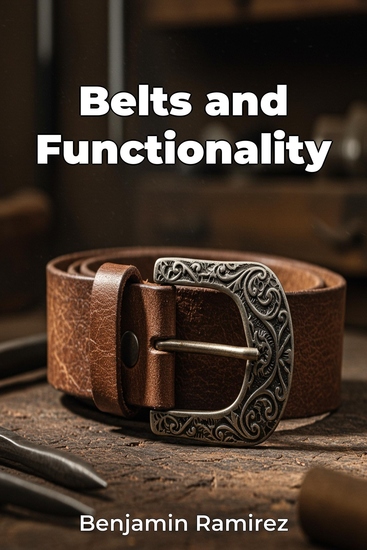
Belts and Functionality - cover

Belts and Functionality

Benjamin Ramirez

Traducteur A AI

Maison d'édition: Publifye

  • 0
  • 0
  • 0

Synopsis

Belts and Functionality explores the surprising journey of belts, transforming from simple garment supports to powerful symbols of fashion and identity. Initially crucial for securing clothing, belts evolved significantly, reflecting societal shifts and technological advancements. The book highlights how social status influenced belt design; for example, elaborate belts once signified wealth and authority, illustrating the cultural significance woven into this everyday item.

 
The book examines the belt's functional development, symbolic representation, and impact on the fashion industry. By tracing its history from ancient civilizations through the Renaissance and into modern fashion trends, the book reveals how belts reflect our enduring need for both practicality and self-expression.

 
From early materials and construction to mass production and designer influences, each chapter unfolds chronologically, culminating in a look at the future of belts in an increasingly sustainable and technologically integrated world. Offering a fresh perspective on an often-overlooked accessory, Belts and Functionality is valuable for fashion enthusiasts, design students, and historians alike. Its detailed research and clear style provide insights into fashion history, making it accessible to anyone curious about the evolution of everyday objects.
Disponible depuis: 27/02/2025.
Longueur d'impression: 58 pages.

D'autres livres qui pourraient vous intéresser

  • Fashion in Ancient Greece: The History of the Clothes and Jewelry Worn by the Greeks - cover

    Fashion in Ancient Greece: The...

    Charles River Editors

    • 0
    • 0
    • 0
    Over 2,000 years later, the ancient Greeks are considered the forefathers of Western Civilization, and thanks to the spread of Hellenism by Alexander the Great and the Romans, Greek culture heavily influenced North Africa, the Middle East, and Asia as well, so it is no surprise that Greek fashions traveled in every direction and influenced much of the known world. However, while there is no shortage of documentation and ancient imagery that depicts Greek clothes, almost no ancient Greek clothes have survived. Wool rots, linen rots faster, and the Greek climate, wet in winter and hot in summer, is just about the worst possible environment for the survival of cloth. The Greeks compounded the problem by cremating many of their dead and by reusing textiles until the fibers gave out. A wealthy Athenian household in the 5th century B.C. owned garments that represented months of skilled labor and a substantial share of the family's movable wealth, but of all the clothes that were manufactured and worn across the entire city across three centuries, what remains today can be held in a few small boxes. 
    	There are exceptions, and they're precious. A cluster of embroidered fragments came out of a tomb at Koropi in Attica, preserved by contact with metal, while charred and mineralized scraps have been recovered from Macedonian burials, including a folded cloth of purple and gold from the royal tomb at Vergina. Bog conditions and desert conditions have preserved Greek textiles outside Greece proper. But beyond that, the physical record thins out into loom weights, spindle whorls, bronze pins, gold ornaments, and the occasional shoe sole. 
    	As a result, the history of Greek fashion has to be assembled from other materials, and all of them are historically dubious in their own particular ways. Sculptures show drapery, but sculptors carved for effect, exaggerating some folds and suppressing others, and marble can't show weave or weight.
    Voir livre
  • Ugly - Giving Us Back our Beauty Standards - cover

    Ugly - Giving Us Back our Beauty...

    Anita Bhagwandas

    • 0
    • 0
    • 0
    We've all had those moments. The ones where you look in the mirror and nothing feels ok. For Anita Bhagwandas, this started when she was a child and it created an enduring internal torment about her looks. 


    We're all told that this is just part of growing up, but it stays with us, evolving as we age. The internet tells us we should love ourselves, whilst bombarding us with images of airbrushed perfection, upholding centuries-old beauty standards which we can't always see. Our beauty rituals are so often based around things we think we need to fix, grow, and develop—sometimes tipping into dangerous obsession. 


    So, what seismic shift does it take to break free from this mentality? In Ugly, Anita uncovers where these beauty standards started, unpicks why they've been perpetuated, and unmasks the structures that continue to support them. From the ever-growing cosmetic surgery industry, to the hidden pitfalls of "pretty privilege," it is time to finally break free from those limiting beauty standards, because feeling ugly should have nothing to do with how we look, and everything to do with who wants us to feel lacking.
    Voir livre
  • Cathars and Huguenots The: The History and Legacy of the Major French Christian Groups Who Were Persecuted by the Catholics - cover

    Cathars and Huguenots The: The...

    Editors Charles River

    • 0
    • 0
    • 0
    Carcassonne today is the capital of the Aude department in the Occitanie region of southwestern France, about 58 miles from Toulouse. This land is also home to several legends and local traditions. When the earth is drenched by heavy storms, the crumbling red soil drifts into the River Aude, staining the water with crimson. This beautiful, yet haunting phenomenon, which the locals call the “blood of the Cathars,” is a symbolic reminder of the blood shed by these “heretics” at the hands of the Catholic Church. Despite the controversial events, and their supposed heresy, it seemed that the fall of the Cathars brought an everlasting curse upon the region. 
    In the 16th century, corruption, debauchery, and the general perversion of ethics were running rampant within the Roman Catholic Church. The public began to grow leery of the crooked church, and soon, they could no longer bite their tongues. Among the church's most vocal opponents was Martin Luther, whose publication of the 95 Theses gave rise to the Protestant movement. This reformed brand of Christianity gradually spread throughout Europe, planting flags across the continent. France was among the first to latch onto the movement, and these new-wave Protestants became known as the “Huguenots.” The exact origins of the Huguenot name is still disputed to this day, but most historians have agreed it is a French and German translation of the Swiss-German term, “eidgenossen,” meaning “oath-fellowship.” The Huguenots mostly resided in the southern regions of France, along with the northern regions of Normandy and Picardy. They shared quite a few similarities with the Protestant Walloons, who lived in what is now Belgium, but the two groups were unique communities. Even so, both groups frequently convened to worship together as refugees.
    Voir livre
  • Timeless Adventures - The Unofficial Story of How Doctor Who Conquered Television - cover

    Timeless Adventures - The...

    Brian J. Robb

    • 0
    • 0
    • 0
    This critical history of Doctor Who covers the series 60 years, from the creation of the show to its triumph as Britain's number one TV drama.
    
    Opening with an in-depth account of the creation of the series within the BBC of the early 1960s, each decade of the show is tackled through a unique political and pop cultural historical viewpoint, exploring the links between contemporary Britain and the stories Doctor Who told, and how such links kept the show popular with a mass television audience.
    
    Timeless Adventures reveals how Doctor Who is at its strongest when it reflects the political and cultural concerns of a mass British audience (the 1960s, 1970s and 21st Century), and at its weakest when catering to a narrow fan-based audience (as in the 1980s). The book also addresses the cancellation of the show in the late 1980s (following the series becoming increasing self-obsessed) and the ways in which a narrowly-focused dedicated fandom contributed to the show's demise and yet was also instrumental in its regeneration for the 21st Century under Russell T. Davies, and analyses the new series to reveal what has made it so popular, reflecting real world issues like consumerism and dieting.
    Voir livre
  • Liberty or Justice for All? - A Conversation across the American Centuries - cover

    Liberty or Justice for All? - A...

    Philip F. Gura

    • 0
    • 0
    • 0
    Liberty or Justice for All? brings to life four of America's greatest thinkers, whose dialogue across the ages has never been more relevant. Philip F. Gura begins his nimble tale with Jonathan Edwards, a fiery preacher who insisted that God would reward those who embraced social cooperation. One generation later, the Founding Fathers grounded their own project of civic renewal in rights and freedom. But if every citizen is guaranteed life, liberty, and the pursuit of happiness, does this mean America is a nation where the individual reigns supreme? 


    America's young democracy soon found its prophet in Ralph Waldo Emerson, who preached a gospel of self-reliance, small government, and self-improvement. But with the coming of the Civil War, Emerson's triumphant individual became a cog in a vast war machine. Radical technological transformations convinced the psychologist-turned-philosopher William James that the self was more fragmented and fragile than Emerson believed. He found virtue in pluralism and diversity, seeing selfishness as the cardinal sin. Two world wars and several failed revolutions later, John Rawls, shaken by the divisions of Vietnam, sought to establish a new secular foundation for social cooperation. Over time, we have sought to hold these opposing value systems in delicate balance, promising both liberty and justice for all.
    Voir livre
  • Scenes From The Journey - looking for the lesson and the beauty of the moment - cover

    Scenes From The Journey -...

    Ann Tudor

    • 0
    • 0
    • 0
    Follow author and narrator Ann Tudor as she moves from one stage of life to the next, looking for the lesson as well as for the beauty of the moment. Her stories are informed by the varied experiences of her life: she has been teacher, wife, mother, grandmother, copy editor, fibre artist, practitioner of the healing arts, pianist, aspiring cellist, and, underlying it all, observer/writer.


    Ann Tudor is a Toronto-based writer of creative non-fiction whose current work includes memoirs and personal essay collections. She has a degree in English from DePauw University and an M.A.T. degree from Vanderbilt University. Her best-selling audiobooks include "Tales from My Table," "Rosie & the Angels,"  and "I Love Pie." Available commercially for the first time now are "We Called Her Eileen," and "A Child's Midwestern Christmas." At various times of her fascinating life she has been a church organist, craftsperson, wife-mother-grandmother, cook, student of the cello, hands-on healer,  and editor for a library science publisher. From each of her vocations and avocations she has coaxed a little additional information on how to make it through the journey of life. You can find essays and information at scenesfromthejourney.blogspot.com.
    Voir livre