Rejoignez-nous pour un voyage dans le monde des livres!
Ajouter ce livre à l'électronique
Grey
Ecrivez un nouveau commentaire Default profile 50px
Grey
Abonnez-vous pour lire le livre complet ou lisez les premières pages gratuitement!
All characters reduced
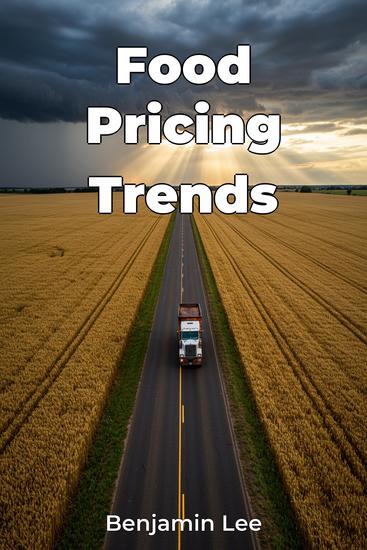
Food Pricing Trends - cover

Food Pricing Trends

Benjamin Lee

Traducteur A AI

Maison d'édition: Publifye

  • 0
  • 0
  • 0

Synopsis

Food Pricing Trends examines the complex factors influencing the cost of food, a critical issue impacting consumers and economies globally. This book investigates how market forces, climate change, and transportation expenses collectively shape what we pay for food. Readers will gain insights into the dynamics of supply and demand, the effects of government subsidies, and the intricacies of international trade, all of which contribute to price fluctuations. The book uniquely integrates economic analysis with environmental and logistical considerations, offering a holistic view of food economics.

 
The book progresses logically, beginning with the fundamental economic principles governing food markets. It then delves into the impact of climate change on agricultural production, highlighting how shifting weather patterns and water scarcity affect crop yields. The role of transportation networks in the global food supply chain is also dissected, revealing how fuel prices and logistical inefficiencies contribute to price volatility.

 
Ultimately, the book emphasizes the interconnectedness of these forces, advocating for informed decision-making and effective policies to ensure food security and price stability.
Disponible depuis: 10/03/2025.
Longueur d'impression: 77 pages.


D'autres livres qui pourraient vous intéresser

  • New Zealand Wars The: The History and Legacy of the British Empire’s Conflicts with the Indigenous Māori - cover

    New Zealand Wars The: The...

    Editors Charles River

    • 0
    • 0
    • 0
    In 1769, Captain James Cook’s historic expedition in the region would lead to an English claim on Australia, but before he reached Australia, he sailed near New Zealand and spent weeks mapping part of New Zealand’s coast. Thus, he was also one of the first to observe and take note of the indigenous peoples of the two islands. His instructions from the Admiralty were to endeavor at all costs to cultivate friendly relations with tribes and peoples he might encounter, and to regard any native people as the natural and legal possessors of any land they were found to occupy. Cook, of course, was not engaged on an expedition of colonization, so when he encountered for the first time a war party of Māori, he certainly had no intention of challenging their overlordship of Aotearoa, although he certainly was interested in discovering more about them. 
    Taking into account similarities of appearance, customs and languages spread across a vast region of scattered islands, it was obvious that the Polynesian race emerged from a single origin, and that origin Cook speculated was somewhere in the Malay Peninsula or the “East Indies.” In this regard, he was not too far from the truth. The origins of the Polynesian race have been fiercely debated since then, and it was only relatively recently, through genetic and linguistic research, that it can now be stated with certainty that the Polynesian race originated on the Chinese mainland and the islands of Taiwan, the Philippines, Malaysia and Indonesia. Oceania was, indeed, the last major region of the Earth to be penetrated and settled by people, and Polynesia was the last region of Oceania to be inhabited. The vehicle of this expansion was the outrigger canoe, and aided by tides and wind patterns, a migration along the Malay Archipelago, and across the wide expanses of the South Pacific, began sometime between 3000 and 1000 BCE, reaching the western Polynesian Islands in about 900 BCE.
    Voir livre
  • Utopia - cover

    Utopia

    Thomas Moore

    • 0
    • 0
    • 0
    Utopia by Thomas More is a seminal work of literature that has long been regarded as one of the most influential pieces of philosophical and political writing in history. In this text, More sets out to create an idealized version of a commonwealth in order to explore the most desirable forms of government and social organization. Through his vivid imagery, he creates a vision of a utopian society that is based upon the socio-economic principles of communal ownership, religious tolerance, and gender equality. Read in English, unabridged.
    Voir livre
  • Give Us Liberty - A Tea Party Manifesto - cover

    Give Us Liberty - A Tea Party...

    Anonyme

    • 0
    • 0
    • 0
    Former Majority Leader of the U.S. House of Representatives and leading organizer of the Tea Party movement, Dick Armey offers a Tea Party Manifesto: Give Us Liberty. Written with Matt Kibbee, President and CEO of FreedomWorks, Give Us Liberty defines the issues and agenda of the wildfire grassroots movement that is electrifying the nation, as it calls on fiscal conservatives to take back America.
    Voir livre
  • Jai Mata Di My Book On Human Welfare - cover

    Jai Mata Di My Book On Human...

    Rajesh D Sanghvi

    • 0
    • 0
    • 0
    Rajesh’s new book Jai Mata Di, achieves what the title claims in its dedication to Mataji, on Human Welfare. The author maintains clarity in thinking and devising solutions to many critical problems that plague our world today, from a totally new perspective! And they are practical to implement! One of his best chapters starts by exploring an Intriguing Question-Could Hitler have been like Jesus, if he knew how to be one? He answers the question, why do we suffer in life? and what is the Elixir of life?  
    The book examines social problems, unemployment, and abject poverty in India, raising questions on how to establish peace in the world, like the Syrian war, the failures of our modern educational systems, He discusses about Health and Immunity from a Spiritual perspective, about environment that threatens our Mother earth today, and many other crucial issues vital to Humanity. 
    Rajesh presents his innovative solutions and ideas, his prime motive being to promote Human welfare, to reduce or end Human Suffering. Surely a matter for our society to introspect, and a must read for all, the book is filled with rich solutions to fundamental problems, presented in a simple fashion, to execute to solve. Indeed, a provocative read filled with practical solutions to implement!
    Voir livre
  • The Principal Speeches of Demosthenes - A Selection - cover

    The Principal Speeches of...

    Demosthenes

    • 0
    • 0
    • 0
    Demosthenes (384-322 BCE) is regarded as one of the greatest orators of Classical times. This view has persisted through the centuries even though his rousing speeches warning of the dangers of Macedonian expansion - firstly guided by Philip II and then Alexander the Great - failed to stem the course of continued military success. 
     
    A contemporary of Plato and Aristotle, it is said that Demosthenes undertook arduous measures to cure himself of a stammer by speaking with pebbles in his mouth and perfecting breath control. Starting as a speech writer, he made his mark at an unusually young age (for the time), delivering his first major public speech at the age of 30, advising Athens to build its naval fleet as a defence against the Persians. In fact, it was the ambition of Philip of Macedon that would prove the principal threat. This was recognised by Demosthenes, as shown by the main speeches included in this collection. 
     
    In the 'Three Olynthiac Orations', Demosthenes outlined the tactics of Philip’s aggression towards Olynthus, an ally of Athens. He urged support for the smaller state, but his words went unheeded until it was too late. Demosthenes’s increasingly unrestrained language - at one point he calls Philip ‘a barbarian’ - did not endear him to the Macedonian regime. 
     
    The 'Olynthiac Orations' are followed by the 'Three Philippics', which chart further military activity by the aforementioned Philip. In between the second and third 'Philippics' comes ‘On the Peace’: a speech given during a short diplomatic space engineered by Philip, but which Demosthenes clearly highlighted as an armistice rather than anything permanent. This ‘Philip’ section ends with ‘The Oration on the Letter'. Philip sent a letter to Athens, which implied that war, again, was imminent. Demosthenes responded with characteristic boldness. 
     
    The final speech on this recording is ‘On the Crown’, addressing a very different matter. The Athenian statesman Ctesiphon proposed that Demosthenes should be honoured with the ‘golden crown’ for his service to the city. This was opposed by Aeschines, a long-standing enemy of Demosthenes in Athenian politics. In the court case that followed (330 BCE), Demosthenes successfully defended Ctesiphon in a speech later described as ‘the greatest speech of the greatest orator in the world'. 
     
    Each of the orations in this collection is preceded with an introduction setting the scene, and outlining the context in which they were delivered. This also gives a concise picture of Athens at this difficult point in its history. Eight years later, when in danger of being captured and imprisoned by the young Alexander who was angered by decades of eloquent and unrestrained opposition, Demosthenes committed suicide. All the speeches are prefaced by the historical setting. Translations by Arthur Wallace Pickard and Charles Rann Kennedy.
    Voir livre
  • Marine Pollution - What Everyone Needs to Know(r) - cover

    Marine Pollution - What Everyone...

    Judith S. Weis

    • 0
    • 0
    • 0
    For millennia, human societies have viewed the ocean as a dumping ground for waste products of all kinds. The sources of marine pollution are extensive, including oil spills, sewage, fertilizers, pesticides, industrial wastes, heavy metals, ocean acidification, plastics, and even invasive species, considered biological pollution. Yet, the solutions are not as clear. 
     
    Updated to reflect recent research, this book discusses the sources of marine pollutants, their effects on marine organisms and humans, and how to reduce or eliminate them. Weis covers the aftermath of oil spills in addition to "emerging" topics like flame retardants, pharmaceuticals, noise pollution, and PFAS. A new chapter examines the prevalence of microplastics and how they rise through the food chain into human beings, along with their associated toxic chemicals. Additional chapters address the deadly effects of climate change in the ocean but also focus on actions that all people can take, citing recent environmental improvements as a cause for hope.
    Voir livre