Begleiten Sie uns auf eine literarische Weltreise!
Buch zum Bücherregal hinzufügen
Grey
Einen neuen Kommentar schreiben Default profile 50px
Grey
Jetzt das ganze Buch im Abo oder die ersten Seiten gratis lesen!
All characters reduced
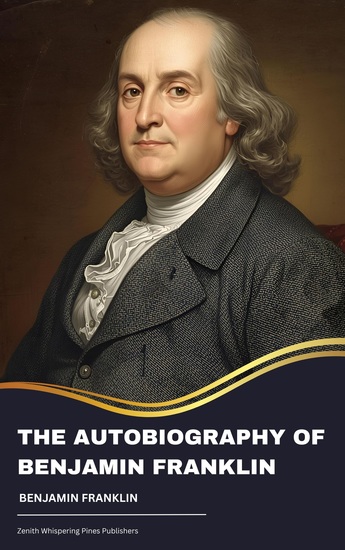
The Autobiography of Benjamin Franklin - cover

The Autobiography of Benjamin Franklin

Benjamin Franklin

Verlag: Zenith Whispering Pines Publishers

  • 0
  • 0
  • 0

Beschreibung

The story of a runaway apprentice who became a world-changing thinker—and helped shape a nation.
In this candid and remarkable autobiography, Benjamin Franklin shares how discipline, curiosity, and unwavering ambition transformed his life. From humble beginnings to becoming a renowned scientist, writer, diplomat, and Founding Father, Franklin offers timeless lessons on self-improvement, leadership, and personal success. His wisdom on habits, character, and practical achievement still inspires readers centuries later.

Praised as "the most important autobiography in American history," this classic reveals the mindset of a man whose ideas shaped the modern world—and whose life proves that greatness is built, not born.

If you want motivation, insight, and a guide to living with purpose, Franklin's journey will light your path.

Start reading today—and learn from a life defined by invention, determination, and vision.
Verfügbar seit: 04.12.2025.
Drucklänge: 195 Seiten.


Weitere Bücher, die Sie mögen werden

  • Liberalism as a Way of Life - cover

    Liberalism as a Way of Life

    Alexandre Lefebvre

    • 0
    • 0
    • 0
    Where do you get your values and sensibilities from? If you grew up in a Western democracy, the answer is probably liberalism. Conservatives are right about one thing: liberalism is the ideology of our times, as omnipresent as religion once was. Yet, as Alexandre Lefebvre argues in Liberalism as a Way of Life, many of us are liberal without fully realizing it—or grasping what it means. Misled into thinking that liberalism is confined to politics, we fail to recognize that it's the water we swim in, saturating every area of public and private life, shaping our psychological and spiritual outlooks, and influencing our moral and aesthetic values—our sense of what is right, wrong, good, bad, funny, worthwhile, and more. This eye-opening book shows how so many of us are liberal to the core, why liberalism provides the basis for a good life, and how we can make our lives better and happier by becoming more aware of, and more committed to, the beliefs we already hold. 


    A lively, engaging, and uplifting guide to living well, the liberal way, Liberalism as a Way of Life is filled with examples from television, movies, stand-up comedy, and social media—from Parks and Recreation and The Good Place to the Borat movies and Hannah Gadsby. Along the way, you'll also learn about seventeen benefits of being a liberal and practical exercises to increase these rewards.
    Zum Buch
  • The Prince - cover

    The Prince

    Niccolò Machiavelli

    • 0
    • 0
    • 0
    "The Prince" is a political treatise by Niccolò Machiavelli, written in 1513 and published in 1532. The book is a pragmatic guide for political leaders, focused on how to maintain power and navigate the complex and often ruthless world of governance. Although the text is commonly viewed as a manual for manipulation and a justification for Machiavellian deceit and cunning, it has also been interpreted as a realistic, if cynical, analysis of power dynamics. The work is a foundational text in political theory and continues to be studied and debated today.
    Zum Buch
  • The Economic Consequences of the Peace - cover

    The Economic Consequences of the...

    John Maynard Keynes

    • 0
    • 0
    • 0
    "The Economic Consequences of the Peace" is a book written by John Maynard Keynes, a British economist, in 1919. The book was a critique of the Treaty of Versailles, which ended World War I and imposed harsh economic sanctions on Germany. 
    In the book, Keynes argued that the treaty would have disastrous economic consequences for Germany and for Europe as a whole. He believed that the sanctions would cripple Germany's economy and lead to political instability, which would in turn lead to further economic problems for the rest of Europe. 
    Keynes also criticized the economic policies of the Allied powers, particularly the United States, which he believed were contributing to a global economic depression. He argued that a more cooperative approach to international economics was needed, with countries working together to promote economic growth and stability. 
    "The Economic Consequences of the Peace" was a highly influential book that helped shape the field of international economics and influenced the development of Keynesian economics. The book's critique of the Treaty of Versailles was widely shared and helped to pave the way for a more conciliatory approach to Germany in the years that followed.
    Zum Buch
  • Rise and Decline of Nations The: Book Summary & Analysis - cover

    Rise and Decline of Nations The:...

    Briefly Summaries

    • 0
    • 0
    • 0
    This is a concise summary and analysis of The Rise and Decline of Nations, by Mancur Olson.
     
    It is not the original book and is not affiliated with or endorsed by Mancur Olson.
     
    Ideal those seeking a quick and insightful overview.
     
    The Rise and Decline of Nations explores the intricate relationship between economic growth, political stability, and the institutional frameworks that govern societies. Drawing from history, economics, and sociology, the book examines how entrenched interest groups and collective actions shape the prosperity—or stagnation—of nations. With thought-provoking insights, it challenges conventional wisdom about power dynamics, providing a groundbreaking perspective on why some nations thrive while others falter.
    Zum Buch
  • Lying - Communicating False Information Deliberately - cover

    Lying - Communicating False...

    Cito Harder

    • 0
    • 0
    • 0
    Lying, the deliberate act of communicating false information, has been a part of human behavior for centuries. It is a complex and multifaceted phenomenon that plays a role in many aspects of life, from personal relationships to politics, business, and beyond. While most people recognize lying as morally wrong, it remains a pervasive and unavoidable part of the human experience. This chapter will explore the nature of lying, the different types of lies, and why people engage in this behavior. 
    At its core, lying involves providing information that the speaker knows to be false, with the intent to deceive the listener. Unlike mistakes or misunderstandings, lies are intentional and often involve a conscious decision to mislead. Lying can take many forms, ranging from small, seemingly harmless "white lies" to more harmful and deliberate fabrications designed to achieve personal gain or avoid consequences. While some lies may appear trivial, others can have significant consequences, leading to broken trust, damaged relationships, or even harm to others. 
    The act of lying is not limited to individuals but can also be embedded in larger societal and cultural practices. From politicians who manipulate public opinion to corporations that mislead consumers about the quality of their products, deception is often employed as a tool to achieve power, influence, or financial success. Understanding the motivations behind lying is key to understanding its prevalence and persistence in society. People lie for various reasons: to protect themselves, to avoid punishment, to gain an advantage, or to spare others' feelings. The reasons behind a lie often depend on the context and the perceived consequences of telling the truth.
    Zum Buch
  • The Chile Project - The Story of the Chicago Boys and the Downfall of Neoliberalism - cover

    The Chile Project - The Story of...

    Sebastian Edwards

    • 0
    • 0
    • 0
    In The Chile Project, Sebastian Edwards tells the story of how the neoliberal economic model came to an end in 2021, when Gabriel Boric was elected president, vowing that "If Chile was the cradle of neoliberalism, it will also be its grave." More than a story about one Latin American country, The Chile Project is a behind-the-scenes history of the spread and consequences of the free-market thinking that dominated economic policymaking around the world in the second half of the twentieth century—but is now on the retreat. 


    In 1955, the United States State Department launched the "Chile Project" to train Chilean economists at the University of Chicago. After General Augusto Pinochet overthrew socialist president Salvador Allende in 1973, Chile's "Chicago Boys" implemented the purest neoliberal model for the next seventeen years, undertaking a package of privatization and deregulation, creating a modern capitalist economy, and sparking talk of a "Chilean miracle." But under the veneer of success, a profound dissatisfaction with the inequalities caused by neoliberalism was growing. In 2019, protests erupted throughout the country, and in 2022 Boric began his presidency with a clear mandate: to end neoliberalismo. 


    The Chile Project provides an important new perspective on the history of neoliberalism and its global decline today.
    Zum Buch