Begleiten Sie uns auf eine literarische Weltreise!
Buch zum Bücherregal hinzufügen
Grey
Einen neuen Kommentar schreiben Default profile 50px
Grey
Jetzt das ganze Buch im Abo oder die ersten Seiten gratis lesen!
All characters reduced
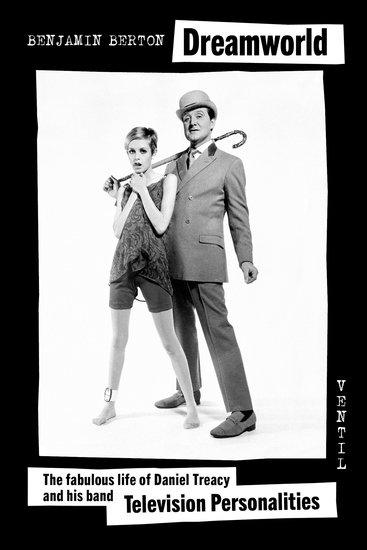
Dreamworld - The fabulous life of Daniel Treacy and his band Television Personalities - cover

Dreamworld - The fabulous life of Daniel Treacy and his band Television Personalities

Benjamin Berton

Verlag: Ventil Verlag

  • 0
  • 0
  • 0

Beschreibung

London 1977: Daniel Treacy drops out of school, bored to death. With friends, he records a few songs thanks to a few pounds sterling lent to him by his parents and sends the finished single to the legendary radio DJ John Peel, who is immediately thrilled —the Television Personalities are born ...

In the turbulent life of Daniel Treacy we meet Jimmy Page, Bob Marley, Alan McGee, David Gilmour, Wham!, Nico and Kurt Cobain. "Dreamworld" is the very real, very crazy story of a genius in music history. Enriched with plenty of scene and period color from British pop from the 1960s to the present, »Dreamworld« tells of all the ups and downs of a legend who was once called the »Godfather of Indie Pop«.

The translation by David Marshall appears with a fully revised color picture section and numerous illustrations.
Verfügbar seit: 29.07.2022.
Drucklänge: 264 Seiten.

Weitere Bücher, die Sie mögen werden

  • The Topophilia Effect - How places affect us - cover

    The Topophilia Effect - How...

    Roberta Rio

    • 0
    • 0
    • 0
    Health. Success. Love. How do the places where we live, work or spend our vacations, affect our life? Historian Roberta Rio is researching the history of buildings, apartments or land and finds recurring patterns. In this book she shows, based on old knowledge and new research results, what we should know about the effect of places and how we find out.
    Zum Buch
  • Movies under the Influence - cover

    Movies under the Influence

    Jocelyn Szczepaniak-Gillece

    • 0
    • 0
    • 0
    Movies under the Influence charts the entangled histories of moviegoing and mind-altering substances from early cinema through the psychedelic 1970s. Jocelyn Szczepaniak-Gillece examines how the parallel trajectories of these two aspects of American culture resulted in them being treated and regulated in similar ways. Rather than looking at drug use within film, she regards cinema and intoxicants as kindred experiences of immersion that have been subject to corresponding forces of ideology and power. 


    Szczepaniak-Gillece demonstrates how American movie theaters sought to cultivate a dual identity, presenting themselves as both a place of wholesome entertainment and a zone of illicit behavior. Movies under the Influence highlights the legislative, legal, and corporate powers that held sway over theaters, locating the convergence of moviegoing and drug use as a site of mediation and social control. 


    As much as substances and cinema are points where power intervenes, they are also settings of potential transcendence, and Movies under the Influence maintains this paradox as a necessary component of American film history. This book examines the relationship intoxicants suggest between mass media, spectatorship, and governmental regulation and provides a new angle from which to understand cinema's lasting role in evolving American culture.
    Zum Buch
  • The Story of Harshad Mehta - cover

    The Story of Harshad Mehta

    Aman Redhu

    • 0
    • 0
    • 0
    Mehta's involvement in the 1992 Indian securities scam made him infamous as a market manipulator. Harshad Shantilal Mehta. Born. Harshad Mehta.
    Zum Buch
  • Greatest Western Shows Volume 7 - Ten Classic Shows from the Golden Era of Radio - cover

    Greatest Western Shows Volume 7...

    Various Various

    • 0
    • 0
    • 0
    Oasis Audio has gone into the vaults and dusted off the very earliest form of audio book, old time radio shows, for our listeners. Introduced episode by episode by Jim Engel, old time radio authority and board member of the Museum of Broadcast Communications in Chicago, this series of classic radio shows is sure to have something for everyone. Celebrity casts and top-notch writers made the 1920s through the early 1950s, the golden era of radio. The series features seven exciting themes with 100 episodes in each. That is 700 classic radio programs in all.   Greatest Western Shows   Hit the dusty trails with the Cisco Kid, Luke Slaughter, Hopalong Cassidy, Roy Rogers, Tales of the Texas Rangers, Wild Bill Hickok. Follow the original Matt Dillon’s exploits on Gunsmoke, and enjoy the Tales of the Texas Rangers in these great adventures of the old west. 100 great Western classics in ten volumes. Volume 7 Have Gun, Will Travel 8-7-60 Viva with John DehnerHave Gun, Will Travel 10-9-60 Sam Crow with John DehnerHave Gun, Will Travel 10-16-60 Stardust with John DehnerHopalong Cassidy 04-14-51 Death Crosses the RiverHopalong Cassidy 04-21-51 Stagecoach WestHopalong Cassidy 04-28-51 The Unwilling OutlawHopalong Cassidy 06-02-51 Hoppy Plays A HunchLuke Slaughter of Tombstone 4-27-58 Death Watch with Sam BuffingtonLuke Slaughter of Tombstone 5-4-58 Worth Its Salt with Sam BuffingtonLuke Slaughter of Tombstone 5-25-58 Outlaw Kid with Sam Buffington
    Zum Buch
  • The Inward Stage - A Performer's Notes On Presence and Meaning - cover

    The Inward Stage - A Performer's...

    Alexander Beresford

    • 0
    • 0
    • 0
    The Inward Stage is not a memoir. It is not a manual. It is not a book of secrets. 
    It is a quietly luminous document, part philosophical journal, part poetic confession, written by a mindreader who spends his life performing illusions for others while quietly unraveling deeper truths for himself. 
    Drawn from times spent backstage, between cities, between minds, and between silences, these pages reveal the reflections of a man who reads thoughts not for applause, but for understanding. He writes of wonder, failure, silence, intimacy, and the sacred art of disappearing at just the right moment. 
    This is a book for those who have performed, on stages or in life, and for anyone who has ever longed to be understood beneath the surface. 
    Written in fragments, aphorisms, and meditations, The Inward Stage is a love letter to mystery, a witness to the sacredness of connection, and a guide for those who find themselves standing quietly at the edge of the visible world.
    Zum Buch
  • Sengoku - Warring States and the Path to Unification - cover

    Sengoku - Warring States and the...

    Rolf Hedger

    • 0
    • 0
    • 0
    The Sengoku period, meaning “Warring States,” was one of the most turbulent and transformative eras in Japanese history. Lasting from the mid-15th century to the early 17th century, it was marked by ceaseless conflict, shifting alliances, and the gradual disintegration of centralized authority. The roots of this period can be traced back to the decline of the Ashikaga Shogunate, the Ōnin War, and the rise of regional warlords known as daimyo, each vying for control over Japan’s fractured political landscape. 
    The Ashikaga Shogunate, which had ruled Japan since the early 14th century, gradually lost its grip on the country due to internal corruption, weak leadership, and an inability to maintain order. By the mid-15th century, the shogunate had become largely symbolic, with real power resting in the hands of feudal lords. These tensions erupted into full-scale conflict with the outbreak of the Ōnin War (1467–1477), a devastating civil war primarily fought in and around Kyoto. What began as a succession dispute within the shogunate spiraled into a nationwide conflict, leading to the destruction of Kyoto and the collapse of central authority. 
    With the Ashikaga Shogunate rendered powerless, Japan entered a chaotic era where military might determined control. Local daimyo, originally appointed as provincial governors, seized the opportunity to establish autonomous domains. These warlords fortified their territories, raised armies, and engaged in relentless battles to expand their influence. The traditional system of hereditary rule began to erode as capable military leaders, often of humble origins, overthrew established families. This period saw the rise of powerful daimyo such as the Takeda, Uesugi, and Hojo clans, each striving to dominate the fractured nation.
    Zum Buch