Join us on a literary world trip!
Add this book to bookshelf
Grey
Write a new comment Default profile 50px
Grey
Subscribe to read the full book or read the first pages for free!
All characters reduced
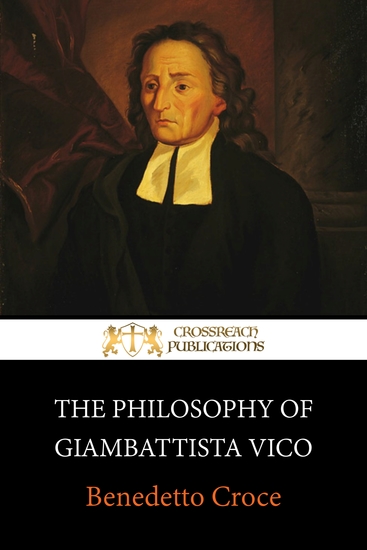
The Philosophy of Giambattista Vico - cover

The Philosophy of Giambattista Vico

Benedetto Croce

Translator R. G. Collingwood

Publisher: CrossReach Publications

  • 0
  • 0
  • 0

Summary

My reasons for believing that a new exposition of Vico's philosophy is required may easily be inferred from the observations on the effects of his work and the biographical notes which form respectively the second and fourth appendices to this volume. Here I merely wish to state that my exposition is not meant for a summary of Vico's writings work by work and part by part. It rather presupposes an acquaintance with these writings, and, where that is lacking, is intended to induce the reader to procure them in order to follow better and to check the interpretation and estimate of them here offered. On this supposition, though I have made free use of my author's actual words, especially in the chapters dealing with history, I have not thought it desirable to mark them as quotations except where it was important to emphasise the precise phrase of the original. I have in general combined such passages from fragments scattered over a wide field, sometimes abbreviating, sometimes amplifying, and always freely adding words and phrases of my own by way of commentary: and the continual use of quotation marks would merely have shown up in a manner more wearisome than valuable the reverse side of my embroidery, which any reader who so desires can study by the help of the references given at the end of the book. In my anxiety to show in every detail of my work, so far as I could, the veneration due to the great name of Vico, I have endeavoured to be brief with the brevity at which he himself aimed as the hall-mark of sterling scientific thought. With this in view I have refrained even from controversy with his various interpreters, and have either contented myself with mere remarks, or more often left my details to be justified by the coherence of my view as a whole. Some of the interpretations supported by me I believe to be the mature fruit of the investigations and controversies which form the greater part of the literature on Vico: all the rest, for which I am personally responsible, and the general idea of my book, I will defend against alternative and contradictory views when occasion arises, should it ever do so, in the detailed and direct manner which I have not thought it necessary to adopt in the course of my exposition. I hope, in fact, that the present work will rekindle rather than quench the discussion of Vico's philosophy: since in him we have, as Goethe calls him, the Altvater whom a nation is happy to possess, and to him we must hark back for a time in order to imbue our modern philosophy with an Italian feeling, however cosmopolitan it may be in thought. The dedication of my book, besides being a token of respect to one of the greatest modern teachers of the history of philosophy, is intended to express the expectation and hope that the gap in this history to which I have called attention more than once, especially on page 277 of the present volume, may soon be filled.
 
B. C.RAIANO (AQUILA),September 1910.​​​​​​​CrossReach Publications
Available since: 12/15/2022.
Print length: 192 pages.

Other books that might interest you

  • The Comte de St Germain - The Secret of kings: A Monograph - cover

    The Comte de St Germain - The...

    Isabel Cooper-Oakley

    • 0
    • 0
    • 0
    The Comte de Saint Germain was a European courtier, with an interest in science and the arts. He achieved prominence in European high society of the mid-1700s. In order to deflect inquiries as to his origins, he would invent fantasies, such as that he was 500 years old, leading Voltaire to sarcastically dub him "The Wonderman".
    Show book
  • The Good Sport - Reflections on a Full Life in College Sports - cover

    The Good Sport - Reflections on...

    Kevin White

    • 0
    • 0
    • 0
    In The Good Sport, Kevin White takes an unflinching look at the current state of intercollegiate sports, including the tumultuous changes brought on by the Supreme Court's landmark decision on name, image, and likeness (NIL) rights. Drawing on his decades of leadership, White examines the chaos, challenges, and opportunities of this new era—and why he believes the future of college sports hangs in the balance.
    Show book
  • The Old Kingdom of Egypt - The Age of the Pyramids - cover

    The Old Kingdom of Egypt - The...

    Omar Khalil

    • 0
    • 0
    • 0
    The Old Kingdom of Egypt, often referred to as the “Age of the Pyramids,” marks one of the most prosperous and significant periods in the history of ancient Egypt. This era, which lasted from around 2686 to 2181 BCE, witnessed the unification of Upper and Lower Egypt under a single ruler and the establishment of the pharaoh as the central figure of both politics and religion. It was a time when the foundations of the Egyptian state were solidified, and the monumental pyramids, including the Great Pyramid of Giza, were built. 
    The rise of the Old Kingdom began with the third dynasty, following the unification of Egypt by King Narmer (also known as Menes). Narmer’s victory over the rival kingdoms of Upper and Lower Egypt not only led to the establishment of the first dynasty but also laid the groundwork for the idea of divine kingship. The pharaoh, believed to be the living god Horus, became the supreme ruler, a position that was both political and religious. This divine status provided the pharaoh with unquestionable authority, ensuring stability and order across the kingdom. 
    Throughout the Old Kingdom, the notion of kingship was reinforced through monumental construction projects, such as the construction of step pyramids and later the smooth-sided pyramids that are so emblematic of ancient Egypt. The earliest monumental stone structure, the Step Pyramid of Djoser, built during the third dynasty, symbolized the pharaoh’s ability to control nature and destiny. These impressive structures were not just tombs for the pharaohs but also symbols of their eternal power and the journey to the afterlife.
    Show book
  • Ancient Egyptian Conspiracy Theories: The History of the Most Popular Conspiracy Theories about Egypt in Antiquity - cover

    Ancient Egyptian Conspiracy...

    Editors Charles River

    • 0
    • 0
    • 0
    Given how far back the Egyptian civilization goes, it’s no surprise that Egypt is still full of mystery, and the unknown continues to generate conspiracy theories that attempt to fill in the gaps. For example, generations have viewed Egypt’s pyramids and the Great Sphinx as symbols of a lost past, which in turn leads to Egypt’s portrayal as a world full of romance and mystery. The age and structural integrity of these magnificent structures also make them symbols of longevity and power, which is only fitting because those are two purposes the ancient pharaohs who commissioned them intended them to serve. 
    In fact, while the sphinx was a well-known mythological creature among various ancient civilizations, the Egyptian statue that is now most famously associated with the creature is full of mysteries that have been endlessly debated throughout the centuries and continue to be hotly contested among scholars. The famous “Riddle of the Sphinx”, told by Sophocles in his play Oedipus Rex in the 5th century B.C., characterized the sphinx as a clever and powerful creature, and the mysteries of the Egyptian statue were discussed even among the ancient Romans. Even the source of the damage suffered by the Sphinx has become the stuff of legend, as evidenced by the story of Napoleon’s French soldiers shooting off the Sphinx’s nose. 
    Of course, the Sphinx is merely one object in Egypt that has been the source of endless theories. The discovery of King Tutankhamun’s tomb revived the legends of pharaohs’ curses and mummies, and ancient Egyptian art has been analyzed in seemingly every conceivable way possible as people come up with alternate theories for how the Egyptians built their most famous buildings and forged their enduring civilization.
    Show book
  • The Enneagram of Emotional Intelligence - A Journey to Personal and Professional Success - cover

    The Enneagram of Emotional...

    Scott Allender, Ian Cron

    • 0
    • 0
    • 0
    Emotional Intelligence (EQ) is one of the biggest predictors of personal and professional success, and the key to effectively developing your EQ is tying it to your own personality type. In this book, certified EQ coach and Enneagram teacher Scott Allender helps you chart a personality-specific path toward lasting emotional intelligence and health. Allender uses the popular Enneagram framework to illuminate how each of the nine personality types aligns with the five essential skills of emotional intelligence: self-perception, self-expression, interpersonal relationships, decision making, and stress management. You'll discover how to 


    ● break free from the hidden fears that dictate your choices 


    ● make more intentional decisions 


    ● better understand the emotional dynamics of colleagues, friends, and family 


    ● and more 


    In this journey toward radical self-awareness, you'll learn how to combat the self-limiting beliefs that keep you from living the life you were meant to live all along.
    Show book
  • Waters of the United States - POTUS SCOTUS WOTUS and the Politics of a National Resource - cover

    Waters of the United States -...

    Royal C. Gardner

    • 0
    • 0
    • 0
    In 2023, the Supreme Court made one of its most devastating rulings in environmental history. By narrowing the legal definition of "waters of the United States" (WOTUS), the court opened the floodgates to unregulated pollution. But while tremendously consequential, the decision was also simply the latest in a long series of battles over WOTUS, and which rivers, streams, lakes, ponds, wetlands, and perhaps even farm fields were to be protected by the Clean Water Act of 1972. 


    Waters of the United States is an unprecedented exploration of this history—and its importance for today's efforts to conserve a critical natural resource. The book not only examines how bodies of water are legally defined (and therefore protected), but who gets to decide on these definitions. The result is a fascinating look at the ongoing power struggle between the president and federal agencies, the courts, the states, and Congress, over water quality. 


    Waters of the United States offers the detailed analysis necessary for any lawyer or environmental advocate to understand the nuances of water policy, while spinning a compelling narrative for listeners who have never cracked a law book. The unique mix of insights into environmental law, history, and politics is required for anyone who cares about the future of the nations water.
    Show book