Rejoignez-nous pour un voyage dans le monde des livres!
Ajouter ce livre à l'électronique
Grey
Ecrivez un nouveau commentaire Default profile 50px
Grey
Abonnez-vous pour lire le livre complet ou lisez les premières pages gratuitement!
All characters reduced
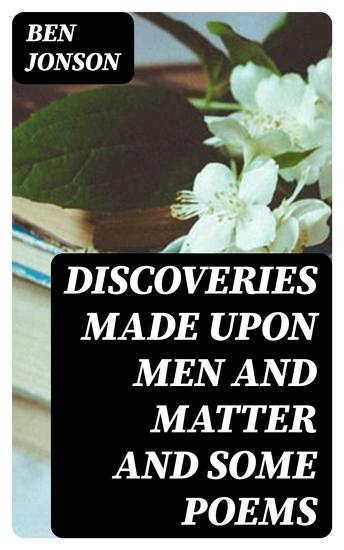
Discoveries Made Upon Men and Matter and Some Poems - cover

Discoveries Made Upon Men and Matter and Some Poems

Ben Jonson

Maison d'édition: DigiCat

  • 0
  • 0
  • 0

Synopsis

In "Discoveries Made Upon Men and Matter and Some Poems," Ben Jonson delivers a rich tapestry of philosophical reflection intertwined with sharp social commentary. This collection showcases Jonson's trademark wit and keen observations, offering insights into human nature, societal norms, and the complexities of existence. The work is laden with Jonson's characteristic use of metaphor and theatricality, as he deftly blends prose and poetry, engaging readers in a dialogue about the moral and existential struggles of his time, while setting the stage for the themes of the burgeoning Enlightenment period. Ben Jonson, a central figure in English literature and a contemporary of Shakespeare, was renowned for his sharp intellect and understanding of human folly. His background as a playwright and poet informed his exploration of the intricacies of character and society, as well as his commitment to uncovering truths beneath surface appearances. The socio-political climate of early 17th-century England, marked by puritanical constraints and a burgeoning interest in reason and science, greatly influenced his reflective and often critical lens. This book is an essential read for anyone interested in the intersections of literature, philosophy, and history. Jonson's insights remain profoundly relevant today as they encourage readers to reconsider their own perceptions of humanity and the world around them. His eloquent probing into the human condition invites contemplation and sparks discussion, making it a timeless addition to any literary collection.
Disponible depuis: 16/09/2022.
Longueur d'impression: 85 pages.

D'autres livres qui pourraient vous intéresser

  • You Got In! Now What? - 100 Insights into Finding Your Best Life in College - cover

    You Got In! Now What? - 100...

    James T. Hamilton

    • 0
    • 0
    • 0
    Once you've been admitted to college, the next step is to develop a strategy of how to find your best life there. But for decades, Professor James T. Hamilton has seen students struggle with their college journey. Some avoid challenging experiences, follow a path of familiar expectations, and rely on shortcuts. Others aim for perfection, ignore their friends and health, labor over what subjects to study, and neglect spending time outside the classroom. The pressure to make college valuable and interesting can feel overwhelming. 


    If only students could learn how others have navigated these challenges. You could ask alums to look back on friendships and college-to-career paths and provide advice. Now, you don't have to wish because You Got In! Now What? tackles the burning questions you have. 


    Hamilton designs lessons to help you find purpose, manage time, maintain friendships and family relationships, stay physically and mentally healthy, and choose classes, majors, and careers. Each lesson is accompanied by an essay based on research and reflections from students, alums, and professors to provide observations for how you can embrace the best that college has to offer. With these insights, you'll explore new ideas, meet people, have adventures, and most importantly, beyond just earning a degree, get an education.
    Voir livre
  • Feed the People! - Food for the 99% - cover

    Feed the People! - Food for the 99%

    Gabriel Rosenberg, Jan Dutkiewicz

    • 0
    • 0
    • 0
    Why Wendell Berry, Michael Pollan, and other slow-food-loving locavores are wrong about food in America—and why Waffle House can save us allThe food industry is a major driver of climate change, pollution, obesity, animal suffering, and workplace exploitation. Many food writers blame the industrial food system and tell individual eaters to fix these problems by buying local, artisanal food from small farmers—a solution most Americans can't afford. But, as food policy experts Gabriel Rosenberg and Jan Dutkiewicz remind us, modern technology has made food more affordable, abundant, varied, and tastier than at any other time in history. In Feed the People!, they argue that modern food pleasures like Waffle House waffles, and the industrial systems that make them possible, are actually good. With smart technology and commonsense policies, we can make them even better.Rosenberg and Dutkiewicz have traveled around the United States to find the people changing the way we make and eat food, from the innovators behind plant-based burgers to the cooks serving free school lunches to the labor organizers unionizing fast food joints. They show that building a food system that works for everyone will take more than just eating your vegetables. Feed the People! invites you to sit at the table and join this delicious movement.
    Voir livre
  • Irish Fairy Forts - Portals to the Past - cover

    Irish Fairy Forts - Portals to...

    Jo Kerrigan

    • 0
    • 0
    • 0
    Far more than just a faint echo of the past, Ireland's fairy forts are still vibrantly alive. 
    The traditions connected to them are so powerful that, even today, people rarely interfere with Irish fairy forts or fairy trees. They aren't built on; roads curve around them; farmers don't plough over them 
    The most numerous ancient remains in Ireland today, numbering up to 50,000 or more, these enigmatic mounds and grassy banks seem to call out to us from an earlier time. So, what are they, who built them and what were they for? And how have so many survived for so long?
    With evocative photographs by Richard Mills, master folklorist Jo Kerrigan explores the origins of these mysterious circular structures: the stories and legends, the history and archaeology, the living traditions and practices connected to them. And reminds us of the dangers of disturbing the ancient spirits dwelling beneath.
    Voir livre
  • How to Tell a Story - An Ancient Guide to the Art of Storytelling for Writers and Readers - cover

    How to Tell a Story - An Ancient...

    Aristotle

    • 0
    • 0
    • 0
    An inviting and accessible new translation of Aristotle's complete Poetics—the first and best introduction to the art of writing and understanding stories 


    Aristotle's Poetics is the most important book ever written for writers and readers of stories—whether novels, short fiction, plays, screenplays, or nonfiction. Aristotle was the first to identify the keys to plot, character, audience perception, tragic pleasure, and dozens of other critical points of good storytelling. Despite being written more than 2,000 years ago, the Poetics remains essential reading for anyone who wants to learn how to write a captivating story—or understand how such stories work and achieve their psychological effects. Yet for all its influence, the Poetics is too little read because it comes down to us in a form that is often difficult to follow, and even the best translations are geared more to specialists than to general readers who simply want to grasp Aristotle's profound and practical insights. In How to Tell a Story, Philip Freeman presents the most accessible translation of the Poetics yet produced, making this indispensable book more engaging and useful than ever before.
    Voir livre
  • Toni Morrison's Spiritual Vision - Faith Folktales and Feminism in Her Life and Literature - cover

    Toni Morrison's Spiritual Vision...

    Nadra Nittle

    • 0
    • 0
    • 0
    When Toni Morrison died in August 2019, she was widely remembered for her contributions to literature as an African American woman, an identity she wore proudly. Morrison was clear that she wrote from a Black, female perspective and for others who shared her identity. But just as much as she was an African American writer, Toni Morrison was a woman of faith. 


    Morrison filled her novels with biblical allusions, magic, folktales, and liberated women, largely because Christianity, African American folk magic, and powerful women defined her own life. Her relatives, particularly her mother, were good storytellers, and her family's oral tradition included ghost stories and African American folktales. But her family was also Christian. As a child, Morrison converted to Catholicism and chose a baptismal name that truly became her own—Anthony, from St. Anthony of Padua—going from Chloe to Toni. Morrison embraced both Catholicism and the occult as a child and, later, as a writer. She was deeply religious, and her spirituality included the Bible, the paranormal, and the folktales she heard as a child. 


    Toni Morrison's Spiritual Vision unpacks this oft-ignored, but essential, element of Toni Morrison's work—her religion—and in so doing, gives listeners a deeper, richer understanding of her life and her writing.
    Voir livre
  • Northern Indian Invaders - Empires of Foreign Origin (3 in 1) - cover

    Northern Indian Invaders -...

    Rolf Hedger

    • 0
    • 0
    • 0
    Northern India has long been a battleground for powerful invaders who established vast empires, shaping the region’s culture, politics, and economy. Among these, the Kushan Empire, the Delhi Sultanate, and the Mughal Empire stood out for their foreign origins and lasting influence on Indian civilization.  
    The Kushans, originally from Central Asia, played a vital role in connecting India with the Silk Road, fostering trade and spreading Buddhism across the subcontinent.  
    The Delhi Sultanate, founded by Turkic and Afghan rulers, introduced Islamic governance, transforming India's political landscape through military conquests and administrative innovations.  
    Later, the Mughal Empire, with its Timurid roots, brought about a golden age of Indo-Islamic culture, marked by architectural marvels like the Taj Mahal, advancements in art, and economic prosperity.  
    These empires, though foreign in origin, became deeply intertwined with India's history, leaving behind a complex yet enduring legacy of conquest, governance, and cultural exchange.
    Voir livre