Begleiten Sie uns auf eine literarische Weltreise!
Buch zum Bücherregal hinzufügen
Grey
Einen neuen Kommentar schreiben Default profile 50px
Grey
Jetzt das ganze Buch im Abo oder die ersten Seiten gratis lesen!
All characters reduced
Forty-two years amongst the Indians and Eskimo - cover

Forty-two years amongst the Indians and Eskimo

Beatrice Batty

Verlag: Good Press

  • 0
  • 0
  • 0

Beschreibung

In "Forty-two Years Amongst the Indians and Eskimo," Beatrice Batty offers a captivating firsthand account of her extensive experiences living among Indigenous peoples in North America. Engagingly written in a narrative style that balances vivid personal anecdotes with ethnographic observation, Batty meticulously documents the cultural practices, social dynamics, and challenges faced by the communities she encountered. The work is set against the backdrop of the late 19th and early 20th centuries, a pivotal period marked by significant socio-political changes and the encroachment of Western civilization on Indigenous territories. Through her lens, readers gain insight into the resilience of Indigenous cultures and the complex interplay between tradition and modernity. Beatrice Batty, a remarkable figure herself, was deeply committed to understanding and advocating for the Indigenous peoples she lived alongside. With a background influenced by both her feminist ideals and a dedication to social justice, Batty was inspired to document her experiences as a means of fostering empathy and awareness among her contemporaries. Her profound respect for the cultures she studied resonates throughout her writing, positioning her as an early ally in the fight against cultural erasure. This book is highly recommended for readers interested in ethnography, cultural history, or Indigenous studies. Batty's work serves as a crucial historical document that not only illuminates the lives of the Indians and Eskimo but also challenges contemporary readers to reflect on the lasting impact of colonialism. Her observations remain relevant, urging a deeper understanding of cultural exchange and the importance of preserving Indigenous voices.
Verfügbar seit: 24.04.2025.
Drucklänge: 200 Seiten.

Weitere Bücher, die Sie mögen werden

  • How to Make a Home - An Ancient Guide to Style and Comfort - cover

    How to Make a Home - An Ancient...

    Vitruvius

    • 0
    • 0
    • 0
    An entertaining and enlightening collection of ancient Roman writings about home design and decoration 


    The idea that our homes can communicate professional as well as personal identities may seem as new as the work-from-home revolution. But it was second nature to the ancient Romans, for whom the home was in many ways the center of public and private life. Roman authors saw infinite practical and symbolic value in houses, and they have much to say about them. How to Make a Home presents some of the best Roman writings on houses—from buying and selling to designing and decorating. 


    Edited and elegantly translated by Marden Fitzpatrick Nichols, How to Make a Home gathers selections by Cicero, Vitruvius, Seneca, and others. These writings reveal the pleasures and pitfalls of the Roman practice of making one's home a cornerstone of self-expression. While the ideal home enshrined Roman virtues and could make a career, lavish building projects could lead to financial ruin and moral condemnation. These authors memorably describe such travails as deceptive staging, decorators run amok, know-it-all owners, unsupervised contractors, and buyer's remorse. Along the way, they also explain why simplicity is bliss, privacy is for nobodies, a neglected house is a sign of a neglected soul, and much more.
    Zum Buch
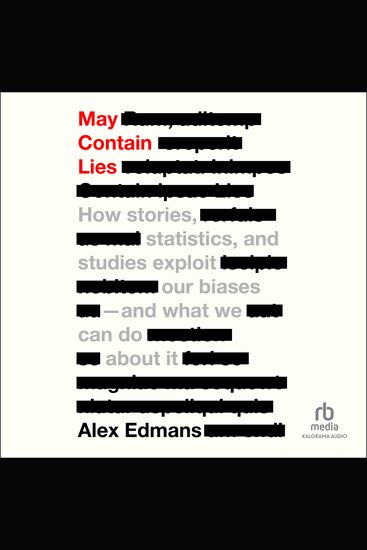
  • May Contain Lies - How Stories Statistics and Studies Exploit Our Biases And What We Can Do About It - cover

    May Contain Lies - How Stories...

    Alex Edmans

    • 0
    • 0
    • 0
    Our lives are minefields of misinformation. It ripples through our social media feeds, our daily headlines, and the pronouncements of politicians, executives, and authors. Stories, statistics, and studies are everywhere, allowing people to find evidence to support whatever position they want. Many of these sources are flawed, yet by playing on our emotions and preying on our biases, they can gain widespread acceptance, warp our views, and distort our decisions. 


    In this eye-opening book, renowned economist Alex Edmans teaches us how to separate fact from fiction. Using colorful examples—from a wellness guru's tragic but fabricated backstory to the blunders that led to the Deepwater Horizon disaster to the diet that ensnared millions yet hastened its founder's death—Edmans highlights the biases that cause us to mistake statements for facts, facts for data, data for evidence, and evidence for proof. 


    Armed with the knowledge of what to guard against, he then provides a practical guide to combat this tide of misinformation. Going beyond simply checking the facts and explaining individual statistics, Edmans explores the relationships between statistics—the science of cause and effect—ultimately training us to think smarter, sharper, and more critically.
    Zum Buch
  • Scorched Earth - Beyond the Digital Age to a Post-Capitalist World - cover

    Scorched Earth - Beyond the...

    Jonathan Crary

    • 0
    • 0
    • 0
    Refusing the digital world of late capitalism 


    In this uncompromising essay, Jonathan Crary presents the obvious but unsayable reality: our "digital age" is synonymous with the disastrous terminal stage of global capitalism and its financialization of social existence, mass impoverishment, ecocide, and military terror. Scorched Earth surveys the wrecking of a living world by the internet complex and its devastation of communities and their capacities for mutual support. 


    This polemic by the author of 24/7 dismantles the presumption that social media could be an instrument of radical change and contends that the networks and platforms of transnational corporations are intrinsically incompatible with a habitable earth or with the human interdependence needed to build egalitarian post-capitalist forms of life.
    Zum Buch
  • House of Borgia: A Captivating Guide to the Borgias and Their Feuds with the Medici Family Sforza Dynasty and Girolamo Savonarola - cover

    House of Borgia: A Captivating...

    Captivating History

    • 0
    • 0
    • 0
    The History of the House of Borgia: The Infamous Family of the Italian Renaissance! 
    Do you know the WHOLE story of the House of Borgia—from their rise from obscurity to the highest echelons of European society? The family produced two popes and a saint, but they are more known for stories of murder, debauchery, and incest. What is accurate, and what is just slander? Were the Borgias worse than any other powerful family of the time? Was Rodrigo Borgia, who became Pope Alexander VI, a monster? Was his son Cesare a psychopath? Was his daughter Lucrezia a murderous temptress?  
    In this audiobook, you will learn the answers to these questions and more about the following:The origins of the House of Borgia in SpainThe rise of the first Borgia pope, Callixtus IIIThe power struggles between the great houses of Italy: the Borgia, the Sforza, the Medici, the Orsini, and the Colonna, among othersThe character of the infamous Rodrigo Borgia, Pope Alexander VIThe fiery battle between the Borgias and Friar Savonarola that ended in death and ruinThe reality of Cesare Borgia and his attempts to carve out his own kingdomThe real story of Lucrezia BorgiaThe role Christopher Columbus and Machiavelli played in the story of the Borgias, along with the monarchs of Spain, France, and NaplesHow the Borgias helped shape the Renaissance and the future of EuropeHow a descendant of the Borgias became a revered saint in the Catholic ChurchAnd so much more! 
    Scroll up and click “add to cart” to learn more about the House of Borgia!
    Zum Buch
  • Kyshtym Disaster The: The Controversial History of the Nuclear Meltdown Hidden by the Soviet Union - cover

    Kyshtym Disaster The: The...

    Charles River Editors

    • 0
    • 0
    • 0
    For decades, it was believed that the first major accident at a nuclear power plant took place at Three Mile Island in Pennsylvania in 1979, which took nearly 15 years and $1 billion to fully clean up after that disaster. However, Three Mile Island paled in comparison to Chernobyl, which to this day remains the most notorious nuclear accident in history. Located in the Ukraine, the Chernobyl power plant was undergoing experiments in the early morning hours of April 26, 1986 when it suffered a series of explosions in one of its nuclear reactors, killing over 30 people at the plant and spread radioactive fallout across a wide swath of the Soviet Union. Although the Soviets would try to cover up just how disastrous the accident at Chernobyl was, it was impossible to hide the full extent of the damage given that radioactive material was affecting Western Europe as well. All told, the accident caused an estimated $18 billion in damages, forced the evacuation of everybody nearby, and continues to produce adverse health effects that are still being felt in the region.  
    	The disasters emphatically demonstrated the dangers of nuclear power plants, and it brought about new regulations across the world in an effort to make the use of nuclear energy safer. Meanwhile, scientists and scholars are still studying the effects of the radiation on people exposed to the disasters and continue to come up with estimates of just how deadly they were. 
    	As it turned out, however, Chernobyl was not the first major nuclear disaster that the Soviets tried to hide. In 1957, a nuclear disaster occurred in an area near the Ural Mountains, far to the east of Moscow and to the north of the border with Kazakhstan, and to this day, it is a disaster few have heard of, even though it was the world’s worst nuclear disaster until Chernobyl. For those aware of it, it is now known as the Kyshtym disaster. 
    Zum Buch
  • The Wonderful Wizard of Oz - cover

    The Wonderful Wizard of Oz

    Lyman Frank Baum

    • 0
    • 0
    • 0
    he Wonderful Wizard of Oz is an American children's novel written by author L. Frank Baum and illustrated by W. W. Denslow. The first novel in the Oz books, the Kansas farm girl named Dorothy ends up in the magical Land of Oz after she and her pet dog Toto are swept away from their home by a tornado. Upon her arrival in Oz, she learns she cannot return home until she has destroyed the Wicked Witch of the West.    The book was first published in the United States in May 1900 by the George M. Hill Company. In January 1901, the publishing company completed printing the first edition, a total of 10,000 copies, which quickly sold out. It had sold three million copies by the time it entered the public domain in 1956. It was often reprinted under the title The Wizard of Oz, which is the title of the successful 1902 Broadway musical adaptation as well as the classic 1939 live-action film.    The ground-breaking success of both the original 1900 novel and the 1902 Broadway musical prompted Baum to write thirteen additional Oz books which serve as official sequels to the first story. Over a century later, the book is one of the best-known stories in American literature, and the Library of Congress has declared the work to be "America's greatest and best-loved homegrown fairytale."
    Zum Buch